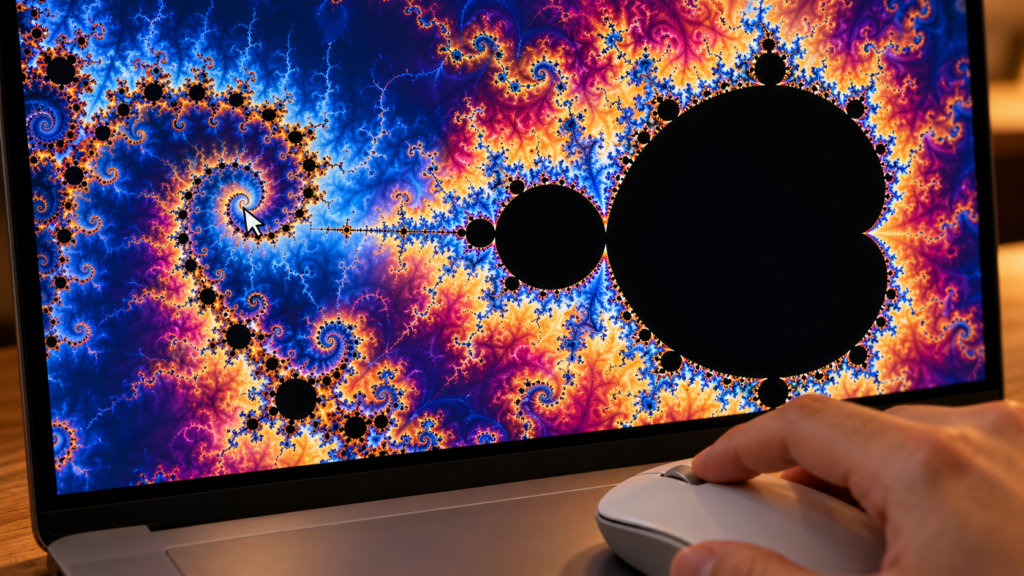
The Mandelbrot Fractal Generator proves that the most accessible gateway to mathematical beauty isn’t a textbook or a course — it’s a zero-dependency web app that lets anyone explore infinite complexity with a mouse wheel or a pinch gesture.
You’ve seen the images: the iconic bug-shaped set, the spiraling seahorse valleys, the miniature Mandelbrots hiding in the tendrils, the infinite self-similarity that keeps revealing new structure no matter how deep you go. Usually, seeing these requires specialized software, programming knowledge, or at minimum a download.
Not here. Open one URL and you’re inside.
Grandma-test difficulty: 0/5 — Open a link and interact Try-it time: Under 60 seconds Worth your time: 5/5 — Do Not Miss
What You Need
- A web browser (Chrome, Firefox, Safari, Edge — any modern browser)
- An internet connection (for the first load; works offline after)
- A mouse with a scroll wheel, or a touchscreen
That’s it. No terminal. No code editor. No GitHub account. No API keys. No “npm install.”
Simple Setup Walkthrough
Step 1: Open the Explorer
Go to https://fractal.rafgraph.dev [S2]. You’ll see a launch page with four options:
- Launch Fractal (224 max escape time) — fastest, good for casual exploration
- Launch 448 — more detail, still snappy
- Launch 896 — deeper detail, slower renders
- Launch 1792 — maximum detail, slow! [S1]
Step 2: Click “Launch Fractal”
The fractal opens fullscreen. You see the classic Mandelbrot set — the main cardioid with its period-2 bulb, the seahorse valley spiraling off to the left, the elephant valley on the right. It renders in about a second [S2].
Step 3: Zoom In
Desktop: Scroll your mouse wheel anywhere on the fractal. The view zooms toward your cursor position.
Mobile: Pinch to zoom. Drag with one finger to pan. The multi-touch interface is buttery smooth [S3].
Step 4: Explore Forever
Keep zooming. The seahorse valley unfurls into infinite spirals. Tiny Mandelbrot copies appear in the tendrils — each one a perfect miniature of the whole. Zoom into those and find more. There is no bottom [S1].
Step 5: Change Detail Level (Optional)
Tap “Back to Launch Page” (top right), pick a higher detail level — 448, 896, or 1792 — and it redraws at your zoom with richer colors [S1].
First Thing to Try
Find a baby Mandelbrot. Zoom into the seahorse valley (the spiral tendril on the left side). Around 10-15 zooms in, you’ll spot a tiny, perfect Mandelbrot set floating in the filament. Click it. Zoom deeper. It has its own seahorse valleys. Its own babies. The self-similarity is real and you’re driving [S1, S2].
Watch the color bands shift. As you zoom, notice how the escape-time color bands — those concentric rings of electric blue, warm amber, magenta, cyan — stretch and multiply. At 224 escape time they’re broad and bold. At 1792 they become fine, psychedelic striations that reveal the iteration count topology like geological strata [S1].
Turn It Into a Game or Challenge
The “Deepest Baby” Challenge: See how many nested Mandelbrot copies you can find in a single session. Start from the main set, zoom into a baby, find its baby, find that baby’s baby. Screenshot each level. My personal best is 5 generations before the render time at 224 escape time made it tedious. At 1792 escape time, the detail holds longer — but each render takes patience [S1].
The “Color Hunter” Challenge: Switch between escape times at the same coordinates. The color bands shift dramatically — 224 gives broad, bold bands; 1792 reveals fine, psychedelic striations. Find a coordinate where the color transition looks like a sunset, or a galaxy, or a nebula. Share the coordinates (they’re in the URL after zooming) with a friend.
Optional Expert Rabbit Hole
The fractal engine (fractal.js) is completely decoupled from the UI (app.js) and exposes a clean API [S1]. You can embed it in your own projects:
“javascript var fractal = new Fractal(canvasElement); fractal.update({ cords: { xCartMin: -0.75, xCartMax: -0.74, yCartMin: 0.1, yCartMax: 0.11 }, maxEscapeTime: 896 }); “
The coloring algorithm is a clever 7-case cycle that produces up to 1,792 colors by incrementing one RGB channel at a time while holding the other two at 0 or 255 [S1]. It’s a great study in procedural color generation with zero external dependencies.
One Thing to Know
Higher escape times = slower renders. At 1792, a deep zoom can take 10-30 seconds per frame on a typical laptop. The 224 default is snappy for exploration; bump it up when you’ve found a spot worth savoring [S1]. No GPU acceleration — it’s pure JavaScript on CPU. Mobile devices will feel it more.
The URL encodes your position. When you zoom, the browser URL updates with your coordinates and escape time. Copy that link to share your exact view, or bookmark it to return later. No account needed — the URL is the save file [S1].
The Bottom Line
Try it tonight if: You’ve ever stared at a Mandelbrot image and wished you could go there. You want to show a kid (or your non-technical friend) that math makes art. You need a zero-friction creative break that doesn’t ask for an account, a download, or a credit card.
Skip if: You need exportable image files (this is a viewer, not a renderer — though you can screenshot). You want parametric control over coloring algorithms. You’re on a decade-old phone and 1792 escape time will melt it.
The Mandelbrot Fractal Generator is the honest “try it tonight” project for mathematical wonder: one URL, zero asks, infinite depth, and the realization that you’re navigating a structure that has no end — only more detail, more beauty, more “wait, that’s in there?” moments. Bookmark it.
Sources
- [S1] Mandelbrot Fractal Generator – GitHub Repository — GitHub / Rafael Pedicini (2016-03-10)
- [S2] Mandelbrot Fractal – Live Interactive Demo — Rafael Pedicini (2026-10-31)
- [S3] Mandelbrot Fractal Generator – Screenshots and Mobile Demo — Rafael Pedicini (2016-03-10)