Grandma-test difficulty
Tier 1 — Instant Click
Try-it time
Under 60 seconds to first living pattern
Worth your time
5/5 — Do Not Miss
—
In 1952, Alan Turing wrote his only biology paper. He proposed that the spots on a leopard, the stripes on a zebra, and the branching of coral all emerge from the same simple mechanism: two chemicals reacting and diffusing through tissue [S3]. He called it reaction-diffusion. For decades it lived in textbooks. Now it lives in your browser — and you can breed it.
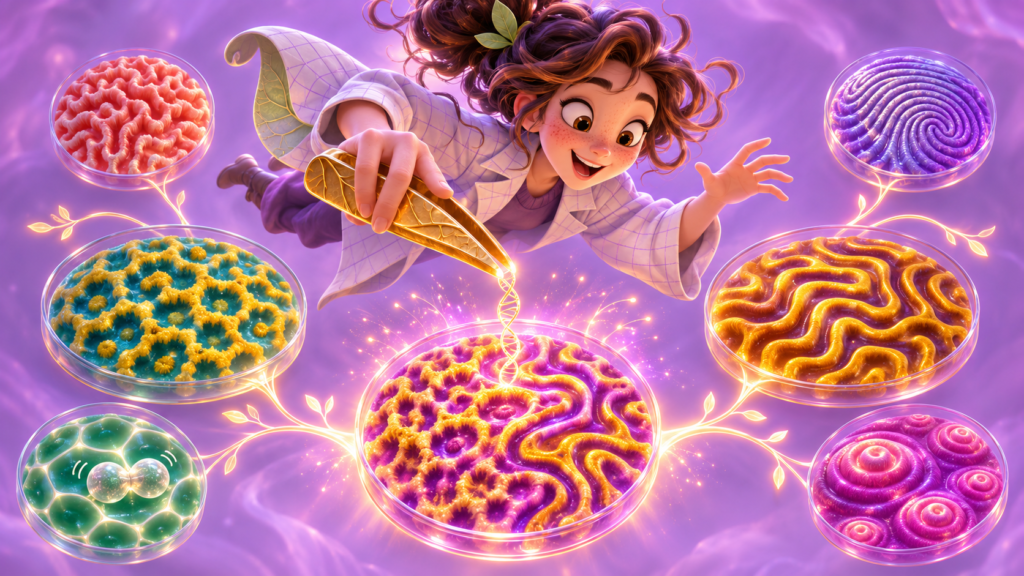
Petri is a breedable garden of living patterns [S1]. Each specimen is a genome — a handful of numbers that grow, live on a canvas, into a unique Turing pattern: coral, mazes, spots, solitons, dividing cells [S1][S2]. Cross two specimens and the offspring inherits a genetic crossover of their genes, plus mutation, and grows something new [S1][S2]. It runs entirely in your browser. No build step, no dependencies, no server required — just open the file [S1][S2]. The project was conceived and built end-to-end by Claude Code as an experiment in AI-driven artifact creation [S1], and it shows: every interaction feels polished, responsive, and thoughtfully designed, from the smooth palette cycling to the instant breeding feedback.
What you need
- A modern web browser (Chrome, Firefox, Safari, Edge — anything from the last few years)
- An internet connection for the initial load (then it works fully offline)
- Zero accounts, zero downloads, zero installation
Simple setup walkthrough
- Open the garden. Go to https://bernardogv.github.io/petri in your browser. The page loads in a few seconds [S2].
- Spawn your first specimen. Click the Spawn Wild button. A pattern begins growing immediately — maybe a spotted coral, maybe a maze, maybe pulsing solitons [S1][S2].
- Watch it evolve. The pattern isn’t static. It ripples, shifts, and stabilizes into a living form. Each specimen cycles through 6 color palettes automatically [S1].
- Breed something new. Click the + on two specimen cards to select them as parents. Hit Breed →. The offspring appears with a genome that’s a crossover of both parents plus a pinch of mutation [S1][S2]. Its pattern will share traits with both parents but grow into something neither showed.
- Share the seed. Every specimen has a code like
PETRI-A3F2-9K1M. Copy it, text it to a friend — when they paste it into Grow from a code, they get the exact same living pattern [S1][S2].
First thing to try
Click Spawn Wild three times. You’ll get three completely different patterns — one might look like leopard spots, another like brain coral, a third like fingerprint whorls. Now pick the two you like most, click their + buttons, and hit Breed →. The offspring will combine visual traits from both parents in a way you couldn’t have predicted. That moment — seeing math become heredity — is the hook. It feels like discovering a secret law of nature that was hiding in plain sight, a moment of pure wonder that makes you want to share it immediately with everyone you know.
Turn it into a game or challenge
Text-to-Creature challenge: Type a phrase into Grow from a code — your name, “midnight storm,” “electric jungle,” “grandma’s cookies.” Each phrase grows a surprise creature.
Lineage game: Breed three generations. Save the seed codes. Can you look at the third-generation pattern and guess which two grandparents contributed? The family tree is tracked visually in the garden [S1].
Perturbation test: Click anywhere on a living pattern. You have just injected a chemical disturbance. Watch the pattern heal — or transform into something new. Some patterns are stable; others bloom into chaos [S1][S2].
Optional expert rabbit hole
The genome is six numbers: {feed, kill, dA, dB, seedKind, palette} [S1]. The first four are Gray-Scott reaction-diffusion parameters — the same equations Turing wrote in 1952 [S3]. Most of the feed/kill space is non-viable (patterns die or homogenize). Petri’s “wild species” anchors are curated from the viable zones, and breeding explores the space between them [S1]. The seed code is a base32 encoding of the genome, making every pattern losslessly shareable as text. The core simulation, RNG, genome codec, and breeding logic are covered by 32 unit tests that run headless in Node.js [S1]. You can download petri.html from the repo and run it entirely offline — it’s a single self-contained file with all JavaScript inlined [S1].
One thing to know
The patterns are computationally intensive. On older laptops or phones, you may see the frame rate drop with many specimens visible. The simulation runs at a fixed timestep regardless of render speed, so the patterns grow correctly even if the animation stutters [S1].
The bottom line
Try it tonight if: You want to see math become life in under a minute. You love the idea that leopard spots and your garden’s newest hybrid follow the same rules. You enjoy sharing strange, beautiful things via text message.
Skip if: You need a game with goals, scores, or progression. You want to export patterns as images or video (no built-in export yet). You’re on a very old device that struggles with Canvas animation.
Petri is the rare tool that makes a profound scientific theory — Turing’s morphogenesis — feel like playing in a garden. You don’t study the math. You breed it, and the results are visible in seconds. And the first time you see an offspring pattern that looks like neither parent, you’ll understand why Turing’s 1952 paper still matters today: because the math is alive, and now so is your curiosity.
Sources
- [S1] Petri — A breedable garden of living reaction-diffusion patterns — GitHub (bernardogv/petri) (2026-06-17)
- [S2] Petri — a breedable garden of living patterns (live demo) — bernardogv.github.io (live deployment) (2026-06-17)
- [S3] Reaction–diffusion system — Wikipedia (2026-01-01)