The hook
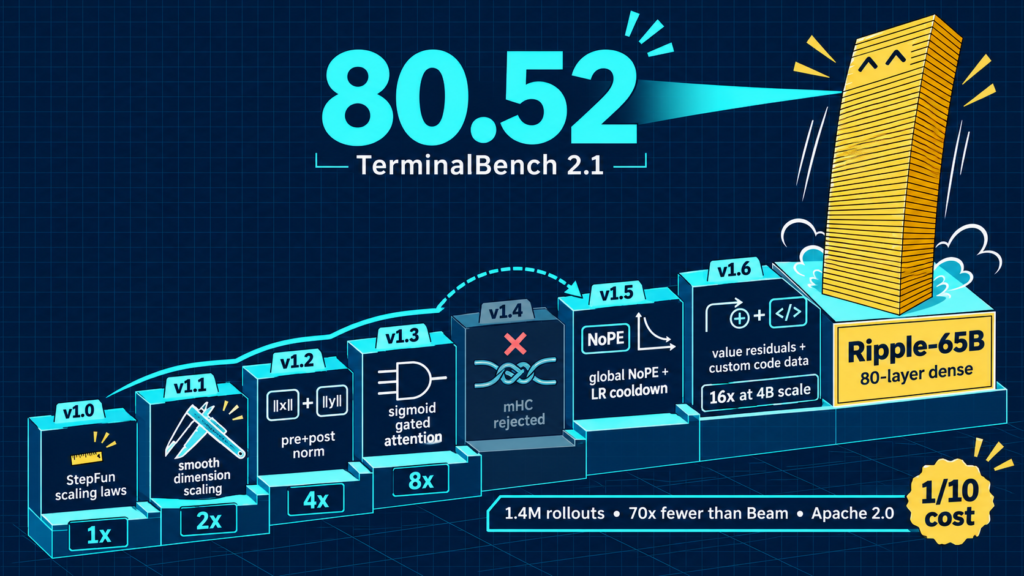
A 65B dense model just topped the U.S. open-weight leaderboard for agentic coding. It beat Reflection Beam 501B, Meta’s Muse Spark Open 816B, Thinking Machines’ Inkling 975B, and NVIDIA’s Nemotron 3 Ultra 550B — models with 8x to 15x more parameters. It did this with roughly 70x fewer RL rollouts than the previous leader, on a reported $32M total R&D budget (about one-tenth the prior SOTA’s estimated cost). The weights are Apache 2.0. You can download them today.
The model is Ripple-65B Preview from Ricursive Intelligence, a full-stack AI lab that co-designs models and the silicon that runs them. Their announcement claims U.S. open-weight state-of-the-art (80.52) on TerminalBench 2.1 [S1].
But the model card adds critical caveats: the TerminalBench 2.1 scores are self-reported, measured with a mix of harnesses, and scores were universally lower under the official Terminus 2 harness at 128K context with summarization (except for Muse Spark Open) [S2]. No independent third-party reproduction exists as of November 5, 2026 [S3]. The company calls this a Preview with relatively light posttraining.
This article separates what’s on the page from what’s been reproduced — and gives you a practical framework for deciding whether Ripple-65B Preview belongs in your terminal agent stack.
At a glance
| | | |—|—| | Model | Ripple-65B Preview (65B dense, Apache 2.0) | | Claimed TerminalBench 2.1 | 80.52 (self-reported) / 80.5 (Terminus 2) | | Architecture | Dense Transformer, d_model=5120, 80 layers, 12T tokens, 1M context | | RL efficiency | 1.4M rollouts vs. ~100M for Reflection Beam (70x fewer) | | Reported R&D cost | $32M total | | Variants | BF16 instruct, NVFP4 quantized, BF16 base, DFlash2 speculative | | Inference providers | Together AI, GMI Cloud, OpenRouter, Fireworks (soon) | | Independent verification | None as of Nov 5, 2026 | | Worth your time | 4/5 — Strong Look: promising hypothesis, public weights, local-friendly size — test on your tasks before committing |
What TerminalBench 2.1 measures
TerminalBench 2.1 is an agentic terminal coding benchmark: 89 tasks across software engineering, system administration, data processing, model training, and security [S4]. An agent gets a written instruction and a purpose-built container with tools. It runs commands, edits files, installs packages, and iterates based on execution feedback. Automated tests verify the final container state.
Key changes from 2.0: 28 tasks were fixed for external dependency drift, resource budget mismatches, and instruction-test misalignment [S4]. Harness choice significantly shifts scores: Ricursive’s model card shows TerminalBench 2.1 scores dropping for most rivals under the official Terminus 2 harness — sometimes dramatically (Nemotron 3 Ultra: 56.4 to 55.1; Inkling 975B: 63.8 to 56.2; Beam 501B: 80.1 to 70.8) [S2]. Ripple’s own score holds at 80.5 under both, but the card calls its results a best-effort attempt at fair comparison and flags that very low rival numbers may reflect harness mismatch [S2][S3].
Takeaway: TerminalBench 2.1 is a better benchmark than 2.0, but cross-model comparisons remain harness-sensitive. A single self-reported number is not a decision basis.
Architecture: dense, thin, and deep
While other frontier labs went MoE, Ricursive chose a modernized dense Transformer. Their reasoning: dense models are simpler to train and serve, maintain solid MFU (40%) with simple sharding, no custom kernels, and no quantization (BF16) [S1].
Distinctive choices:
- Thin-and-deep: d_model=5120 (narrow) x 80 layers (deep) vs. typical wide-and-shallow
- Gemma 3N-like architecture switched from Olmo 3’s llama-like baseline for stability
- Overprovisioned attention heads, increased SWA-to-global layer ratio, reduced SWA window
- FFN activation clipping (from OpenAI’s GPT-OSS work) [S1]
- Gated attention (sigmoid-gated) [S1]
- Global NoPE (No Positional Encoding) [S1]
- Value residuals [S1]
Co-design with NVIDIA hardware is explicit: decisions reduce pretraining/posttraining infrastructure complexity while enabling strong reasoning and agentic performance [S1]. The model fits on an NVIDIA DGX Spark in NVFP4 [S2].
RL recipe: steep ascent, not brute force
The 70x RL efficiency claim is the most striking number. Ricursive reports:
- 1.4M rollouts total to reach 80.5 TerminalBench 2.1
- Reflection Beam: ~100M rollouts (per Ricursive’s estimate)
- No purchased posttraining data — synthetic pipelines, quality filtering, coverage metrics in-house [S1]
- Mixed RL: truncated importance sampling, score centering, linear length penalty, long-horizon synthetic environments [S1]
- Continuous task hardening: added harder tasks as the model improved [S1]
The model ladder approach is worth studying. From Olmo 3’s ladder [S1], they iterated through 6 ladder versions (v1.0–v1.6), each adding one architectural change, measuring compute efficiency on code at small scale before scaling. Compounded changes yielded 16x compute efficiency improvement on code at 4B scale — the efficiency gap widens with scale [S1].
Cost claim: $32M total R&D
Ricursive states $32M is their full R&D cost from scratch, including pretraining ladder, data mixing, evals, debugging, synthetic data, posttraining recipe, and final hero run [S1]. They compare to Reflection Beam estimated at ~$300M+.
Important: The model card gives no compute budget or dollar figure [S3]. The $32M is from the blog only. No independent audit exists. Treat as claimed upper bound.
The lesson is architectural: a dense model with a compute-efficient ladder and steep-ascent RL can reach frontier agentic performance at a fraction of the parameter count — and parameter count drives serving cost.
Benchmark table: leads and lags
Ricursive’s model card table (self-reported, mixed harnesses, some in-house evals italicized) [S2] shows three patterns:
- Ripple leads on TerminalBench 2.1 and SWE-bench Pro v2.0 Hard — the hardest agentic coding rows. Also leads on AIME math.
- Ripple trails on knowledge (MMLU-Pro, GPQA) and SWE-bench Verified/Pro v1.0 — Reflection Beam and larger MoEs win.
- Muse Spark Open 816B leads on DeepSWE 1.1 and MCP Atlas — tool-use and repository-scale tasks.
The card itself compares against DeepSeek V4 Flash base and says it’s comparable on reasoning, math, and code but trails on knowledge [S2].
Local deployment: the NVFP4 advantage
At 65B dense, BF16 is ~129.6 GB (64.78B params confirmed) [S3] — multi-GPU territory. The NVFP4 quantized checkpoint targets single-device local inference on hardware like NVIDIA DGX Spark [S1][S2].
The card provides a Transformers loading snippet with trust_remote_code=True (custom code required) and a ChatML-style chat template with tool calls including execute_bash [S2]. For local runners, NVFP4 + a Colab notebook are the entry point.
Practical note: Audit the repository’s modeling code before running trust_remote_code=True. The chat template supports tool calling — relevant for terminal agents.
How to evaluate it
explainx.ai’s guidance is the right frame [S3]: a good first test is your own harness. Pick five tasks you care about, run them with Ripple and your current model, compare time to a passing result — not a leaderboard number.
Suggested protocol:
- Pull the NVFP4 checkpoint (or BF16 if you have VRAM) from Hugging Face
- Run your actual terminal agent tasks: code migration, test generation, refactoring, infrastructure scripting, debugging sessions
- Measure time-to-passing-result and token cost per task — agentic work burns long tool loops; per-token API price is the floor, not the bill [S3]
- Compare against your current model (Claude Code, OpenCode + preferred model, etc.)
- Decide on task performance, not TerminalBench rank
This is the only evaluation that matters for production use. The benchmark is a filter; your tasks are the test.
Where Ripple fits
| Job | Reasonable pick from Ricursive’s table | Why | |—|—|—| | Terminal/shell agents on a single local box | Ripple-65B Preview (NVFP4) | Highest TerminalBench 2.1 in card, smallest memory footprint | | Repository bug fixing with long track record | Reflection Beam 501B | Higher SWE-bench Verified and Pro v1.0 | | Tool use through MCP | Muse Spark Open 816B | 89.2 on MCP Atlas, highest in card | | Knowledge and science questions | Larger MoE (Nemotron, Muse, Inkling) | Higher MMLU-Pro and GPQA Diamond |
These follow Ricursive’s own table — treat as starting hypotheses, not conclusions [S3].
Limits and open questions
- Preview status: Post-training is light; expect changes
- Text-only pretraining: 12T tokens, predominantly English and code; no vision
- No independent evals: Zero third-party reproductions as of Nov 5, 2026 [S3]
- Safety rows self-run: FORTRESS Adversarial 83.8, Benign 95.5, StrongREJECT 97.5 — all self-reported [S2]
- Context quality at 1M unmeasured: Pretraining was 8K; long-context stage ran at 2M for 6.5B tokens [S3]
- Harness dependency: TerminalBench scores shift materially with harness; cross-model comparison requires same agent/harness
- Custom code required: trust_remote_code=True needed; audit before running
Sources
- [S1] Introducing Ripple-65B Preview, a Frontier Open-Weight Model — Ricursive Intelligence (2026-11-04)
- [S2] ricursiveAI/Ripple-65B-Preview — Hugging Face Model Card — Hugging Face / Ricursive Intelligence (2026-11-04)
- [S3] Ripple-65B Preview: 80.5 Terminal-Bench, Apache 2.0 (Claimed vs Verified) — explainx.ai / Yash Thakker (2026-11-04)
- [S4] Terminal-Bench 2.1 — Official Benchmark Release Notes — Terminal-Bench / tbench.ai (2026-07-08)