The Cost Frontier Just Shifted
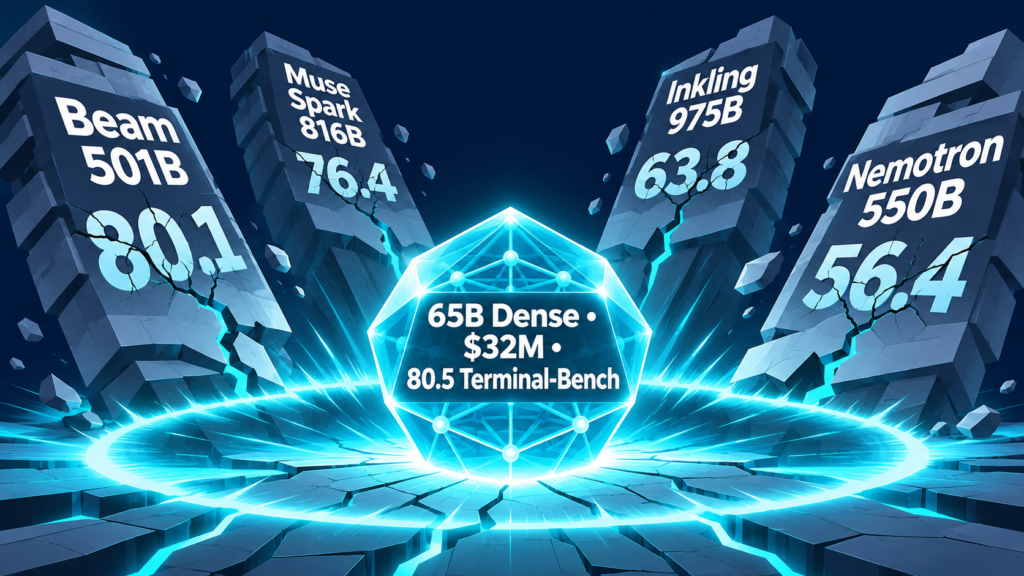
For years, the open-weight leaderboard has been a MoE arms race: Reflection Beam 501B, Meta Muse Spark Open 816B, Thinking Machines Inkling 975B, NVIDIA Nemotron 3 Ultra 550B. Each release pushed total parameters higher, active parameters higher, training compute higher. The implicit bet: scale wins, and Mixture-of-Experts is the only way to scale efficiently.
Ricursive Intelligence, a U.S. full-stack AI lab founded in 2024, just falsified that bet [S1]. Their Ripple-65B Preview — a dense 65B parameter Transformer trained from scratch on 12 trillion tokens — scores 80.52 on Terminal-Bench 2.1, edging out Reflection Beam 501B (80.1) and decisively beating Muse Spark Open 816B (76.4), Inkling 975B (63.8), and Nemotron 3 Ultra 550B (56.4) [S1][S2]. All self-reported, all at full BF16 precision, all on the same benchmark.
The kicker: full R&D cost was $32M [S1]. Ricursive estimates this at one-tenth the cost of the prior open-weight agentic coding leader. That figure covers everything: ladder experiments, data mixing, evals, synthetic data pipelines, debugging, and the final hero pretraining and posttraining runs. A team that scaled from 1 to 5 people. No custom kernels. No quantization during training. 40% MFU with simple sharding [S1][S2].
Grandma-test difficulty: 3/5 — Requires model download (~130 GB BF16, ~33 GB NVFP4) and compatible serving stack; NVFP4 runs on DGX Spark-class hardware
Try-it time: 15 minutes to first token on OpenRouter/Together AI; hours for local NVFP4 setup
Worth your time: 4/5 — Strong Look: redefines the cost/performance frontier for local agentic coding
Architecture: Dense Wins When Co-Designed
The MoE orthodoxy says dense models can’t compete on efficiency. Ricursive’s counterargument: co-design the architecture for your training and serving platform, and dense wins [S1].
Ripple-65B uses a thin-and-deep aspect ratio: narrow d_model (5120) but 80 total layers [S2]. This is a deliberate departure from the Llama-like wide-and-shallow pattern. The team moved to a Gemma 3N-like architecture for training stability at scale [S2]. Key architectural choices:
- Overprovisioned attention heads for reasoning, compensated by increased sliding-window-to-global layer ratio and reduced SWA window size [S2]
- Gated attention (arXiv:2505.06708) for improved gradient flow
- Global NoPE (arXiv:2501.18795) — removing positional embeddings from global attention layers
- Value residuals (arXiv:2410.17897) for training stability
- FFN activation clipping — also used in OpenAI’s gpt-oss [S1][S2]
The result: 65B total = 65B active parameters. No routing overhead. No expert imbalance. No MoE-specific infrastructure. On 2x B200, the model hits 250 tok/s at batch=8 before quantization [S2][S3]. The NVFP4 checkpoint (MLP layers quantized, attention in BF16) targets NVIDIA DGX Spark-class devices for local deployment [S3].
Laddering: 16x Compute Efficiency at 4B, 55x at 65B
Ricursive didn’t guess the recipe. They laddered it [S1][S2]. Starting from Olmo 3’s model ladder (AI2), they ran a series of controlled interventions at small scale (4B and below), only promoting changes that held:
| Ladder Version | Intervention | Result | |—|—|—| | v1.0 | StepFun batch size & LR scaling laws | Baseline | | v1.1 | Smooth architectural dimension scaling | Improved | | v1.2 | Pre+post norm (vs post-norm) | Neutral at 4B, gains at 4B+ | | v1.3 | Sigmoid gated attention | Improved | | v1.4 | 2-stream mHC | Rejected — failed at 4B | | v1.5 | Global NoPE + LR cooldown to zero | Improved | | v1.6 | Value residuals | Improved | | Final | Custom 12T code-upsampled dataset | 16x CE gain at 4B, 55x at 65B |
The compounding effect is critical: the compute efficiency advantage increases with scale. Olmo 3’s ladder has a shallower slope; Ripple’s ladder steepens. At hero scale, the same code performance costs 55x less compute [S1][S2].
Post-Training: RL Efficiency Over Brute Force
The prior SOTA, Reflection Beam, reportedly used 100M+ RL rollouts [S1][S3]. Ripple hit 80.5 Terminal-Bench 2.1 with 1.4M rollouts — roughly 70x fewer [S1][S3].
How? A mixed RL recipe designed for compute efficiency [S1]:
- Truncated importance sampling (OpenReview:xsonlP8DRV) — bounds variance, stabilizes updates
- Score centering (arXiv:2609.20807) — normalizes rewards across tasks
- Linear length penalty (Microsoft MAI Thinking) — discourages verbose, low-signal trajectories
- High-quality long-horizon synthetic environments — no purchased post-training data; all synthetic pipelines built in-house [S1][S3]
Tasks were continuously added as the model improved — a curriculum approach rather than a static benchmark chase [S1]. The team explicitly notes that replicating benchmark scores is challenging due to harness variance (Terminal-Bench 2.1 scores dropped universally on official Terminus 2 at 128K with summarization, except Muse Spark Open) [S2].
What Ripple-65B Doesn’t Win
The model card is unusually candid about weak spots [S2][S3]:
| Benchmark | Ripple-65B | Best Rival | Gap | |—|—|—|—| | SciCode | 39.4 | Muse Spark Open 58.5 | -19.1 | | DeepSWE 1.1 | 44.3 | Muse Spark Open 60.0 | -15.7 | | MCP Atlas | 71.67 | Muse Spark Open 89.2 | -17.5 | | GPQA Diamond | 85.2 | Muse Spark Open 89.0 | -3.8 | | SWE-bench Verified | 76.5 | Reflection Beam 81.6 | -5.1 |
SciCode (scientific coding) and DeepSWE (deep software engineering) are the largest gaps. MCP Atlas (model-context-protocol tool use) also trails. GPQA Diamond (hard science reasoning) is competitive but behind the MoE giants. SWE-bench Verified (real-world GitHub issues) trails Reflection Beam and Inkling [S2][S3].
The pattern is clear: **Ripple dominates agentic terminal coding (Terminal-Bench), but trails on scientific reasoning, deep multi-file engineering, and broad tool-use ecosystems**. The dense 65B capacity ceiling shows against models with 400B+ active parameters [S2][S3].
Deployment Reality: What You Can Run Today
| Artifact | Size | Target Hardware | Availability | |—|—|—|—| | BF16 Instruct | ~130 GB | 8x H100 / 4x B200 | Hugging Face [S2] | | NVFP4 Instruct | ~33 GB | DGX Spark, RTX 5090 (24-32 GB) | Hugging Face [S2][S3] | | BF16 Base | ~130 GB | Fine-tuning / research | Hugging Face [S2] | | DFlash2 Drafter | ~2 GB | Speculative decoding | Hugging Face [S2] |
Hosted (zero-setup): OpenRouter, Together AI (coming soon), GMI Cloud, Fireworks [S1][S3].
Local NVFP4: The 33 GB NVFP4 build fits on a single DGX Spark (Grace + GPU) or high-end consumer GPU with 24-32 GB VRAM. Ricursive provides a Colab notebook for quick testing [S3].
Licensing: Apache 2.0 across all artifacts — unrestricted commercial use, modification, redistribution [S1][S2][S3]. No Llama-style user caps. No Muse Model License restrictions.
What This Means for the Open-Weight Frontier
Three takeaways:
- Dense is not dead — it was under-optimized. Co-designing architecture, data, and infrastructure for a specific hardware target (NVIDIA) yielded a 55x compute efficiency gain at hero scale. The MoE complexity tax (routing, expert balance, custom kernels, sharding) is real — and avoidable if you’re willing to ladder carefully.
- $32M is a new floor for frontier open-weight models. Not $300M. Not $1B. A 5-person team with thoughtful laddering, synthetic data pipelines, and RL efficiency. This should expand the set of labs that can meaningfully contribute to the open frontier.
- Local agentic coding just got a credible flagship. A 65B dense model with 1M context, Apache 2.0, NVFP4 for DGX Spark, and Terminal-Bench 80.5 is the first US open-weight model that makes “run a SOTA coding agent on your desk” a coherent proposition — not a quantized shadow of a cloud model [S1][S2][S3].
The Verdict
Ripple-65B Preview is a landmark result for compute-efficient open-weight training. It proves that dense architectures, when co-designed with laddering and targeted RL, can punch 8-15x above their parameter weight on agentic coding. The $32M cost and 5-person team are arguably more important than the benchmark score — they demonstrate a reproducible methodology.
For practitioners: if your workload is terminal-centric agentic coding (Terminal-Bench domain), Ripple-65B is now the US open-weight leader. If you need scientific coding (SciCode), deep multi-repo engineering (DeepSWE), or broad MCP tool ecosystems — the larger MoE models still lead. Choose the model for the task, not the parameter count.
The open-weight frontier just became more accessible. That’s the real story.
Sources
- [S1] Introducing Ripple-65B Preview, a Frontier Open-Weight Model — Ricursive Intelligence (2026-11-04)
- [S2] ricursiveAI/Ripple-65B-Preview Model Card — Hugging Face (Ricursive Intelligence) (2026-11-10)
- [S3] Ricursive AI Releases Ripple-65B Preview: A 65B Dense Open-Weight Model Scoring 80.5 on Terminal-Bench 2.1 — MarkTechPost (2026-11-04)