Kimi K3 Is a 2.8-Trillion-Parameter Model—But Can Your PC Run It
By Jason Ead
6 min read
Moonshot AI has released Kimi K3, an open-weight AI model with a headline-grabbing 2.8 trillion parameters, native vision capabilities, and a context window of roughly one million tokens. Moonshot calls it the first open model in the “3T class.” (huggingface.co)
That sounds like a model built only for giant data centers.
In practice, the story is more complicated—and more interesting.
Kimi K3 does not use all 2.8 trillion parameters every time it generates a word. It uses a design called Mixture-of-Experts, or MoE, that selects a much smaller portion of the model for each token.
The simple version is this:
Imagine a company with 896 specialists. Instead of putting all 896 people in every meeting, Kimi K3 selects 16 specialists whose knowledge is most relevant to the current problem.
That makes Kimi K3 much more efficient than a dense 2.8-trillion-parameter model would be. However, it does not make the complete model small, cheap, or practical for an ordinary gaming PC.
The Numbers That Actually Matter
Kimi K3 contains:
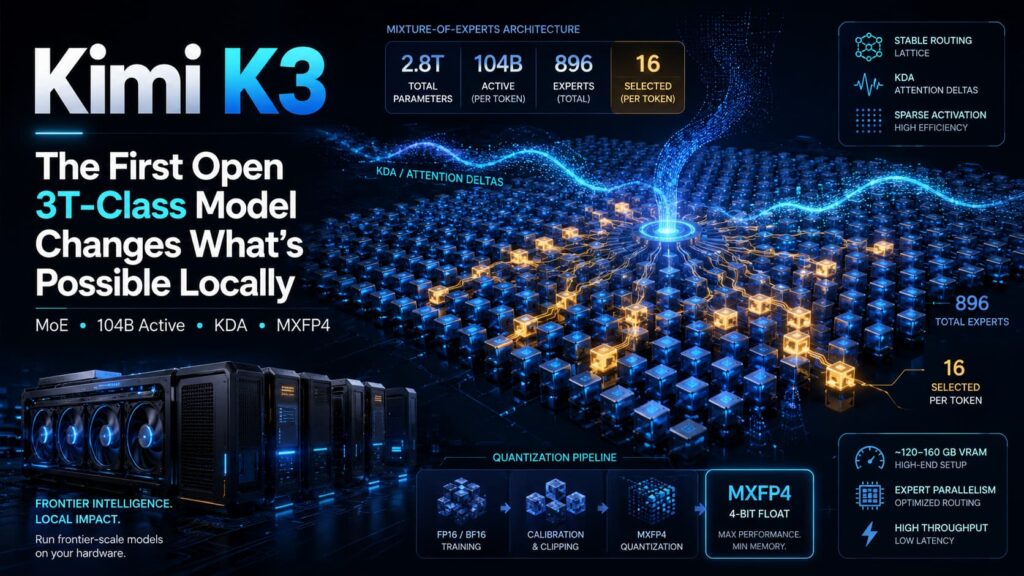
- 2.8 trillion total parameters
- 104 billion activated parameters per token
- 896 routed experts
- 16 selected experts per token
- 93 layers
- Native image understanding
- A 1,048,576-token context window
- MXFP4 weights and MXFP8 activations produced through quantization-aware training
Those figures come from Moonshot’s model card and technical report. (huggingface.co)
For newcomers, a parameter is one of the learned numerical values inside a model. More parameters can give a model more capacity, but the total parameter count does not directly tell you how fast it runs, how intelligent it is, or how much hardware inference requires.
With an MoE model, two counts matter:
Total parameters describe the model’s complete pool of learned capacity.
Activated parameters describe approximately how much of that pool participates in processing each token.
Kimi K3 therefore has the storage and distribution challenge of an enormous 2.8T model, while its per-token computation behaves more like a very large 104B active model.
That is more efficient than activating all 2.8 trillion parameters, but 104B active parameters is still far beyond the lightweight-model category.
Can You Run Kimi K3 Locally?
For most people, no—not in the way “local AI” normally means running a model through Ollama or LM Studio on a gaming computer.
A more accurate hardware breakdown is:
Typical gaming PC
A computer with a 12 GB, 16 GB, or 24 GB GPU is not a realistic target for running the complete Kimi K3 model at useful speed.
Community quantizations and heavy CPU or disk offloading may eventually make experimental loading possible, but “it launches” and “it is practical” are different standards.
High-end personal workstation
Even a machine with several consumer GPUs would face major capacity, bandwidth, power, cooling, software, and expert-routing challenges.
This model is not simply a 104B checkpoint that can be treated like an ordinary dense model. Its full 2.8T expert pool still has to be stored and managed across the deployment.
Enterprise self-hosted server
This is the realistic meaning of “local” for Kimi K3: a private server or GPU cluster controlled by a company, research lab, or well-funded operator.
That still matters. An organization can potentially run frontier-class open weights on infrastructure it controls instead of sending its code, documents, or customer data to a closed external API.
The breakthrough is therefore not “your gaming PC can now run a 3T model.”
It is:
A private organization can obtain and deploy the weights of a model in the 3T class while using sparse computation to avoid activating the entire network for every token.
Why Mixture-of-Experts Matters
Traditional dense models use nearly all their parameters for every token. MoE models divide much of the network into specialized expert blocks and use a router to select which experts should handle each token.
This creates two benefits:
- The model can hold much more total capacity.
- It avoids paying the full compute cost of that capacity on every step.
Kimi K3 scales this approach to 896 routed experts, selecting 16 for each token, plus shared experts. Moonshot calls its routing system Stable LatentMoE and says it helped produce an approximately 2.5× improvement in overall scaling efficiency compared with Kimi K2. That is Moonshot’s reported result, not yet a broad independent conclusion. (huggingface.co)
The important expert-level distinction is that sparse activation primarily reduces computation. It does not automatically eliminate the memory and communication costs of storing and routing among a 2.8T-parameter model.
At this scale, inter-GPU communication, expert placement, memory bandwidth, batching behavior, and backend optimization may matter as much as the raw arithmetic.
What Are KDA and Attention Residuals?
Kimi K3 also changes how most of its attention layers work.
Moonshot lists:
- 69 Kimi Delta Attention layers
- 24 Gated Multi-Head Latent Attention layers
- Attention Residuals
- 93 layers in total (huggingface.co)
Attention is the mechanism that helps a model decide which earlier information matters while processing new text or images. Standard attention becomes increasingly expensive as the input grows, which is a serious problem when a model claims support for one million tokens.
Moonshot’s Kimi Delta Attention, or KDA, is designed to improve efficiency across long sequences. Attention Residuals, or AttnRes, are intended to improve information flow through the depth of the network. Moonshot presents the combination of KDA, AttnRes, and Stable LatentMoE as a major reason Kimi K3 scales more efficiently than its previous generation. (huggingface.co)
For practical operators, the architectural novelty has a downside: new attention systems often depend on highly optimized backend support. A model can be openly downloadable before every popular inference engine runs it efficiently.
Native Vision Instead of a Text-Only Core
Kimi K3 is also a native multimodal model. Moonshot lists a 401-million-parameter MoonViT-V2 vision encoder and support for text and images, while its launch materials also describe video understanding. (huggingface.co)
That means Kimi K3 is designed for work such as:
- Understanding screenshots and diagrams
- Navigating visual software interfaces
- Analyzing documents containing text and images
- Building or modifying websites from visual references
- Supporting coding agents that can inspect what an application produced
This is more important than adding casual image description to a chatbot. Native vision can let an agent inspect the result of its own work, notice a broken layout, and attempt another correction.
Why MXFP4 Matters
Kimi K3 uses MXFP4 for weights and MXFP8 for activations, with quantization-aware training. (huggingface.co)
Quantization stores and processes model values using lower numerical precision. Lower precision can reduce memory use and increase throughput, but it can also damage model quality.
Post-training quantization takes an already trained model and compresses it afterward.
Quantization-aware training exposes the model to lower-precision behavior during training, allowing it to adapt to some of the error introduced by the final numerical format.
That makes Kimi K3’s native low-precision design noteworthy. It does not mean there is no quality loss, and it does not make the full 2.8T model fit into the memory required by only its 104B active parameters. It means Moonshot designed deployment efficiency into the training process rather than treating compression only as an aftermarket modification.
The Benchmarks Look Strong—but Read the Footnotes
Moonshot reports that Kimi K3 performs near leading proprietary models across reasoning, coding, research, and long-horizon agent tasks.
Selected published results include:
| Benchmark | Kimi K3 | GPT-5.6 Sol | Claude Fable 5 |
|---|---|---|---|
| GPQA Diamond | 93.5 | 94.1 | 92.6 |
| DeepSWE | 67.5 | 73.0 | 70.0 |
| Terminal-Bench 2.1 | 88.3 | 88.8 | 88.0 |
| SWE-Marathon | 42.0 | 39.0 | 35.0 |
Moonshot’s results show Kimi K3 competing closely with top proprietary systems and leading some reported tests. (huggingface.co)
However, these are not perfectly controlled comparisons.
Moonshot’s evaluation notes show that different models were sometimes paired with different agent harnesses, including Kimi Code, Codex, Claude Code, and Terminus. A benchmark score can reflect the model, the surrounding agent software, prompt design, tool integration, retry policy, and evaluation configuration. (huggingface.co)
The correct conclusion is not that Kimi K3 has already proven it is better than every closed model.
The safer conclusion is:
Kimi K3’s launch results are strong enough to justify serious independent testing, especially for coding agents, tool use, research, and long-running tasks.
Is It Actually Open Source?
The most accurate term is open-weight.
Moonshot has released the model weights, model card, license, and technical report. The GitHub repository currently contains the README, license, assets, and technical report rather than the complete training pipeline and dataset. (github.com)
That gives developers substantially more control than a closed API, but it is not the same as having every ingredient required to reproduce the model from scratch.
Kimi K3 also uses its own license rather than Apache 2.0 or MIT. The license grants broad rights to use, copy, modify, distribute, sublicense, sell, deploy, fine-tune, and create derivative works, subject to stated conditions. It separately defines “Model as a Service,” so anyone planning commercial hosted access should read the complete terms rather than relying on the “open-weight” label alone. (huggingface.co)
What Deployment Support Exists Right Now?
The ecosystem is further along than a bare research release.
The current Hugging Face page includes instructions for:
- Transformers
- vLLM
- SGLang
- Docker Model Runner
- OpenAI-compatible serving
- Browsing community quantizations for llama.cpp, Ollama, LM Studio, and compatible tools (huggingface.co)
That does not guarantee that every option is equally optimized, stable, or affordable. In particular, being listed as supported does not establish that the full model will run well on consumer hardware.
The questions operators should watch now are:
- Which backends deliver the best KDA kernels?
- What hardware configurations can hold the full expert pool?
- How much interconnect bandwidth is required?
- What throughput is possible at different context lengths?
- How large is the practical KV-cache requirement?
- How much quality survives community quantization?
- Can smaller distilled or expert-pruned derivatives preserve K3’s strengths?
Those answers will determine whether Kimi K3 becomes broadly deployable or remains mainly an enterprise-scale open-weight model.
The Practical Verdict
For ordinary local-AI users:
Do not download Kimi K3 expecting it to replace a 7B, 14B, or 32B model on your gaming computer. Watch for smaller derivatives, distillations, and credible community benchmarks instead.
For advanced multi-GPU hobbyists:
Treat it as an architecture to study, not yet an obvious daily driver. Loading experiments may appear, but usable speed and complete-model memory remain the real tests.
For companies and research labs:
Kimi K3 is worth evaluating once your chosen backend and hardware configuration are validated. Open weights, native vision, long context, and strong agent-oriented results make it especially interesting for private coding, research, and document workflows.
For the wider open-model ecosystem:
This release matters even to people who will never run the full checkpoint. It demonstrates that a lab can release a 2.8T-class sparse model with 104B activated parameters, native multimodality, low-precision training, and competitive agent benchmarks.
The real story is not that a 2.8-trillion-parameter model suddenly fits on a home PC.
The real story is that frontier-scale capacity is moving into downloadable, privately deployable weights—and that the line between open models and the strongest closed systems continues to narrow.