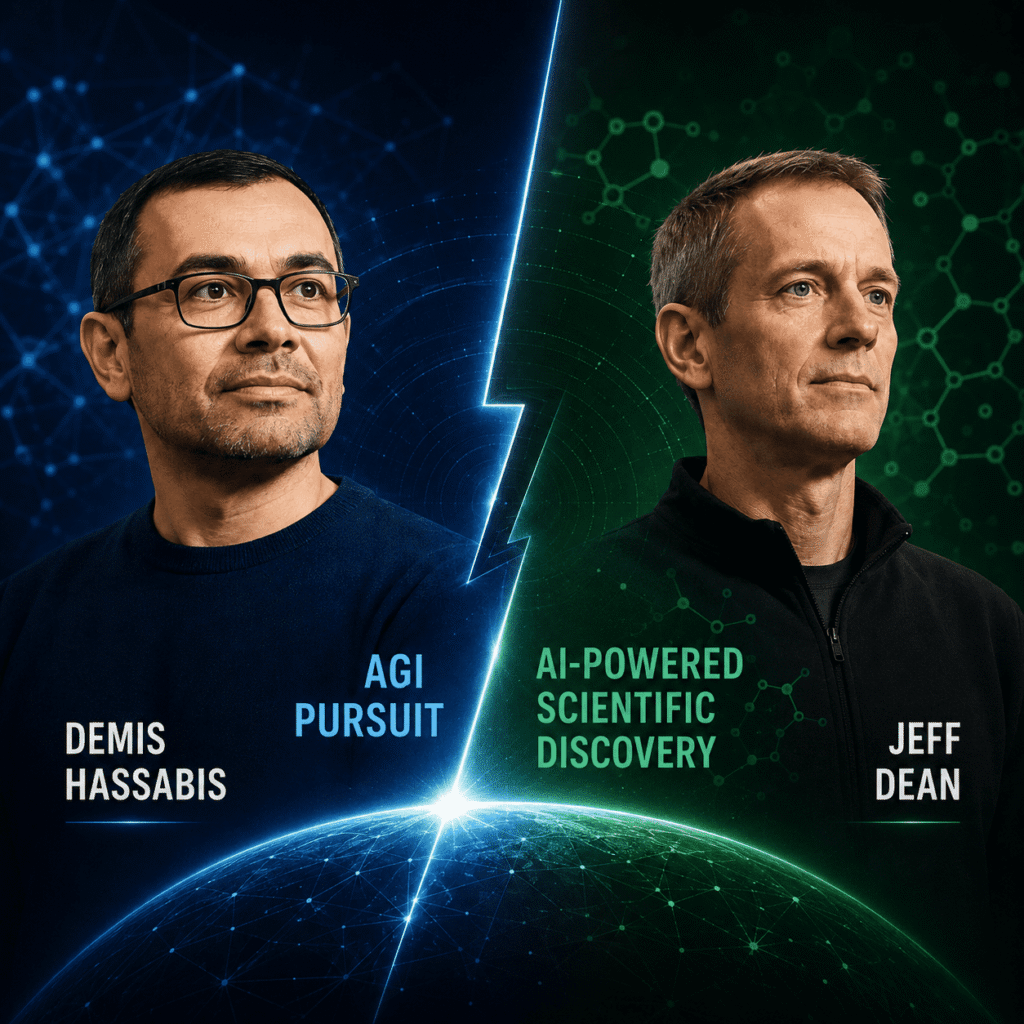
Google’s AI Leadership Shakeup: Hassabis Ascends, Departs Form Discovery Loop
In a series of announcements that have sent ripples through the artificial intelligence community, Google and its parent company Alphabet have unveiled significant leadership changes at Google DeepMind, alongside the departure of longtime Google fellow Jeff Dean to launch a new AI-focused startup. The moves, announced on August 5, 2026, signal a strategic shift in how one of the world’s most powerful AI organizations approaches the pursuit of artificial general intelligence (AGI) and the commercialization of AI research.
Google DeepMind’s New Leadership Structure
According to an internal message shared by Google and Alphabet CEO Sundar Pichai, Demis Hassabis, the co-founder and former CEO of Google DeepMind, will transition to the role of Chair of Google DeepMind and Chief Scientist of Alphabet, while continuing to lead Alphabet’s Isomorphic Labs, which applies AI to drug discovery[S1]. Hassabis says “As you’ve heard me say many times, I’ve always believed the No.1 application of AI should be to improve human health”, and that he will “It’s time for AI to prove its unequivocal value to the world”[S1].
Koray Kavukcuoglu, formerly the Chief Technology Officer of Google DeepMind and a key figure behind breakthroughs like WaveNet and DQN, will step up as Senior Vice President of Google DeepMind, reporting directly to Pichai[S1]. Kavukcuoglu will also retain his role as Chief AI Architect of Google, overseeing Gemini model development, frontier AI research, and the Gemini app and developer teams[S1].
The leadership shuffle comes as Google DeepMind continues to build momentum, with the Gemini models in high demand and the Gemini app reaching over 950 million monthly users[S1]. Pichai emphasized that the changes are designed to accelerate progress on the AI frontier while ensuring strong leadership for the organization’s core mission.
The restructuring reflects a deliberate effort to separate the visionary, long-term pursuit of AGI from the day-to-day operational leadership needed to drive rapid innovation in AI products and services. By moving Hassabis into a role focused on external engagement and AGI strategy, Google aims to leverage his deep expertise in the pursuit of human-level artificial intelligence while ensuring that the operational teams remain focused on delivering near-term advancements.
This strategic separation allows Hassabis to dedicate his full attention to the speculative but potentially transformative work of ensuring AGI development aligns with human values and safety considerations, while Kavukcuoglu can focus on the engineering excellence and rapid iteration needed to maintain Google’s competitive edge in AI products and services.
Jeff Dean Departs to Form Discovery Loop
In a separate but related move, Jeff Dean — who joined Google as its 30th employee in 1999 and has served as a senior fellow and chief scientist at Google DeepMind — is leaving the company to co-found Discovery Loop, a public benefit corporation focused on using AI to accelerate scientific discovery[S2][S3]. Dean will be joined by fellow Google luminaries Sanjay Ghemawat, Quoc Le, and Oriol Vinyals in launching the venture, with Dean expected to serve as CEO[S3].
Discovery Loop aims to automate and scale experimental processes in fields ranging from machine learning to biology and engineering using “high-octane algorithms”[S3]. Its mission is “fundamentally transform the speed and efficiency of innovation by automating complete experimental loops”[S3]. The startup has already secured initial funding from Radical Ventures, Khosla Ventures, Alphabet, Kleiner Perkins, Lightspeed, and Doerr Capital[S3].
Implications for AI Research and the AGI Pursuit
The leadership changes reflect a dual strategy: allowing Hassabis to focus on the long-term, speculative pursuit of AGI while empowering Kavukcuoglu to drive near-term AI productization and research within Google[S1]. Meanwhile, Dean’s departure to form Discovery Loop highlights a growing trend of AI researchers seeking to apply machine learning techniques to accelerate the scientific method itself[S3].
Industry analysts note that the moves could help Google maintain its competitive edge in AI while fostering innovation outside the company’s traditional structures. The formation of Discovery Loop, backed by Alphabet as a founding investor, suggests a model where Big Tech can spin off ambitious research initiatives while retaining strategic ties and potential pathways for technology transfer[S2].
The changes also come at a time when the AI industry is grappling with questions about the scalability of current model-based approaches, the energy consumption of large-scale training, and the need for more efficient methods of moving from narrow AI to more generalizable systems. Both the AGI-focused direction under Hassabis and the AI-for-science approach of Discovery Loop represent potential avenues to address these challenges.
Industry Reaction and Historical Context
The announcements have prompted widespread discussion across the AI research community, with many noting the symbolic significance of two of Google’s most iconic AI figures reshaping their roles within months of each other. Hassabis, a neuroscientist and entrepreneur who co-founded DeepMind in 2010 before its acquisition by Google, has long been viewed as a visionary leader in the pursuit of AGI. Dean, a legendary engineer and researcher known for his contributions to Google’s search infrastructure, distributed systems, and early AI research, has been a cornerstone of Google’s technical prowess for over two decades.
Historically, Google has undergone several leadership transitions in its AI division, most notably when John Giannandrea departed to join Apple in 2018, leading to the split of AI responsibilities between Jeff Dean (then leading Google AI) and Fei-Fei Li (who joined Google Cloud). The current changes, however, are distinct in their simultaneous focus on both internal restructuring and external entrepreneurial ventures.
Reactions on social media and industry forums have been mixed, with some praising the clarity of the new structure and others expressing concern about the potential loss of institutional knowledge. Notably, several prominent AI researchers have highlighted the importance of maintaining environments that support both blue-sky research and rigorous engineering — a balance that Google appears to be attempting to strike with its latest moves.
What This Means for the Future of AI
As the AI industry grapples with the challenges of scaling models, ensuring safety, and translating research into real-world impact, Google’s latest organizational shifts offer a case study in how major tech companies are adapting their internal structures to meet evolving demands[S2]. The emphasis on AGI research through Hassabis’s new role, coupled with the push for AI-driven scientific discovery via Discovery Loop, underscores a belief that the next wave of AI advancement will come not just from larger models, but from innovative approaches to how AI is developed and deployed.
For developers, researchers, and enterprises watching the AI landscape, the changes signal continued investment in both foundational research and practical applications. The strong financial backing for Discovery Loop indicates confidence in the potential of AI to revolutionize scientific experimentation, while Google’s renewed focus on Gemini models and AI-first applications suggests that the commercialization of AI remains a top priority.
As one industry observer noted, the true test will be in the outcomes: whether Hassabis’s external engagement yields breakthroughs in AGI safety and alignment, and whether Discovery Loop’s approach to automating experimental loops can deliver on its promise to accelerate the pace of scientific and technological progress[S2][S3].
Sources
- [S1] The next chapter of our AI momentum — Google (2026-08-05)
- [S2] Google just announced a major shakeup of its top AI leadership — The Verge (2026-08-05)
- [S3] Jeff Dean and other top AI researchers are leaving Google to launch their own startup — TechCrunch (2026-08-05)