Inside Meta Muse Glimmer: How Meta Fit a 30B Agentic Coding Model Onto a 24GB GPU
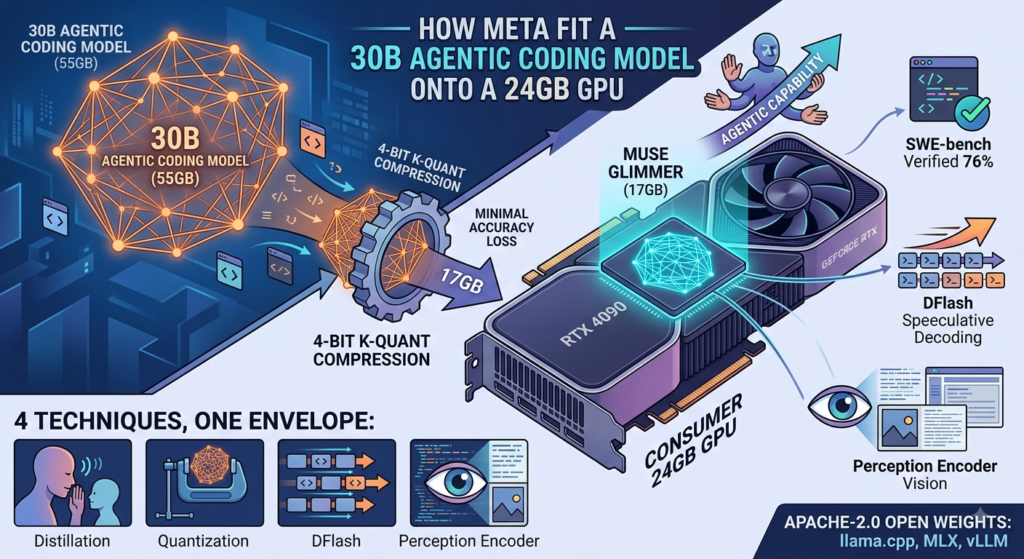
Few releases have tried to square the circle facing every local-AI engineer: agentic coding models are useful only when they run fast enough to feel like an agent, yet the models powerful enough to handle multi-step tool calling rarely fit a single consumer GPU. Meta’s answer, introduced today as Muse Glimmer, is a 30-billion-parameter, Apache-2.0-licensed agentic model whose entire existence is an argument against the assumption that you need a data center. The model runs on a Mac or PC with a single consumer GPU, fits inside a 24-32 GB VRAM enclosure, and is fast enough for fluid conversation. The interesting part is not that it exists, but how Meta assembled four separate techniques so they hold hands inside that envelope.
The Local-Agent Imperative
The starting constraint is arithmetic, not philosophy. A 30B-parameter model at full precision is roughly 55 GB of weights alone [S1]. Even at half precision it brushes 28 GB, and once the KV cache for a long-horizon agentic session and a vision encoder are added, you have blown past what a single RTX 4090-class card can hold. That is why most agentic coding models today live in the cloud or demand multiple GPUs. Glimmer refuses that tradeoff, which makes the engineering choices that follow consequential rather than academic.
On Hugging Face, the full-precision checkpoint confirms the math: the sharded weight bundle totals about 59.5 GB and is explicitly marked isQuantized=false [S2]. That number is the line every downstream decision has to clear. The benchmark numbers matter less than the physical ones at first — SWE-bench Verified sits at 76% of tasks resolved, evaluated against size-peers Gemma4-31B and Qwen3.6-27B [S2][S1]. The question the architecture has to answer is: how do you stay capable and local at once?
Distillation From a Larger Teacher
Glimmer is not trained from scratch; it is the product of a three-phase recipe that borrows heavily from the small-model, big-teacher tradition. In Pre-Training, Meta distills the model from a larger Muse Spark teacher via logit distillation over a similar data mix [S1]. That establishes a competent base without requiring Glimmer’s own compute budget to pay for frontier-scale pre-training. Mid-Training extends the context window and thickens reasoning with agent-heavy data and richer traces. Post-Training combines supervised fine-tuning with on-policy distillation and reinforcement learning across general, reasoning, coding, and agentic domains [S1].
The distillation framing explains two otherwise surprising product decisions: Glimmer can be agentic at 30B, and Meta is willing to put it on a consumer GPU. You are not paying frontier-model pre-training cost; you are inheriting most of a bigger teacher’s capability through a compact student, then shaping that student for the specific failure modes of agents — tool-call precision, long-horizon planning, error recovery — rather than for perplexity alone.
K-Quant: Compressing 55GB Into 17GB
The physical fit is the headline number. Starting from over 55 GB at full precision, Meta applies 4-bit quantization — specifically K-Quant variants that land at roughly 17 GB (K-Quant-17GB) or a lighter Dynamic variant [S1]. That compression buys the headroom the KV cache, the perception encoder, and the speculative drafter all need to share a 24/32 GB card [S1].
Meta is explicit about the tradeoff it is buying: We use quantization techniques to compress the model’s weights to approximately 4-bit precision, shrinking the language model to under 20 GB. This leaves enough headroom for the model’s KV cache, the perception encoder for image understanding, and the speculative decoding drafter to run simultaneously within a 24 GB or 32 GB envelope.[S1] It is also, implicitly, a claim about what kind of accuracy survives the cut: agentic accuracy — tool calls, code edits, multi-step reasoning — rather than raw perplexity. For a coding agent, 1% average degradation is a tolerable price for runs-on-my-laptop.
DFlash: Block Diffusion for Faster Tokens
Small and local is not enough; Glimmer must also feel local, which is why it ships with a speculative decoding drafter built on DFlash [S3]. The technique, published as DFlash: Block Diffusion for Flash Speculative Decoding, has the main model propose entire blocks of tokens for parallel verification, accepting correct runs and correcting wrong ones instead of decoding token by token [S3][S1]. The drafter is a lightweight companion, so its memory overhead stays small, keeping the whole assembly inside the same VRAM enclosure [S1].
Meta measured the K-Quant-17GB model plus the quantized DFlash drafter on a MacBook M4-Max, an M5-Max, and a RTX-5090 [S1]. Speed on a local rig is what converts downloaded into usable-as-an-agent, and that is where block diffusion earns its place in the stack: long reasoning chains and multi-step tool calls no longer pay token-by-token latency.
Perception Encoder: Vision for Agents
Glimmer is multimodal, and Meta points explicitly at arXiv:2504.13181, Perception Encoder: The best visual embeddings are not at the output of the network, as the vision backbone [S1][S4]. The encoder ingests interleaved text and images, which is what lets an agent read a screenshot of a UI, a chart, or a debug traceback and act on it. Tying Glimmer to a peer-reviewed vision encoder rather than an internal blob also signals how much of the on-your-device story depends on standing on other people’s published research — Perception Encoder is itself a public checkpoint that any inference stack can pull in [S4].
The Partner Matrix: llama.cpp to vLLM
A model that fits on the GPU and decodes fast is only useful if the stacks you already run can load it. Glimmer is targeted at a deliberately broad partner surface: llama.cpp, MLX, and ExecuTorch for local/edge inference; Ollama, LM Studio, and Unsloth for the desktop workflow; and vLLM and SGLang for serving at scale, alongside hosted inference via Together AI, Fireworks AI, and OpenRouter [S1]. Customization is exposed through PyTorch TorchTitan. That matrix is the practical half of the runs-anywhere promise — the optimizations above make the model small and fast, the integration surface makes it loadable without writing new glue.
Numbers, Benchmarks, and the Bottom Line
The evaluation set is built for agentic work: DeepSearch QA, MCP-Atlas, tau-Bench, and SWE-Bench [S1][S2]. SWE-bench Verified at 76% resolved is the concrete anchor [S2]. The size-class comparison to Gemma4-31B and Qwen3.6-27B is the relevant one, because Glimmer is explicitly positioned as a calibrated 30B student, not a frontier model [S1].
What holds the package together is that none of the four techniques is novel in isolation — distillation, 4-bit quantization, speculative decoding, and vision encoders are all table stakes. Glimmer’s contribution is compositional: it chains them so the model is simultaneously Apache-licensed open weights, small enough for a 24 GB card, fast enough for real interaction, and capable enough on SWE-bench to be worth trying as an agent rather than a demo. For engineers who want to ship agents that run where their users do, that composition is the thing to watch.
Sources
- [S1] Introducing Muse Glimmer: An Open Agentic Model That Runs on Your Device — Meta AI Research (2026-08-10)
- [S2] meta-models/Muse-Glimmer-30B — Hugging Face model card — Hugging Face (Meta) (2026-08-10)
- [S3] DFlash: Block Diffusion for Flash Speculative Decoding — arXiv (Jian Chen, Yesheng Liang, Zhijian Liu) (2026-02-10)
- [S4] Perception Encoder: The best visual embeddings are not at the output of the network — arXiv (Daniel Bolya et al.) (2025-04-25)