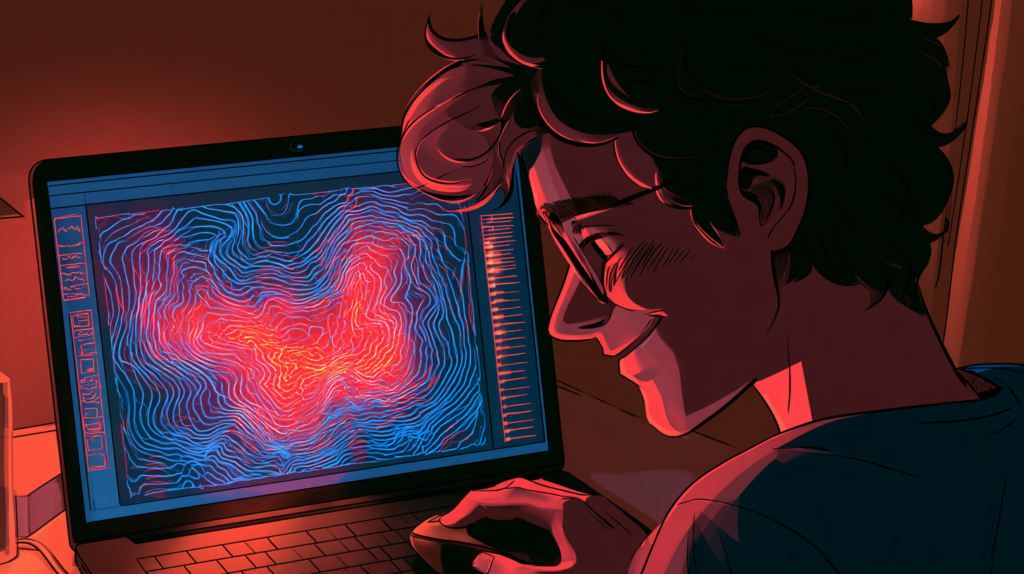
Draw a shape. Hear the drum it would be.
Open a browser tab. Draw a lopsided star with your mouse. Click the center. A drum sound rings out — not a sample, not an AI guess, but the actual vibration modes of that exact shape, solved from the outline you just drew [S1]. The overtones follow the physics of a membrane clamped at its rim. Move your strike point half an inch and the timbre shifts. Hit a nodal line — the curve where that mode stands perfectly still — and that mode goes silent [S2].
This is Eigendrum (eigendrum.com), a free browser toy by Basel Ashraf. It turns the famous ‘can you hear the shape of a drum?’ math problem into something tangible. You do not need to download anything, create an account, or own special hardware — everything happens in your browser [S1][S2].
At a glance
| | | |—|—| | Grandma-test difficulty | 0/5 — Open a link and interact | | Try-it time | 30 seconds to first sound; 5 minutes to the ‘wait, that worked?!’ moment | | Worth your time | 5/5 — Do Not Miss |
What you need
- A web browser (Chrome, Firefox, Safari, Edge — anything from the last few years)
- Speakers or headphones
- That’s it. No account, no download, no terminal, no Docker, no API key.
Simple setup (one step)
- Open eigendrum.com. The page loads, a circular drum appears, and you’re ready. The solver runs in a background worker; the first solve takes ~700 ms [S2].
That’s the entire setup. The shape lives in the URL fragment (after the #), so your browser never sends it to a server. A local clone (git clone && open index.html) works identically with zero network calls [S2].
First thing to try: strike the circle
Click anywhere on the white drumhead. Hear that? That’s the fundamental (mode 1) plus a chorus of overtones — ratios of Bessel function zeros, because that’s what a circular drum does [S2]. The mode list on the right lights up, showing which modes rang loudest. Click a different spot. The timbre changes. Click exactly in the center — the modes with a nodal diameter through the center go silent, because the mallet landed where they don’t move [S2].
Pro tip: Press any row in the mode list. You’ll hear that single mode in isolation — a pure decaying sinusoid at its exact eigenfrequency. No real mallet can do this; a physical strike always excites many modes at once. This is the x-ray that lets you learn what each mode sounds like before you hear the mixture [S1].
Turn it into a game: the isospectral challenge
Open the preset dropdown (top left) and select Kac drum I. It looks like a hook. Strike it. Now switch to Kac drum II — an arrow shape. Strike it.
They sound identical. Not close — identical. The frequency table reports agreement to within 1.07×10⁻⁷ percent across all 16 computed modes [S1][S5]. The frequency comb at the bottom draws the partner drum’s ticks above the axis, landing exactly on top of this drum’s ticks below it. You are hearing Mark Kac’s 1966 question answered: no, you cannot hear the shape of a drum [S4][S5].
Challenge: Can you draw a third shape that matches them? (Spoiler: the math says no — these two are a very special pair. But trying teaches you how shape controls spectrum.)
Play variations
- Draw your own drum. Click Freehand in the preset dropdown. Draw any blob. The mesher turns it into ~2000 triangles and solves in ~700 ms [S2].
- Write a shape as an equation. Select Formula and type 1 + 0.3cos(5t) for a five-lobed flower, or 3cos(t) – cos(3t), 3sin(t) – sin(3t) for a deltoid. Change one number and hear the spectrum shift [S1].
- Share a drum. Copy the URL — the shape travels in the fragment (e.g., #f=p:1+0.3cos(5t)). Paste it to a friend. They hear your exact drum [S1].
- Export the hit. Click Export WAV to save the strike as audio. Click Export PNG to save the vibrating mode visualization [S1].
Optional expert rabbit hole
If you want to go deeper, the GitHub repo is a masterclass in numerical methods [S2][S3]:
- Expression parser (src/math/expr.js): Recursive-descent, no eval, handles untrusted formulas from shared URLs safely.
- Mesher (src/geom/mesh.js): Lattice of right-isosceles triangles → centroid test → boundary projection → repair (smooth, drop splinters, even spacing).
- Eigensolver (src/math/eig.js): Banded Cholesky + reverse Cuthill-McKee reordering → block inverse iteration with Rayleigh-Ritz projection → lowest 16 eigenpairs of Kφ = λMφ.
- Audio synthesis (src/audio/synth.js): Mass-normalized modal coefficients → 1/ω impulse rolloff → one-pole contact-time filter → Rayleigh damping (αM + βK) with brightness control.
- Accuracy tests (tests/, tools/bench.mjs): Convergence verified against closed-form spectra (disk, square, rectangle, right triangle) — second-order convergence, all errors positive (conforming FEM property).
Run npm test (57 tests) or node tools/isospectral.mjs to verify the Kac drums yourself [S2].
One thing to know
The sound is synthesized from physics, not sampled. It’s a sum of decaying sinusoids — clean, mathematical, a bit electronic. If you expect the thump of a recorded Ludwig kit, you’ll be disappointed. This is a physics toy, not a sample library [S1]. Also, the deployed site at eigendrum.com includes privacy-respecting analytics and a sponsorship slot; a local clone (npm run serve) strips both entirely [S2].
The bottom line
Try it tonight if: You like math made audible, you want a zero-friction demo of eigenvalues and Chladni figures, or you’ve ever tapped a table and wondered what shape makes what sound.
Skip it if: You need a DAW plugin, low-latency MIDI, or sampled realism.
Eigendrum is the rare thing that makes a graduate-level math problem feel like a fidget toy. Open the tab. Draw a blob. Click it. Hear the shape. That’s the whole article — except you’ll probably stay for twenty minutes chasing the isospectral pair, writing five-lobed flowers in polar coordinates, and sending drum links to friends who won’t believe a hook and an arrow sound the same.
[S1] [S2] [S3] [S4] [S5]
Sources
- [S1] Eigendrum — Interactive visualization and audio exploration of drum eigenmodes — Basel Ashraf (2026-08-10)
- [S2] Eigendrum GitHub repository (MIT licensed) — Basel Ashraf (2026-08-10)
- [S3] Show HN: Eigendrum – Draw any shape and hear what it sounds like as a drum — Hacker News (2026-08-10)
- [S4] Can One Hear the Shape of a Drum? (Mark Kac, 1966) — American Mathematical Monthly (1966)
- [S5] One cannot hear the shape of a drum (Gordon, Webb, Wolpert, 1992) — SIAM Review (1992)