Be Your Evolution AI News Daily
Five fresh signals. Five durable tools. No hype tax.
Top 5: New and Worth Your Attention
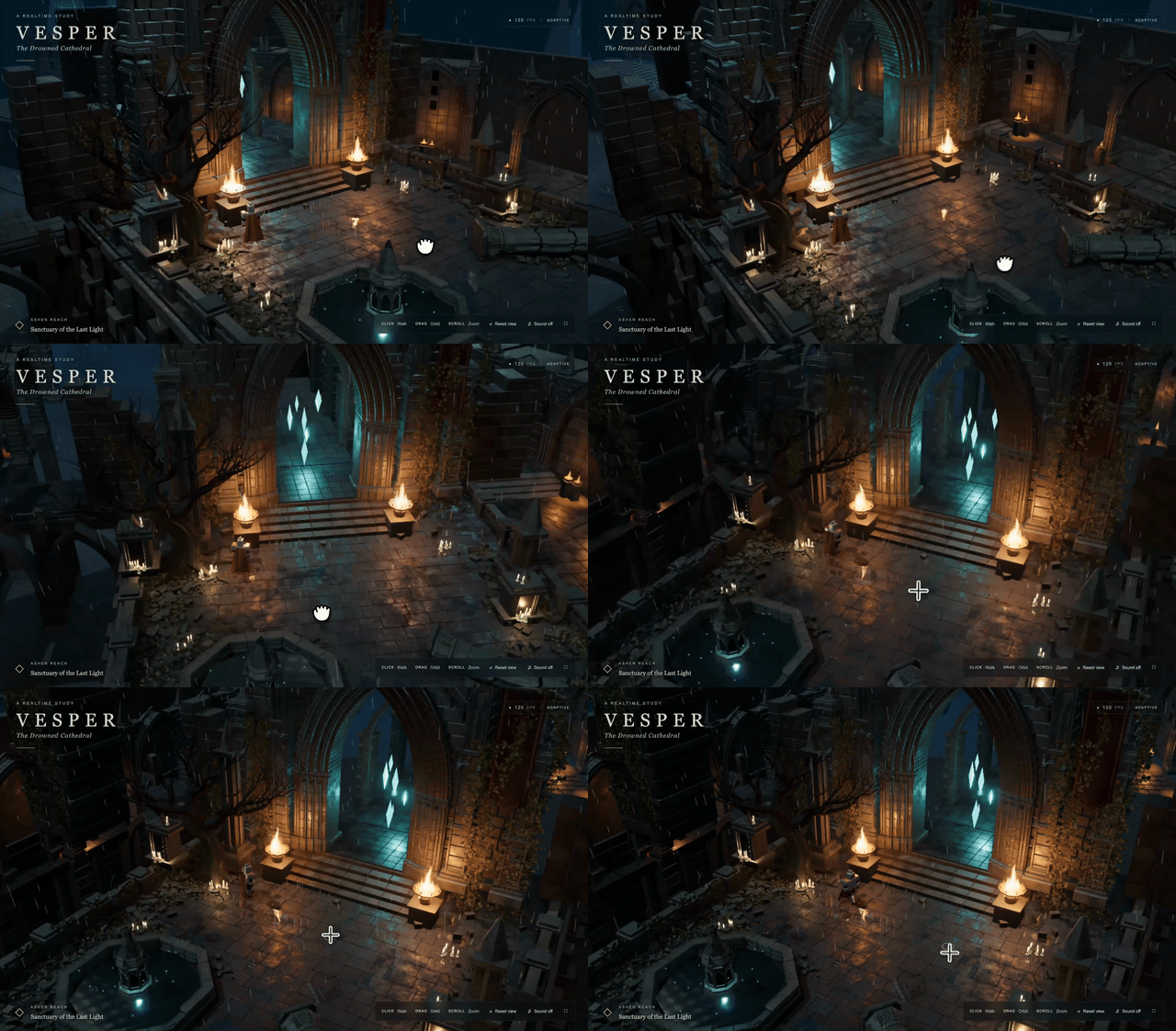
1. Dream Loop
Dream Loop gives a coding agent a visual target before it builds: generate the ideal screenshot, implement toward it, let a separate critic compare the live result, then iterate. That simple loop turns “make it look better” into something inspectable. Jason can use it on one small Three.js scene, lock the target image, and watch whether each round closes a visible gap instead of accumulating decorative changes that never improve the composition.
OPERATIONAL VALUE
Creates a repeatable target-versus-render feedback loop for game scenes, product interfaces, and high-fidelity prototypes where verbal taste alone is too ambiguous.
QUICK VIDEO
Show the generated dream frame, the rough first render, the critic’s three biggest gaps, and the visibly tighter second pass.
Reality: Dream Loop is MIT open source, has no tagged release, and says it is currently tested only with GPT-6 Astra in Codex. It needs image generation and vision; subagents are strongly preferred, and Blender is optional for custom 3D. The loop can consume substantial tokens and time, so use a disposable branch, a fixed budget, and human approval of the target.
OPEN PRIMARY SOURCE →2. agent-memory 0.1.0
agent-memory keeps long-term agent knowledge as readable Markdown while a rebuildable local index ranks what should be recalled. It returns file paths and short abstracts first, so the agent can stop before flooding context with old material. Jason can connect a throwaway store to Codex, record one project decision, retrieve it from a fresh session, and inspect the source file and provenance before deciding whether shared memory is genuinely clearer than disciplined project notes.
OPERATIONAL VALUE
Offers one portable, greppable memory store across agent hosts, with local retrieval and deletion proposals that remain visible for human review.
QUICK VIDEO
Teach Codex one project rule, close the session, recall it from a new task, then open the exact Markdown evidence behind the answer.
Reality: Version 0.1.0 is MIT open source, requires Python 3.12 or newer, and has no tagged GitHub release. The repository reports its own bounded-memory experiments, not a universal benchmark. Conversation traces may contain secrets or stale decisions; keep the store project-scoped, review background distillation, and treat every recalled note as evidence rather than authority.
OPEN PRIMARY SOURCE →3. PaperGraph MCP 0.10.0
PaperGraph MCP turns an arXiv paper, LaTeX project, or born-digital PDF into a theorem-centered reading workspace with source spans, proof references, queues, and reviewable import plans. Today’s 0.10.0 release adds Paper Map, a first-load overview that flags likely main results and evidence gaps without pretending to verify proofs. Jason can load one technical paper and test whether its reading route makes the claims easier to audit than a conventional AI summary.
OPERATIONAL VALUE
Gives research agents bounded, source-linked structures for navigating dense papers while requiring review before following external citations or importing more material.
QUICK VIDEO
Open a difficult paper, reveal its Paper Map, choose one theorem, and jump from the extracted claim back to the exact source slice.
Reality: PaperGraph 0.10.0 is MIT open source, requires Python 3.10+ and uv for the documented pinned setup, and reports 434 tests passing with one skipped. It does not verify proofs, infer hidden prerequisites, or prove that an empty dependency list is complete. PDF extraction can miss structure; private manuscripts deserve local handling and explicit review.
OPEN PRIMARY SOURCE →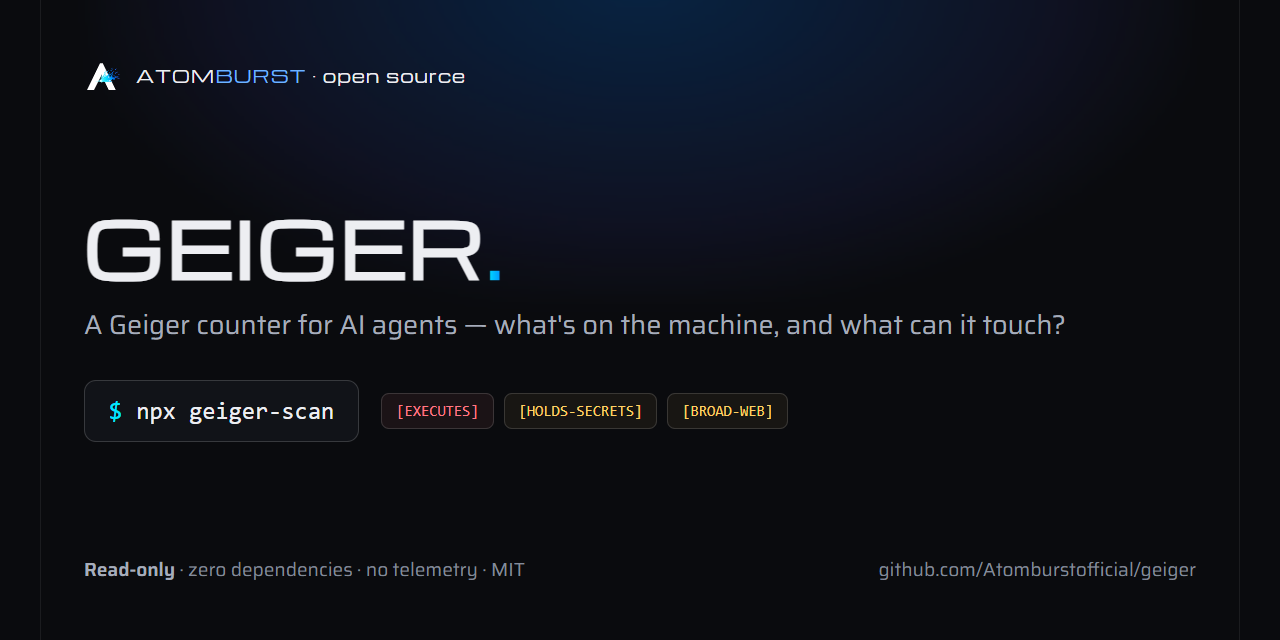
4. Geiger 0.2.1
Geiger inventories local agents, MCP servers, plugins, hooks, extensions, and credential-shaped configuration without printing secret values. Release 0.2.1 adds Kilo CLI, Grok Build, Firefox, and JetBrains coverage. This is useful precisely because agent tooling accumulates quietly. Jason can run the no-install scan, compare every finding with the actual config path, and use the HTML report as a cleanup checklist rather than assuming a green label proves the machine is safe.
OPERATIONAL VALUE
Turns scattered agent configuration into a readable local inventory of execution, filesystem, network, browser, and secret exposure with evidence paths for verification.
QUICK VIDEO
Scan a busy workstation, reveal the forgotten MCP and browser permissions, then manually verify one flagged configuration without exposing its secret.
Reality: Geiger 0.2.1 is MIT open source, requires Node.js 18+, has zero runtime dependencies, and promises read-only behavior unless an output file is requested. Detection is not containment: configuration formats change, unknown tools may be missed, and capability labels do not establish intent. Read the command’s source, inspect the report privately, and confirm important findings by hand.
OPEN PRIMARY SOURCE →5. Bang Motion 1.0.0
Bang Motion is an Agent Skills package for browser-based openers, promos, kinetic type, and explainers. Its strongest idea is structural: one continuous visual world, deterministic time, changing viewpoints, and checks that reject slide-deck habits. The deliverable is a single autoplaying HTML file. Jason can give it one Be Your Evolution topic, choose the visual-journalism style, and judge whether the result feels directed before investing in voice timing or MP4 export.
OPERATIONAL VALUE
Packages repeatable motion-direction rules and starter architectures into a portable skill that can create editable browser graphics without a dedicated video application.
QUICK VIDEO
Start with a plain newsletter headline, generate a 20-second opener, scrub its deterministic timeline, then expose the anti-slide checks it passed.
Reality: Bang Motion is MIT open source, but 1.0.0 is identified in its changelog as prerelease work and has no GitHub release. Playback loads GSAP and fonts from CDNs; automated frame checks need Node and Puppeteer, while MP4 export needs ffmpeg. Generated visuals, fonts, photos, music, and voice assets carry separate rights, so inspect every dependency before publishing.
OPEN PRIMARY SOURCE →5 Proven Classics
AutoGen helped define multi-agent application patterns, but its primary repository is now community-managed maintenance mode. Existing users should study migration; new projects should begin with Microsoft Agent Framework instead.
Source →Semantic Kernel remains an actively maintained MIT framework for model connectors, plugins, agents, and orchestration across .NET, Python, and Java. Provider costs, behavior, and application security remain separate.
Source →Haystack remains a mature Apache-2.0 toolkit for explicit retrieval, routing, generation, and agent pipelines. Its component graph is especially useful when inspection and controlled data flow matter.
Source →LocalAI remains a flexible MIT-licensed local inference API for text, vision, audio, image, and video backends. Hardware needs and each downloaded model’s weight license still vary.
Source →vLLM remains an Apache-2.0 serving engine for high-throughput model inference and OpenAI-compatible endpoints. It earns attention when real concurrency justifies GPU memory planning and production operations.
Source →Reality Check
All ten repositories are publicly inspectable, but “open source” does not make an agent workflow automatically safe or cheap. Today’s code licenses include MIT, Apache-2.0, and AutoGen’s current repository-level CC-BY-4.0 terms; model weights, hosted APIs, fonts, media, papers, and generated output remain separately governed. Visual loops can consume heavy model budgets, memory stores can preserve secrets and stale decisions, inventory scanners can miss new formats, research extraction can omit structure, and local inference still needs compatible hardware. Pin versions, use disposable projects, keep data local when possible, and verify outputs against original evidence.
Bottom Line
Try Geiger first because a read-only inventory can expose what your growing agent stack can actually touch before you add more tools. Then test Dream Loop on one bounded Three.js scene: it offers the clearest visual proof of whether target-driven critique improves the work. PaperGraph is the strongest specialist pick for technical reading; keep agent-memory small and inspectable until its background lifecycle earns trust, and treat Bang Motion as a promising prerelease creative system.
Primary-source research completed September 10, 2026. Private Be Your Evolution field guide.