Be Your Evolution AI News Daily
Five fresh signals. Five durable tools. No hype tax.
Top 5: New and Worth Your Attention
1. ffmpeg-skill 1.3.0
ffmpeg-skill gives Codex a measured video-editing workflow instead of asking it to improvise shell commands. Its 41 tools probe media, cut, join, caption, clean audio, render projects, and verify the result through structured arguments. Today’s 1.3.0 release adds chapter markers and title, artist, and comment metadata while copying streams. Jason can use it to turn one long screen recording into a clean short without uploading private footage or handing raw filter graphs to an agent.
OPERATIONAL VALUE
Provides a reusable probe-edit-verify system for local media work, with machine-readable contracts and per-tool environment checks that make agent actions easier to inspect.
QUICK VIDEO
Feed it a messy recording, remove dead air, add chapters and captions, then compare the verified output spec with the untouched source.
Reality: Version 1.3.0 is MIT open source. The documented baseline is Python 3.9+, FFmpeg 5.0+, and ffprobe; optional features depend on the filters and codecs in the local FFmpeg build. It edits files rather than deciding editorial taste, and a valid encode can still be a bad cut. Work from copies, inspect contact sheets, and review captions, loudness, rights, and delivery settings.
OPEN PRIMARY SOURCE →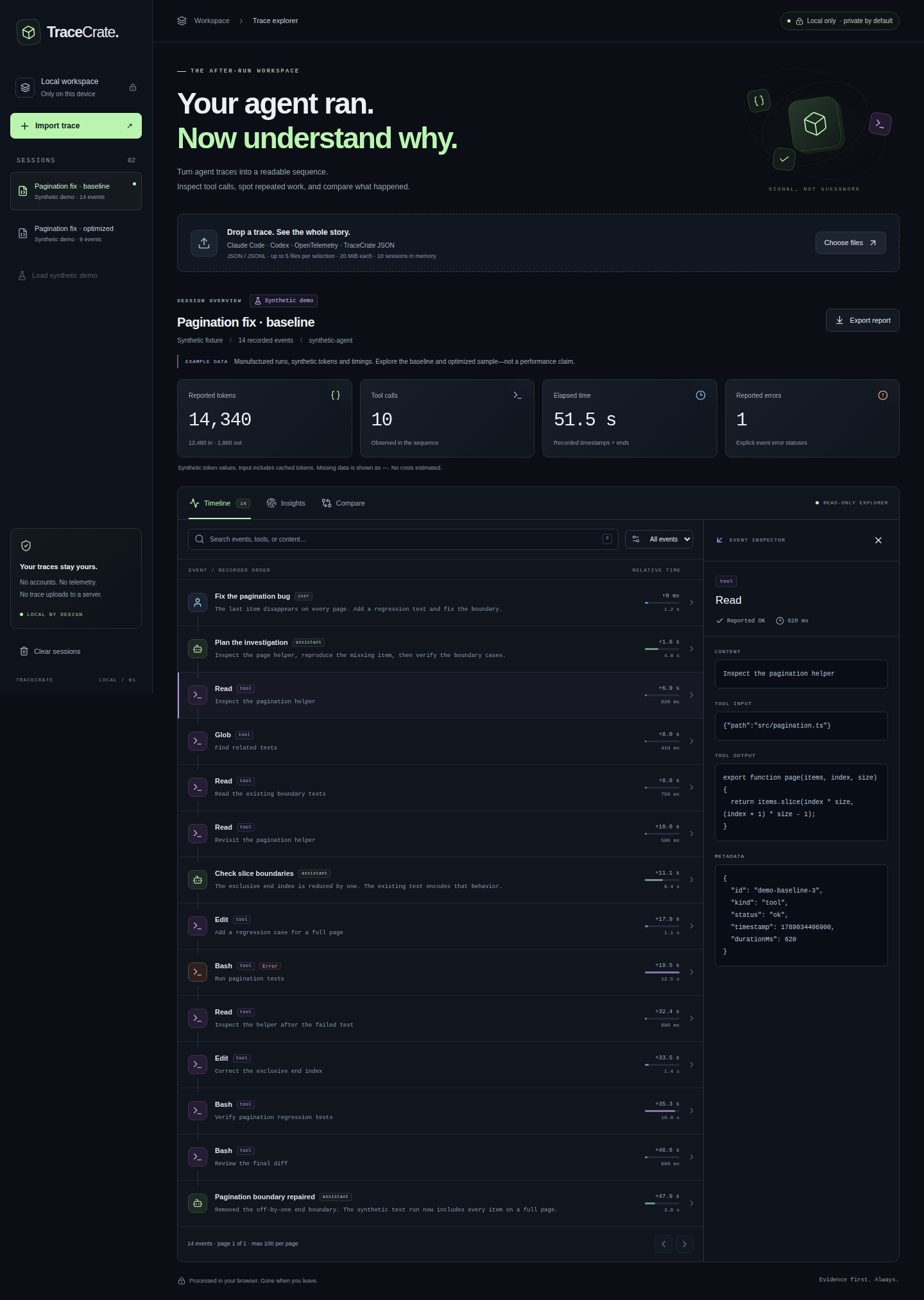
2. TraceCrate 0.1.0
TraceCrate turns selected Claude Code, Codex, and OTLP JSON traces into a searchable timeline, recorded metrics, heuristic flags, and two-run comparisons inside the browser. It does not execute logged commands or require an account, backend, telemetry service, API key, or model call. Jason can open the synthetic demo first, then import one disposable Codex rollout locally and inspect repeated tools, long durations, explicit errors, and a structure-only export before sharing anything.
OPERATIONAL VALUE
Makes agent runs easier to audit and compare while keeping selected traces in memory and putting deliberate export boundaries in front of sensitive histories.
QUICK VIDEO
Open two synthetic runs, isolate one repeated tool call, compare recorded metrics, then preview the redacted structure-only report before download.
Reality: TraceCrate 0.1.0 is MIT open source and its release reports 107 unit tests plus 36 Chromium desktop/mobile tests. Local use requires Node.js 22.12 or newer, with 24 recommended. Supported inputs are documented subsets, not universal trace formats. Pattern redaction can miss secrets, structure-only timing can remain sensitive, and heuristics do not establish causes. Review every export and never load histories you are not authorized to inspect.
OPEN PRIMARY SOURCE →3. Codex Astra + Luna Orchestrator
This repository packages project-scoped Codex profiles that separate orchestration, execution, and review roles across Astra and Luna. The useful part is not the model branding; it is the inspectable topology, named agent files, plan-specific reasoning settings, and guarded installer that lists overwrites before touching existing configuration. Jason can compare its Pro profile with one current project, copy only the role ideas he needs, and measure whether the split improves throughput enough to justify extra coordination and token use.
OPERATIONAL VALUE
Offers a concrete starting point for repeatable multi-agent Codex roles, reviewer separation, concurrency limits, and token-usage guidance without inventing the configuration from scratch.
QUICK VIDEO
Run the same bounded coding task once with a single agent and once with explorer, worker, tester, and reviewer roles, then compare outcome and usage.
Reality: The repository is Apache-2.0 open source, actively changing, and has no tagged release. Its presets assume current Codex model names, plan access, trusted project configuration, and up to four concurrent subagents. The installer can add or replace project files after confirmation; review every diff and do not blindly copy global settings. More agents can add duplicated research, conflicting edits, latency, and cost when a single focused agent would be enough.
OPEN PRIMARY SOURCE →4. anything2explainer
anything2explainer is a Codex and Claude Code skill for building narrated Remotion explainers from a topic or source document. It supplies the research, narration, storyboard, shot-building, voice, subtitle, render, and quantitative QC method rather than pretending one prompt makes a finished film. Jason can test the 30-second pilot checkpoint on a Be Your Evolution concept and judge the black-canvas visual language before committing agents to a multi-minute production.
OPERATIONAL VALUE
Turns a vague “make an explainer” request into a staged production system with explicit approvals, source artifacts, reusable code, synchronized narration, and review gates.
QUICK VIDEO
Show a raw topic becoming research, narration, storyboard, and a 30-second pilot, then stop at the human style-approval gate.
Reality: This is source-available under PolyForm Noncommercial 1.0.0, not open source and not cleared for commercial use without separate permission. It has no tagged release, was developed on macOS, and describes Windows as untested. The stack needs Node 18+, Remotion, FFmpeg, Python packages, TTS, roughly 2–3 GB per reference-tier project, and multiple agents. Fonts, voices, claims, music, and final distribution rights remain your responsibility.
OPEN PRIMARY SOURCE →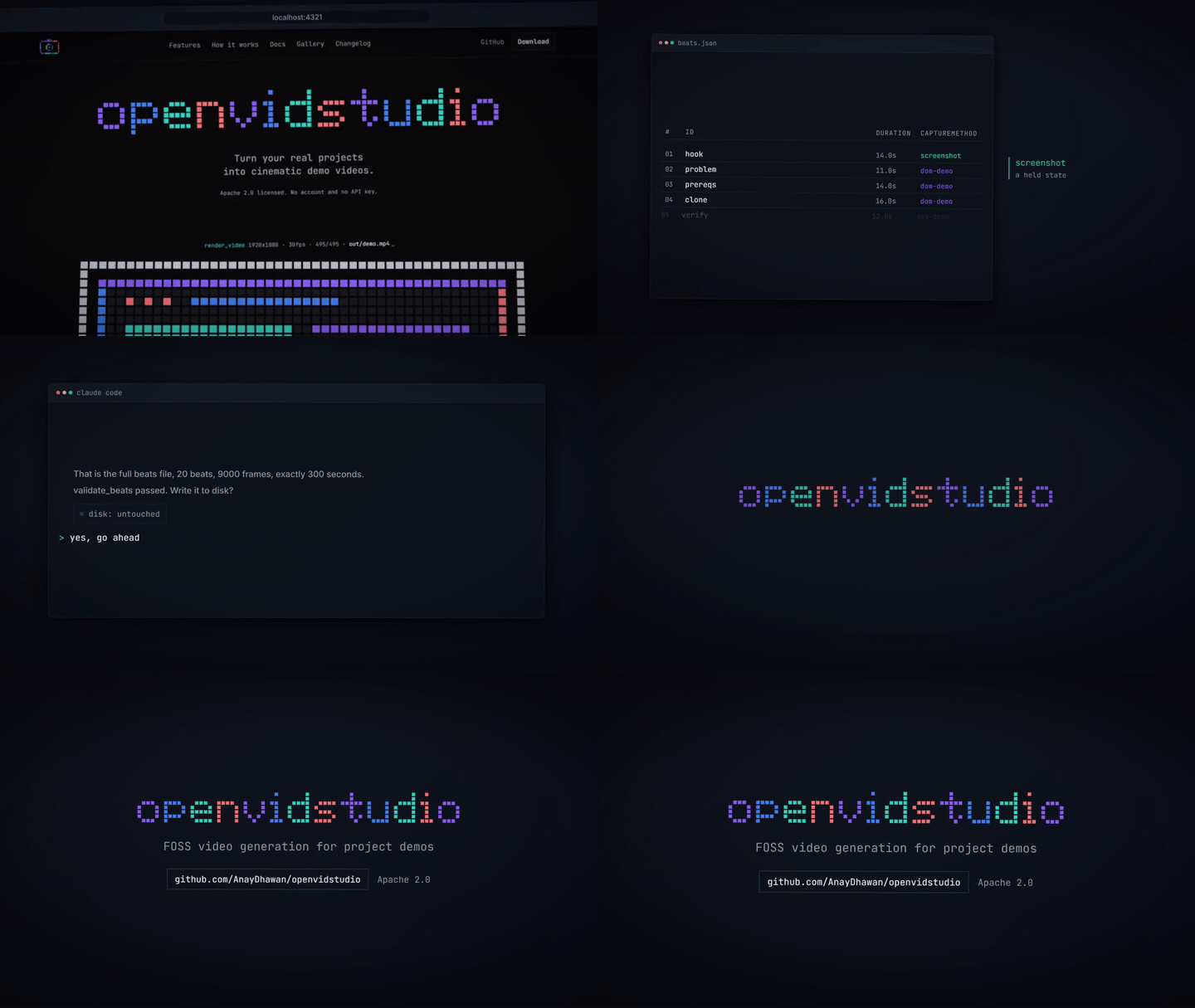
5. openvidstudio
openvidstudio lets an MCP-capable coding agent capture a real running product with Playwright and assemble the footage in Remotion. Its strongest constraint is useful: product UI comes from actual pixels, while optional AI b-roll is reserved for shots the app cannot produce. Jason can point it at one local site, approve the beat plan, extract the existing brand, and render a short launch demo whose claims and screens can be checked against the live product.
OPERATIONAL VALUE
Combines product discovery, brand extraction, browser capture, narration, contact sheets, rendering, and QC behind sixteen MCP tools with an approval gate before files are written.
QUICK VIDEO
Start from a running landing page, approve three beats, capture real interactions, and reveal the contact sheet beside the final directed product demo.
Reality: openvidstudio is Apache-2.0 open source, has no tagged release, and says the pipeline runs end to end. The documented requirements include Node 18+, FFmpeg 4+, Playwright, Chromium, and a reachable app; narration adds Python and edge-tts. An npx install executes a moving package, so pin and review before use. Optional Higgsfield b-roll introduces separate account, provider, cost, and media-rights considerations.
OPEN PRIMARY SOURCE →5 Proven Classics
Jupyter AI remains a BSD-3-Clause extension for bringing chat, agents, and generative commands into computational notebooks. It is especially useful when claims should stay beside executable analysis.
Source →Unstructured remains an Apache-2.0 toolkit for partitioning PDFs, office files, HTML, and more into model-ready elements. Complex layouts still demand sampling, OCR checks, and source comparison.
Source →MLX remains an MIT array framework designed for Apple silicon, with shared-memory execution and a growing model ecosystem. It deserves attention when a Mac is the local AI target.
Source →Hugging Face Transformers remains the Apache-2.0 model-definition backbone for text, vision, audio, and multimodal work. Library openness never overrides each checkpoint’s separate license and usage conditions.
Source →ONNX Runtime remains an MIT cross-platform inference engine with multiple hardware execution providers. It is valuable when deployment portability matters, but exported-model compatibility and numerical behavior need testing.
Source →Reality Check
Four featured repositories are open source under MIT or Apache-2.0; anything2explainer is source-available under PolyForm Noncommercial and is not an open-source or general commercial-use option. Today’s workflows can touch private video, product interfaces, agent histories, local configuration, and copyrighted assets. Keep inputs disposable until the pipeline is understood, pin moving packages, review installer diffs, and inspect every exported frame, caption, log, and report. Model access, TTS voices, fonts, music, captured products, hosted services, and model weights remain separately governed even when the surrounding code is open.
Bottom Line
Try ffmpeg-skill first on a copied screen recording: it has the clearest immediate payoff, a fresh release, local execution, and a verification habit worth borrowing. Then use TraceCrate’s synthetic demo to see whether its timeline makes yesterday’s agent run easier to understand before exposing any real history. openvidstudio is the best next creative experiment for a product demo. Treat the orchestrator profiles as a design reference, and keep anything2explainer to noncommercial evaluation unless its licensing fits the intended use.
Primary-source research completed September 11, 2026. Private Be Your Evolution field guide.