Be Your Evolution AI News Daily
Five fresh signals. Five durable tools. No hype tax.
Top 5: New and Worth Your Attention
1. Crabbox 0.58.0
Crabbox gives coding agents a repeatable way to move expensive or platform-specific tests off the laptop while preserving the familiar edit-run loop. One command leases or selects a runner, syncs the dirty working tree, streams command output, captures artifacts, and releases the machine. Version 0.58.0 makes the evidence more useful: local history can survive lease cleanup, container runs record the image that actually executed, and a quickstart skill can teach compatible agents the workflow without cloud credentials.
OPERATIONAL VALUE
Run browser suites, large builds, GPU jobs, or OS-specific checks on disposable capacity; retain logs and results for reviewer evidence after the runner is gone.
QUICK VIDEO
Split screen: an agent edits locally, runs a recorded remote test, then opens retained logs after the remote lease has already been released.
Reality: Version 0.58.0 is MIT open source. Homebrew or release archives provide the complete distribution; the CLI also needs Git, SSH tooling, rsync, and curl. Go installs build only the CLI. This is trusted developer automation, not a hostile multi-tenant sandbox, secrets scrubber, or CI replacement. Review captured output before sharing, and remember that cloud runners and sandbox vendors keep separate costs and terms.
OPEN PRIMARY SOURCE →2. RepoTracer 2.1.0
RepoTracer gives Claude Code or Codex a separate investigator for repository archaeology, so searching, reading, and testing a theory do not consume the same conversation that must implement the fix. The investigator reports back through one MCP tool and can continue the same investigation later. Version 2.1.0 turns that idea into a more usable product with both parent agents selected by default, independent scout profiles, reusable sessions, structured cited results, and clearer model and reasoning controls.
OPERATIONAL VALUE
Delegate cross-file behavior tracing, call-path discovery, experiments, and “where does this really happen?” questions while preserving the main agent’s context and limits.
QUICK VIDEO
Run the same bug investigation directly and with repo_scout; compare remaining context, then continue the scout with one focused follow-up question.
Reality: Version 2.1.0 is MIT open source. Run the documented npx setup, select Codex, Claude Code, or both, and use a native CLI that is already signed in. Optional Ollama or vLLM support uses an OpenAI-compatible endpoint. Connected CLIs, subscriptions, and model endpoints keep their own terms. The project publishes benchmark artifacts, but its performance claims are maintainer-authored results, not independent validation.
OPEN PRIMARY SOURCE →3. engrim 1.4.2
engrim is a local, project-scoped memory layer that lets several coding agents share durable decisions without sharing an enormous transcript. It stores curated records in SQLite, combines keyword and lightweight vector retrieval, and injects a small working-memory pack when a session starts. Version 1.4.2 is especially relevant for Codex users because it adds native lifecycle hooks and clean uninstall behavior. The practical promise is simple: switch agents or clear context without repeatedly re-explaining architecture, constraints, and immediate next steps.
OPERATIONAL VALUE
Preserve architectural decisions, constraints, feedback, and resume pointers across Codex, Claude Code, Cursor, Windsurf, and Antigravity while keeping the database local.
QUICK VIDEO
Save a decision in one agent, clear the session, open the same repository in Codex, and show the compact startup context pack restoring it.
Reality: Version 1.4.2 is MIT open source and requires Python 3.10+. The setup command can target Codex, and dry-run mode previews configuration changes. Its “99%+ context cut” and zero-regression case study are maintainer-reported, not independent proof. Review every hook change before enabling it; a local memory database can still retain sensitive repository context and stale decisions, so inspect, prune, and exclude it deliberately.
OPEN PRIMARY SOURCE →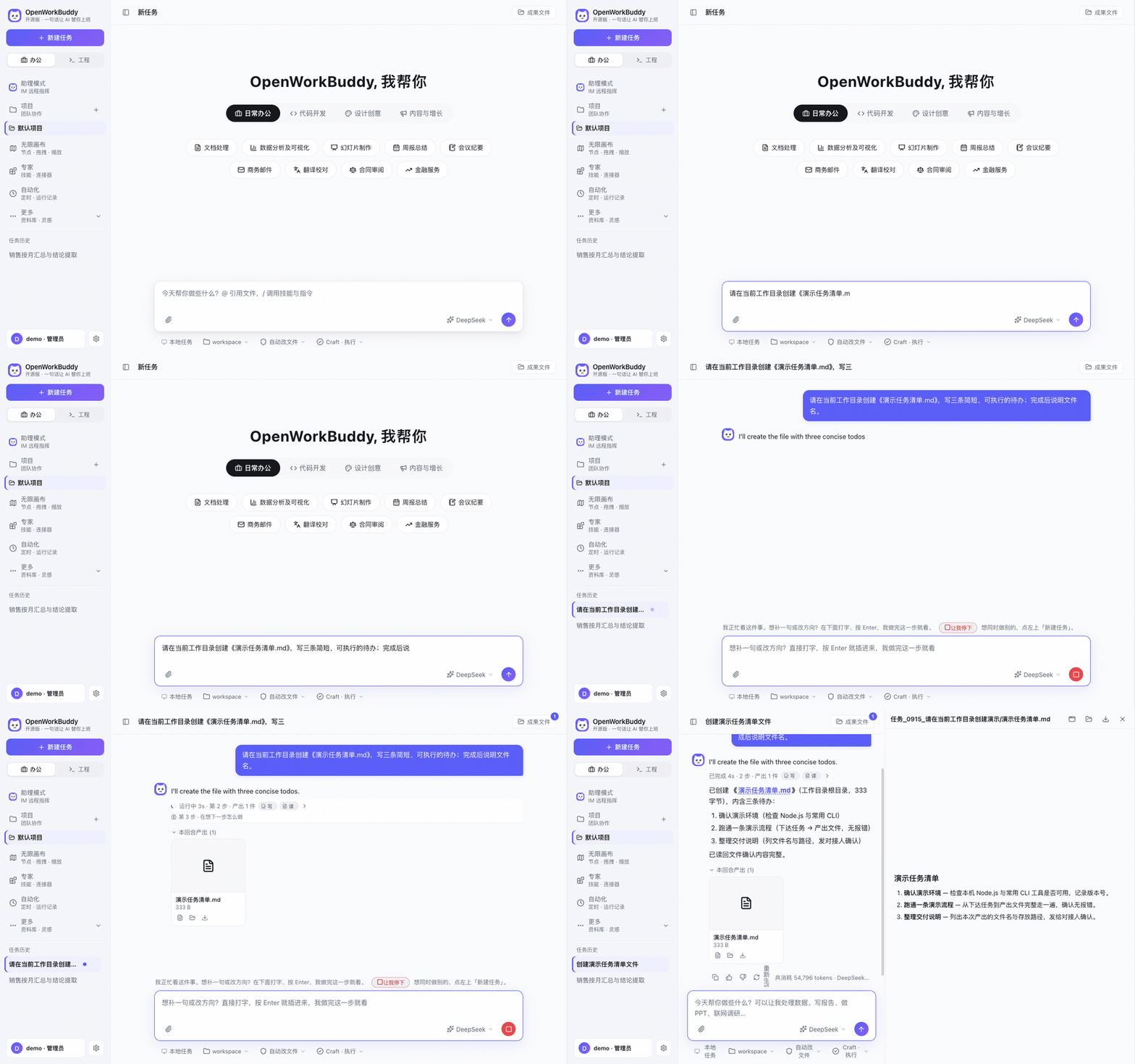
4. OpenWorkBuddy 0.1.8
OpenWorkBuddy is a local-first office agent focused on delivering usable files instead of a chat transcript. It can plan work, create PowerPoint, Word, Excel, and web outputs, check that files really exist, run scheduled jobs, and connect through skills or MCP. The September 13 update makes the office workflow more complete with SMTP sending, recurring tasks, transcription-to-minutes, file ingestion, and traces. It can use hosted providers, Ollama, or an installed Codex or Claude Code as its engine.
OPERATIONAL VALUE
Turn a spreadsheet into a review deck, transcribe a meeting into structured minutes, schedule a recurring report, or deliver an Office artifact without stitching together separate tools.
QUICK VIDEO
Drop in a meeting recording and spreadsheet, request minutes plus a Q3 deck, inspect the files, then preview an allowlisted email before sending.
Reality: This is source available under PolyForm Noncommercial 1.0.0, not open source; company or other commercial use needs a separate license. Downloaded desktop installers may be unsigned, while source setup needs Node.js 18+. The agent can execute shell commands and access files and networks, so keep it on localhost until permission gates and recipient allowlists are understood. “Local-first” also does not mean every model call remains local.
OPEN PRIMARY SOURCE →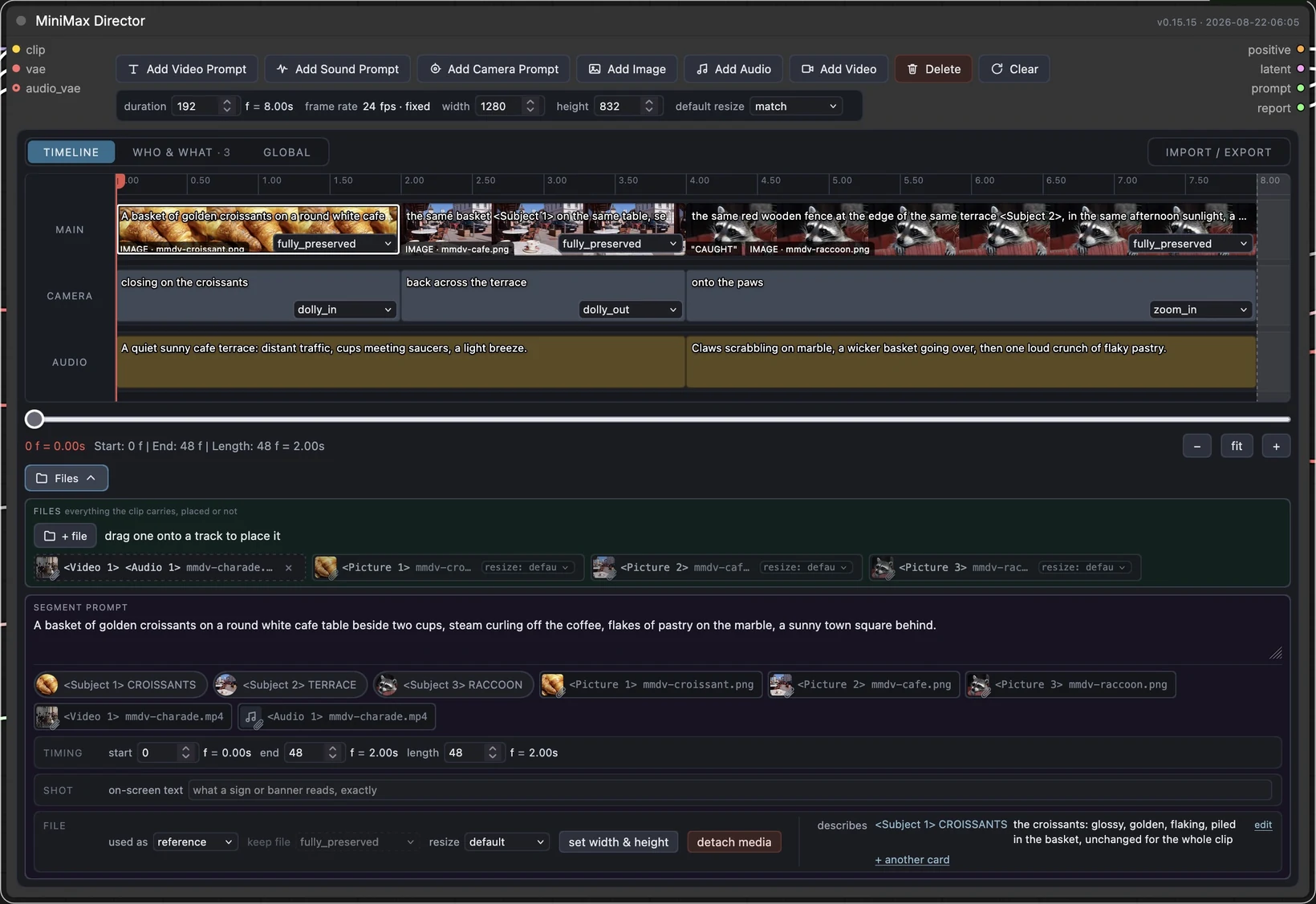
5. ComfyUI MiniMaxDirector 0.17.15
MiniMaxDirector replaces one giant video prompt with a visual timeline of shots, subjects, camera moves, dialogue, voiceovers, audio cues, and on-screen text. It compiles that timeline into the structured prompt MiniMax H3 expects, snaps clip lengths to the model’s valid frame lattice, and lints mistakes before an expensive render. The included workflow wires loaders, sampler, separate picture and audio decoding, and video output. Current main continues refining the tool after the Nodes 2.0-compatible 0.17.12 release.
OPERATIONAL VALUE
Storyboard multi-shot H3 clips, keep reference subjects and voices organized, preview the compiled prompt, and catch timing errors before spending GPU time.
QUICK VIDEO
Build a three-shot dialogue scene on the timeline, show the live compiled prompt and lint report, then toggle the four-step Turbo branch for a draft.
Reality: The code is MIT open source, but MiniMax H3 and optional turbo weights are separately licensed. The shipped workflow needs ComfyUI 0.31.0+, this repository in custom_nodes, and four large H3 files in specific model folders. Rendering needs capable GPU resources; turbo and upscale branches add weights, time, VRAM, and license considerations. Version 0.17.15 is current main, while 0.17.12 remains the latest formal release.
OPEN PRIMARY SOURCE →5 Proven Classics
Disposable cloud sandboxes give coding agents an isolated place to run commands, install dependencies, and return artifacts. The Apache-licensed SDK and templates remain practical infrastructure for tool-using agents.
Source →MLflow remains a durable backbone for tracking experiments, packaging models, evaluating generative AI, and managing deployment workflows. Its broad integrations stay useful long after the first notebook prototype.
Source →PyTorch is still the default practical foundation for training, fine-tuning, and experimenting with neural networks. Its ecosystem, documentation, hardware support, and debugging experience make prototypes easier to productionize.
Source →JupyterLab remains the most flexible workbench for inspecting data, testing models, documenting experiments, and sharing reproducible analysis. Its notebook-plus-terminal workflow still shortens the distance from question to evidence.
Source →whisper.cpp makes high-quality speech recognition practical on laptops, desktops, phones, and edge hardware. Quantization, broad platform support, and a simple CLI keep local transcription accessible.
Source →Reality Check
Crabbox, RepoTracer, engrim, and MiniMaxDirector use permissive open-source licenses; OpenWorkBuddy does not—it is PolyForm Noncommercial source available, and commercial or company use needs permission. Code licenses do not cover cloud runners, model subscriptions, MiniMax weights, generated media, or connected services. Today’s tools can copy dirty working trees, inspect private code, add lifecycle hooks, retain local memory, execute shell commands, send email, and consume large GPU resources. Start with disposable inputs, pin versions, preview configuration changes, minimize credentials, review captured artifacts, and keep a human approval boundary around writes and external delivery.
Bottom Line
Try RepoTracer first on one stubborn “where does this behavior come from?” question; the payoff is easy to compare against a normal agent session. Test Crabbox second if local hardware or cross-platform checks are slowing delivery. engrim is promising for multi-agent continuity, but audit its hooks and retained memory. OpenWorkBuddy needs a licensing decision before business use. MiniMaxDirector is today’s strongest visual demo—worth the setup only if MiniMax H3 video is already on your roadmap.
Primary-source research completed September 13, 2026. Private Be Your Evolution field guide.