Be Your Evolution AI News Daily
Five fresh signals. Five durable tools. No hype tax.
Top 5: New and Worth Your Attention

1. Official MCP Skills Extension
The official Model Context Protocol Skills extension gives MCP servers a standard way to advertise and distribute reusable skill packages through MCP resources. SEP-2640 is final, and the stable specification now defines discovery, manifests, content retrieval, versioning, integrity metadata, and client behavior. The practical shift is important: a team can publish approved capabilities once and let compatible agents discover them without hand-copying folders or inventing another private catalog format.
OPERATIONAL VALUE
Use one governed MCP server to distribute versioned company skills across supported agent clients, while keeping provenance, compatibility, and update behavior explicit.
QUICK VIDEO
Serve one small editorial skill, inspect its manifest through MCP, install it from a compatible client, then update the version and show the client detecting the change.
Reality: The specification repository is Apache-2.0 open source, but a finalized extension is not universal client support. Check the official implementation matrix before designing a workflow around it. The protocol transports skills; it does not certify their safety, quality, licensing, or trustworthiness. Servers still need authentication, integrity checks, access control, and a review policy for executable scripts and referenced assets.
OPEN PRIMARY SOURCE →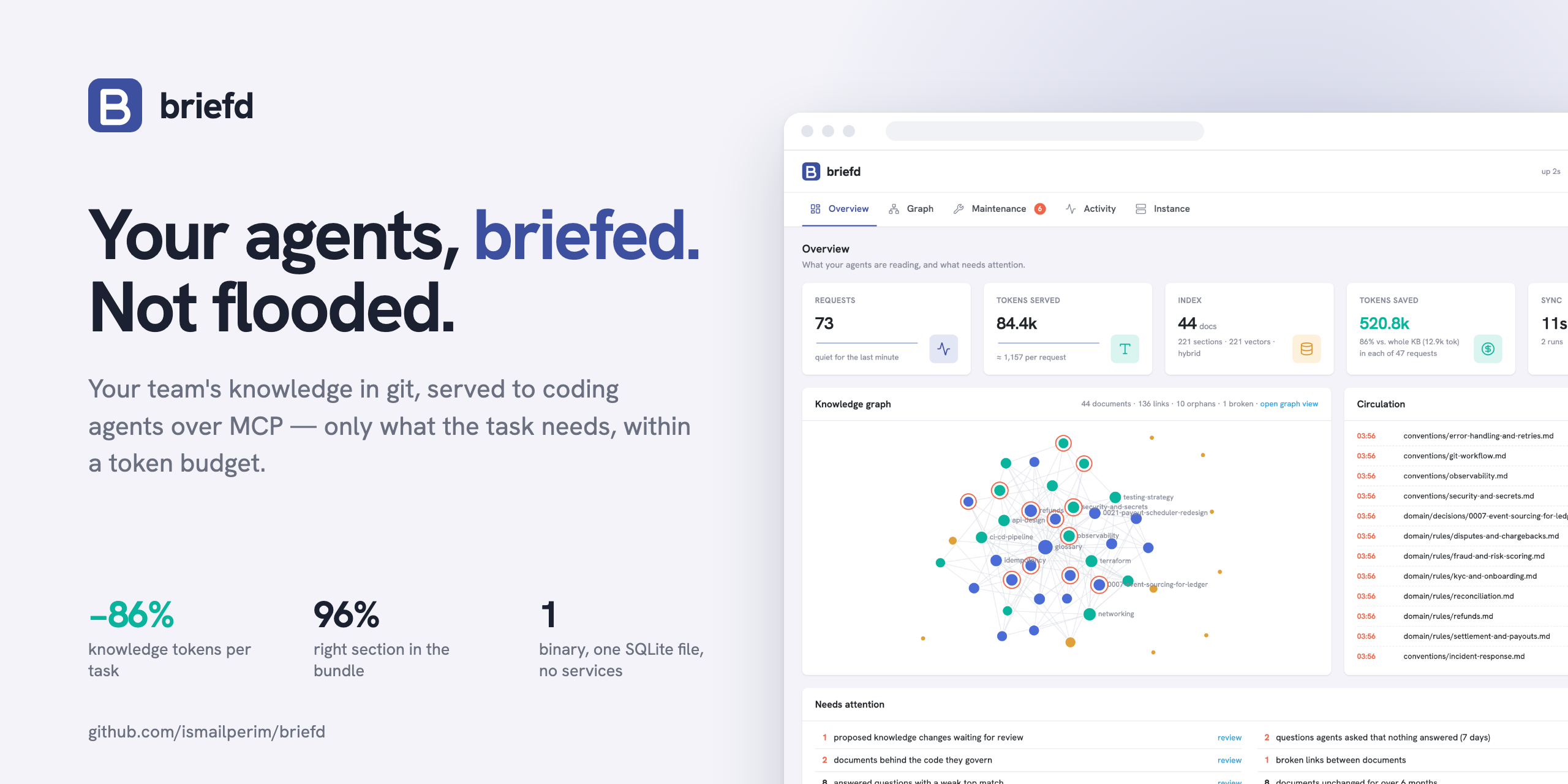
2. briefd 0.6.0
briefd turns a Git-backed knowledge repository into compact, task-specific context bundles for coding agents. Instead of pasting every convention and architecture note into every session, its MCP tools retrieve, deduplicate, and pack only relevant sections under a hard token budget. Version 0.6.0 adds a built-in demo, agent installation guidance, a briefd skill, stronger Azure DevOps cloning, link graphs, and a more useful maintenance dashboard for stale or missing knowledge.
OPERATIONAL VALUE
Keep shared project rules and decisions reviewable in Markdown, then give each agent only the slices needed for its current task instead of paying the full context tax.
QUICK VIDEO
Run the bundled demo, ask an agent for a 1,000-token bundle about one architecture decision, inspect its sources, then open the dashboard’s graph and stale-content queue.
Reality: briefd is Apache-2.0 open source and ships as a Go binary or container. The fast demo can skip embeddings; the normal multilingual path downloads roughly 470 MB and maintains a local SQLite index. Its benchmark is reproducible but project-authored, so validate retrieval on your own documents. Remote Git hosts, pull-request proposals, MCP exposure, backups, tokens, and knowledge freshness still need ordinary operational controls.
OPEN PRIMARY SOURCE →
3. Agent Skills 0.6.10
Addy Osmani’s Agent Skills 0.6.10 is a practical reliability release for a mature engineering-skill collection. It stops auto-injecting a redundant meta-router on Codex and Claude Code, fixes Windows session-start failures, prevents a simplify hook from restoring stale backups over newer work, and strengthens validators and evaluation graders. The result is less hidden context overhead and safer behavior around real files—exactly the kind of maintenance that makes reusable agent instructions worth revisiting.
OPERATIONAL VALUE
Borrow one tested workflow for planning, review, browser QA, or code simplification instead of rebuilding the same procedure in every repository—and avoid stacking duplicate skill routers on native hosts.
QUICK VIDEO
Install only the code-review skill, review a small pull request, compare its findings with a blank agent prompt, then show the reduced startup context after the router change.
Reality: The repository is MIT open source, but each skill can call external tools and inherit their requirements. Inspect every selected SKILL.md, script, and reference before installation. A one-skill install may omit shared reference files, and workflows that edit, deploy, or simplify code still require backups, scoped permissions, tests, and human review. Version 0.6.10 changes startup behavior, so users who depended on forced meta-skill injection must opt into the standalone hook.
OPEN PRIMARY SOURCE →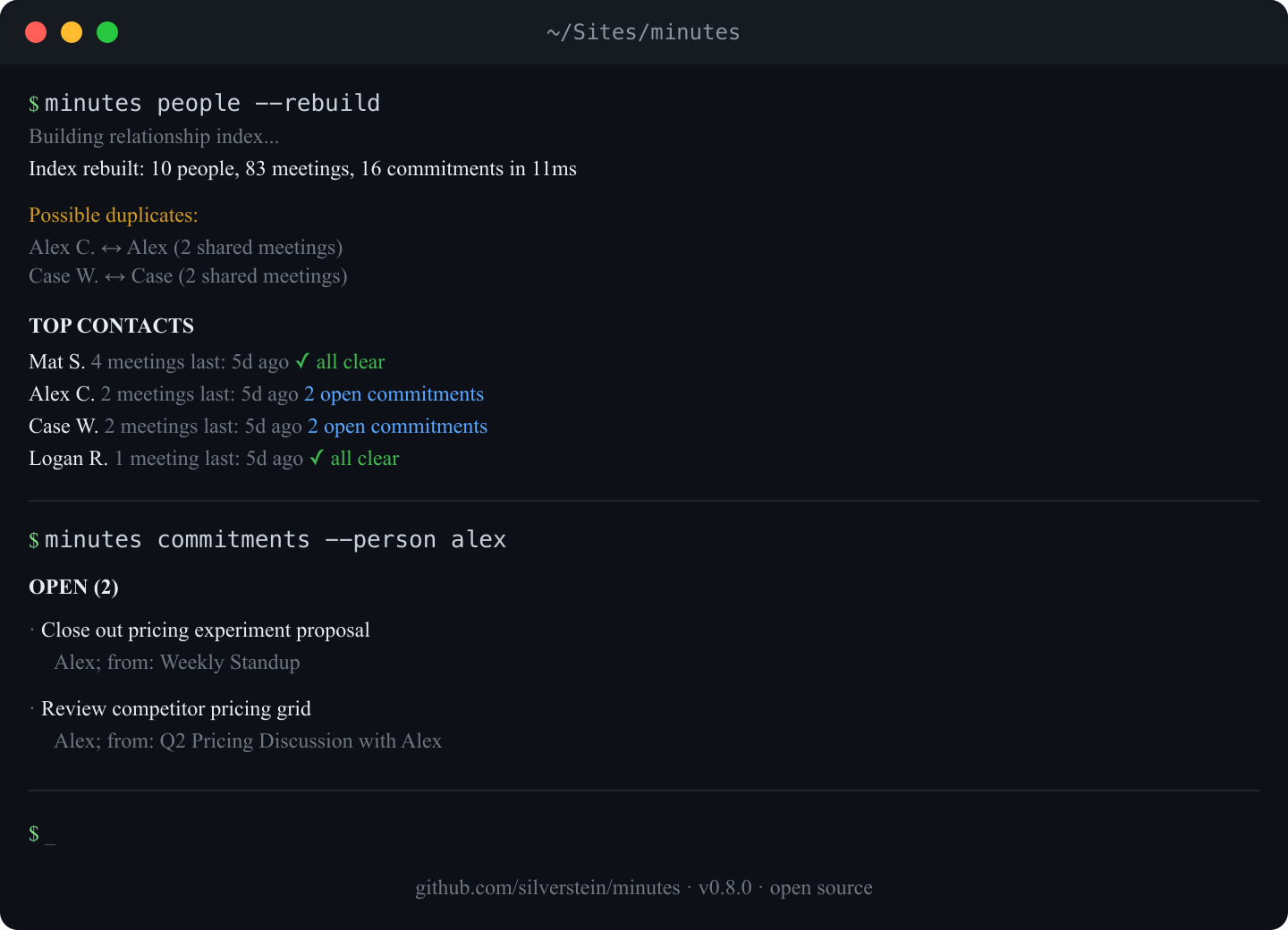
4. Minutes 0.26.3
Minutes records and transcribes meetings, calls, and voice memos locally into Markdown that MCP clients can search. Release 0.26.3 brings ordinary notes into the same searchable corpus, serializes model setup so simultaneous processes do not corrupt downloads, improves diarized CLI output, and fixes Windows and macOS edge cases. Its clearest advantage is ownership: the searchable archive remains a folder of readable files rather than becoming data trapped inside a meeting SaaS dashboard.
OPERATIONAL VALUE
Build a private, searchable decision trail that Codex or another MCP client can query before drafting follow-ups, project briefs, or reminders—without uploading raw audio for transcription.
QUICK VIDEO
Seed the bundled demo meetings, ask which billing decision changed a month later, inspect the cited Markdown, then add a note and confirm it appears in the same search.
Reality: Minutes is MIT open source. Local capture, transcription, and storage still involve microphone permissions, model downloads, disk space, retention choices, and sensitive workplace content. Windows desktop builds remain unsigned previews, while macOS and package-manager setup have platform-specific trust steps. If you connect a cloud assistant or summarizer, the context you authorize leaves the machine under that provider’s terms; local files also need encryption, backups, and access policy.
OPEN PRIMARY SOURCE →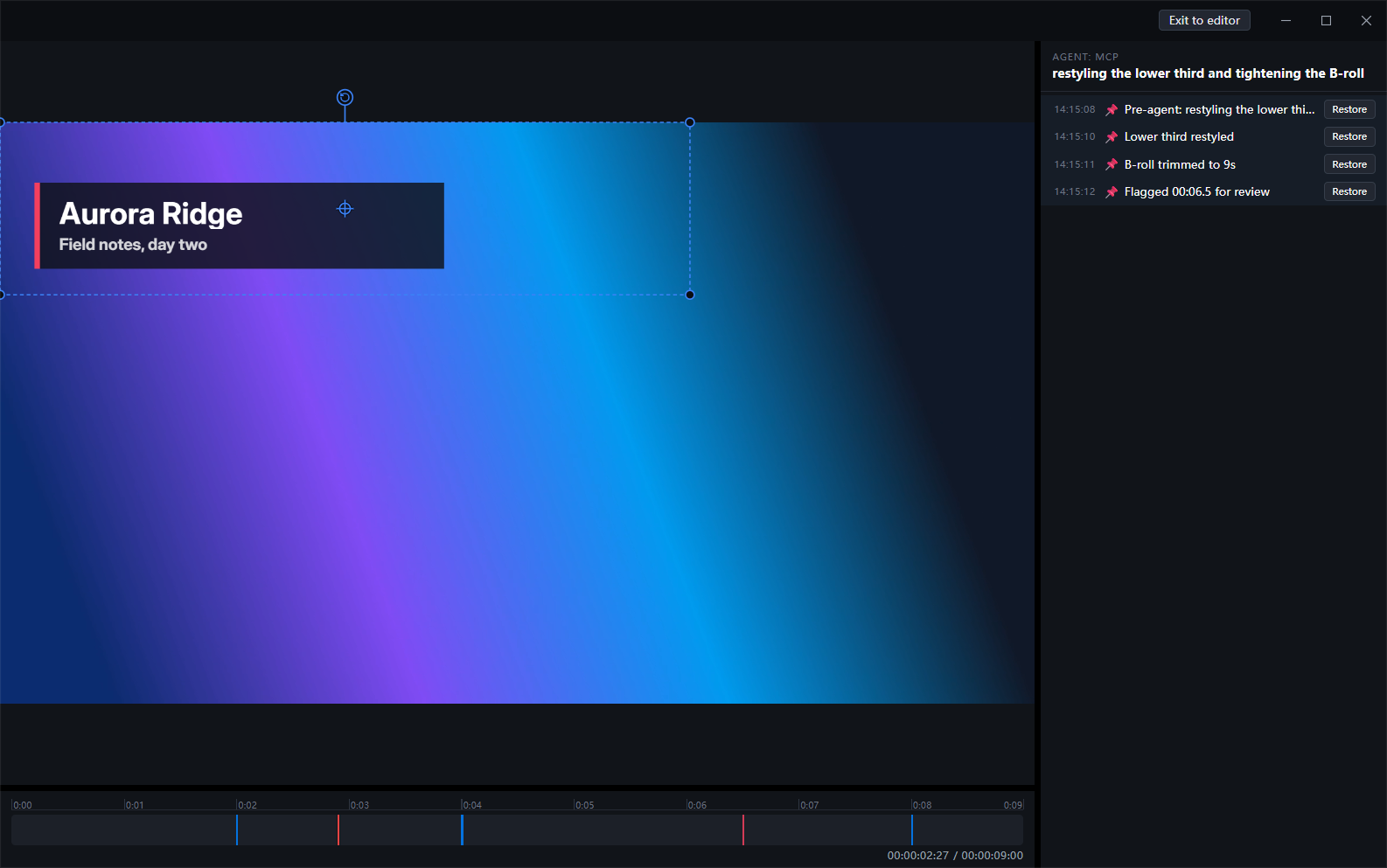
5. WeftCut 0.1.8
WeftCut is an open desktop video editor whose full timeline can be driven through a local MCP server. An agent can place, trim, split, caption, keyframe, mix, checkpoint, and rehearse multi-step edits while every action remains visible and reversible in the interface. Version 0.1.8 offers Windows, Linux, and Apple Silicon builds. The standout demo angle is Motifs: editable HTML, CSS, SVG, or WebGL overlays rendered deterministically as video layers.
OPERATIONAL VALUE
Let an agent assemble repetitive cuts, captions, lower thirds, and scratch audio inside a real editable project, while checkpoints and a dry-run clone protect the working timeline.
QUICK VIDEO
Import a short clip, ask an agent to trim dead air and add captions, generate a branded HTML lower third, scrub the result, then restore the pre-edit checkpoint.
Reality: WeftCut is MIT open source but still pre-1.0 and under active development. The macOS build is ad-hoc signed and not notarized; macOS builds do not self-update. Local speech engines are optional downloads, while cloud transcription or generation brings separate accounts, cost, and data terms. Test exports on disposable footage, preserve originals, review every automated cut, and confirm licenses for source media, fonts, music, model weights, and generated assets.
OPEN PRIMARY SOURCE →5 Proven Classics
tiktoken remains the dependable way to count and inspect OpenAI model tokens before requests ship. The MIT library is small, fast, and useful for budgeting prompts, chunks, and context windows.
Source →pgvector keeps embeddings beside ordinary relational data and supports exact or approximate nearest-neighbor search. Its PostgreSQL-style license is permissive; production quality still depends on indexing, recall tests, and database operations.
Source →bitsandbytes remains a practical route to lower-memory model loading and quantized training. The MIT code is established, but hardware, platform, kernel support, and model-specific accuracy should be verified first.
Source →Datasets still provides a strong, consistent layer for loading, streaming, transforming, and sharing machine-learning data. The library is Apache-2.0; every dataset’s license, consent, provenance, and usage limits remain separate.
Source →marimo’s reactive Python notebooks are stored as executable source files, making them easier to version, test, and reuse as applications. The Apache-2.0 project is especially useful for reproducible AI experiments.
Source →Reality Check
All five featured projects publish open-source code: the official MCP Skills extension, briefd, and WeftCut are Apache-2.0 or MIT as stated above; Agent Skills and Minutes are MIT. Open-source code does not make downloaded skills, workplace recordings, connected providers, remote repositories, models, or generated media automatically safe or freely reusable. The MCP extension is a transport standard, not a trust seal. briefd’s metrics are project-authored; WeftCut is pre-1.0; Minutes handles sensitive conversations. Start with sample data, pin versions, minimize permissions, inspect scripts and manifests, preserve originals, and keep a human approval point before publishing or executing consequential output.
Bottom Line
Try briefd first if repeated project context is bloating agent sessions: the demo is quick, the knowledge stays reviewable, and the value is measurable on your own repository. Then update Agent Skills if you use that collection on Codex or Windows; 0.6.10 removes avoidable routing overhead and fixes a real file-recovery hazard. Watch the official MCP Skills extension closely because it could become the clean distribution layer for internal capabilities. Minutes is the strongest private-memory experiment, while WeftCut earns the visual demo slot but should stay on disposable media until its pre-1.0 workflow proves stable.
Primary-source research completed September 23, 2026. Private Be Your Evolution field guide.