Be Your Evolution AI News Daily
Five fresh signals. Five durable tools. No hype tax.
Top 5: New and Worth Your Attention

1. Unreal Agent 0.2.0
Unreal Agent is a Go harness designed around asynchronous, recoverable agent work. Instead of treating a tool call as one blocking action, it records serializable operations, persists session history, deduplicates redelivered inputs, and keeps execution state separate from the model-facing transcript. Version 0.2.0 arrived two days after the repository opened, so the attraction is architectural clarity rather than production maturity: it offers a concrete vocabulary for agents that must survive retries, crashes, long-running tools, and session forks.
OPERATIONAL VALUE
Study or prototype a durable agent loop where tool work can continue asynchronously and an interrupted session can resume without replaying accepted inputs.
QUICK VIDEO
Start one session, dispatch a slow mock operation, interrupt the process, resume it, then fork the history to show two different next steps.
Reality: The code is MIT open source and currently presents itself as a harness library, executables, and benchmark runners—not a polished end-user agent. Its README documents component contracts and invariants more than a turnkey quickstart. You will need Go expertise, an LLM adapter, persistence choices, tool implementations, authentication, sandboxing, and your own production tests. Versioned operations and explicit recovery semantics are promising, but a brand-new 0.2.0 project should be evaluated in a disposable prototype before it handles credentials or consequential work.
OPEN PRIMARY SOURCE →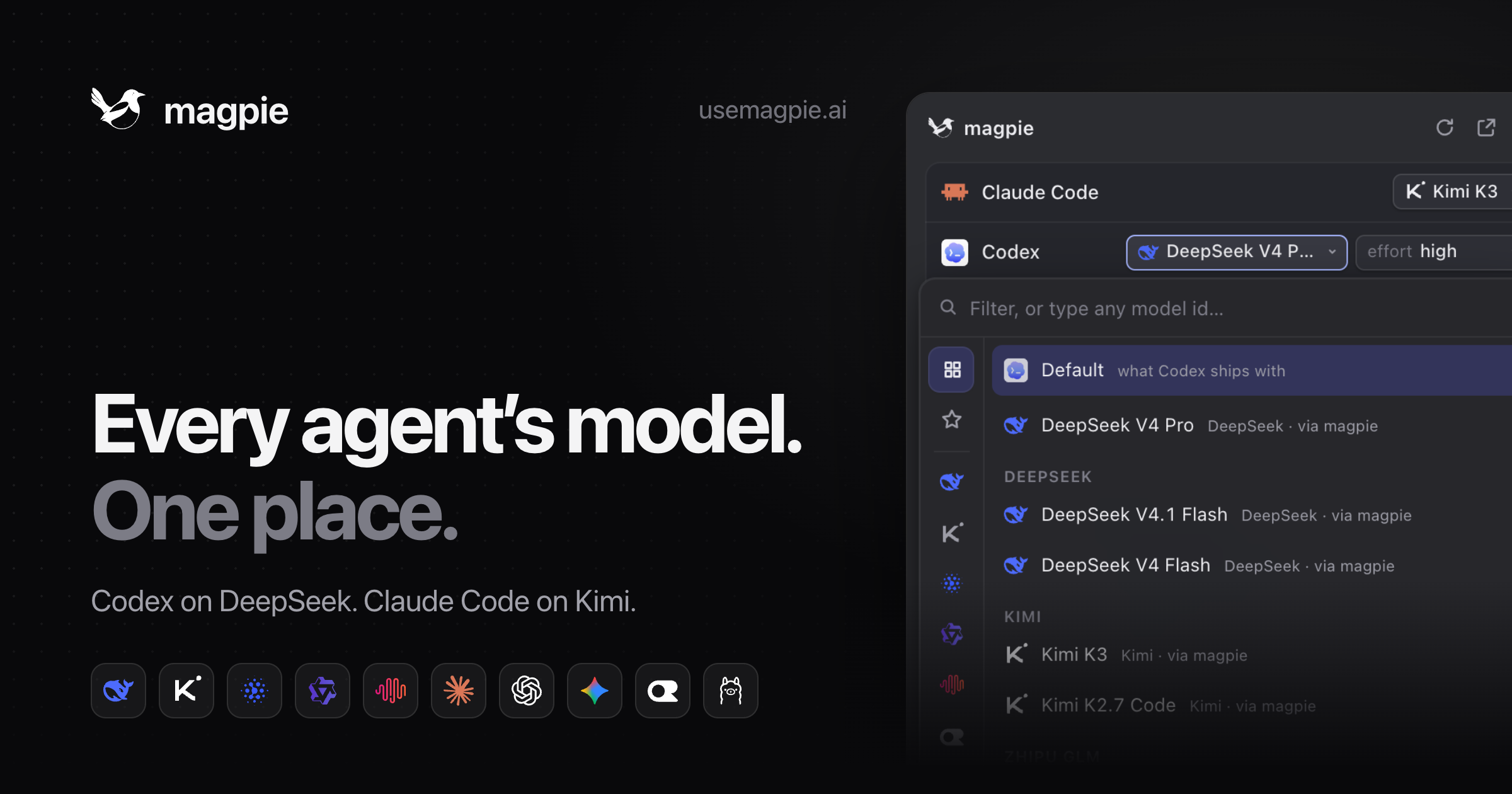
2. Magpie
Magpie puts the model settings for Codex, Claude Code, Gemini CLI, OpenCode, Goose, and other agents in one menu-bar app, terminal UI, or CLI. It edits only the selected configuration keys, stores profiles, and can expose providers through a local gateway that translates OpenAI and Anthropic-style APIs. The clever part is operational visibility: you can see which model each installed agent will use before a costly run, then switch a whole working set without hand-editing scattered configuration files.
OPERATIONAL VALUE
Standardize model and reasoning settings across several coding agents, snapshot known-good profiles, and quickly compare a local model with a paid provider.
QUICK VIDEO
Open Magpie, switch Codex and one second agent to an Ollama model, save a “local” profile, then restore the original cloud profile in one move.
Reality: Magpie is MIT open source and ships desktop, TUI, and CLI paths for macOS, Linux, and Windows, but it modifies real agent configuration files and can import credentials or signed-in provider sessions. Back up those files, review imports, bind the gateway only to localhost, and verify each vendor’s subscription and API terms before routing one product through another login. Provider models, fees, quotas, privacy rules, and acceptable-use policies remain proprietary or separately licensed even though Magpie’s routing code is open.
OPEN PRIMARY SOURCE →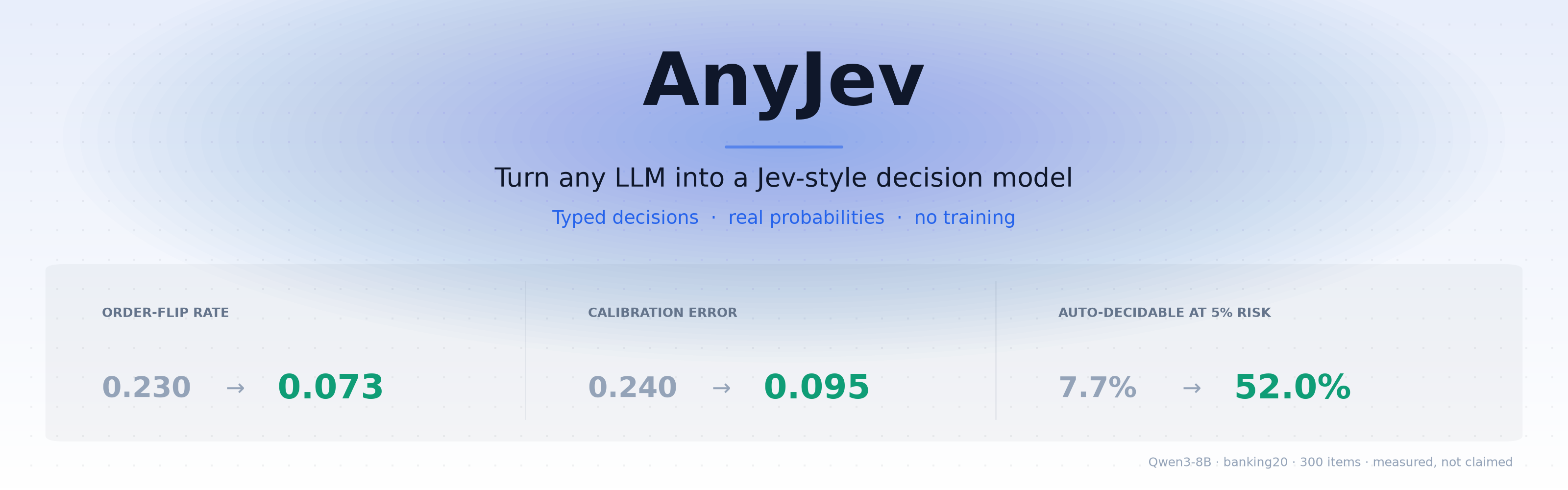
3. AnyJev 0.0.2
AnyJev converts a compatible language model into a typed decision endpoint that returns choices, scores, and probability-like outputs without generating ordinary text. Its zero-label mode corrects label and option-order bias; a higher level can fit a small closed-form head for one question using labeled examples. That makes it interesting for narrow routing, triage, and policy decisions where an agent needs a structured answer and an abstention threshold—not another paragraph that downstream code must parse.
OPERATIONAL VALUE
Prototype a low-latency classifier for routing support tickets, choosing workflow branches, or deciding when confidence is too low and a human should review.
QUICK VIDEO
Run the synthetic demo, reverse the option order, compare raw logits with AnyJev’s corrected decision, then raise a confidence threshold to trigger abstention.
Reality: AnyJev is Apache-2.0 open source, but release 0.0.2 is experimental and its own documentation is unusually candid: shipped fitted heads target selected Qwen3 models, L2 heads are specific to a question and model, decisions currently support at most 26 options, and reported accuracy is teacher-model agreement rather than ground truth. Real use needs Python, model weights, hidden-state access through Transformers or vLLM, compute, task-specific evaluation, and separately reviewed model licenses. Never treat its probabilities as safety guarantees.
OPEN PRIMARY SOURCE →
4. Short Video Generator AI
Short Video Generator AI turns a local file or YouTube URL into vertical clips through a visible pipeline: download or ingest, transcribe locally with faster-whisper, ask a selected LLM to identify highlights, crop and caption the result, and render final shorts. It includes a command line and a local queue interface. The useful angle is not magical one-click virality; it is a hackable starting point for converting a long tutorial into draft clips whose timestamps, subtitles, and edits you can inspect.
OPERATIONAL VALUE
Batch a webinar, screen recording, or product walkthrough into candidate vertical clips, then spend editing time on the strongest drafts instead of manually scanning the full timeline.
QUICK VIDEO
Feed it a two-minute B.Y.E. tool demo, watch local transcription and highlight selection, then compare the automatic crop and captions with the original.
Reality: The pipeline code is MIT open source and requires Python 3.10+, project dependencies, media tooling, and an API key for OpenAI, Gemini, or MuAPI; transcription can remain local, but highlight selection sends transcript content to the chosen provider. Downloading or republishing online video requires permission, and music, faces, trademarks, captions, and generated edits keep their own rights and platform rules. Review every cut for accuracy, context, safe framing, and subtitle timing before publication.
OPEN PRIMARY SOURCE →5. ComfyUI Qwen Image 2.1 Prompt Enhancer
This custom node exposes Qwen Image 2.1’s separate prompt-rewriter checkpoints inside ComfyUI for text-to-image and image-edit instructions. It loads the model through ComfyUI’s native CLIP mechanism, returns both an expanded positive prompt and the model’s reasoning trace, and keeps the workflow local once the weights are downloaded. It is a tidy way to compare a rough creative brief with a model-expanded version, especially when you want the rewritten prompt visible and reusable rather than hidden behind a hosted interface.
OPERATIONAL VALUE
Turn short art-direction notes into inspectable, repeatable prompts before generation, or normalize image-edit instructions across a batch while retaining the expanded text for review.
QUICK VIDEO
Run “a calm futuristic newsroom” through the enhancer, reveal the reasoning and expanded prompt, then generate side-by-side results with and without rewriting.
Reality: The custom-node code is MIT open source, while the two Qwen prompt-enhancer checkpoints are separate model weights whose model cards and terms must be reviewed independently. Each listed INT8 checkpoint is about 9.47 GB; the README estimates roughly 20 GB VRAM in bfloat16 and calls a 24 GB GPU comfortable. Installation requires downloading weights into ComfyUI and cloning third-party code into custom_nodes. Audit the node, pin a commit, scan model files, and prefer a disposable ComfyUI profile before adding it to a trusted workstation.
OPEN PRIMARY SOURCE →5 Proven Classics
Open WebUI remains a strong self-hosted front end for local and compatible cloud models. Its current code uses a modified BSD-style license; extensions, models, providers, and enterprise features have separate terms.
Source →n8n remains excellent for visual automation, approvals, and connecting agent workflows to business systems. It is fair-code under Sustainable Use and enterprise licenses—not OSI open source—so review commercial restrictions.
Source →Pydantic AI remains a practical typed Python framework for agents, structured outputs, tools, and evaluation. The core is MIT; model providers, gateway services, observability backends, and generated content remain separate.
Source →Browser Use remains a capable MIT-licensed browser-agent library with local and hosted paths. Real sites are brittle and consequential, so isolate sessions, minimize permissions, protect credentials, and require confirmation for writes.
Source →Gradio remains the fastest Apache-2.0 route from a Python function or model to a usable web demo. Public sharing links, uploaded data, dependencies, and underlying model licenses still need care.
Source →Reality Check
Open source describes code, not the whole operating stack. Unreal Agent still needs hardened adapters, storage, and tools; Magpie touches live agent configuration and provider sessions; AnyJev’s outputs are experimental decision signals, not certified probabilities; Short Video Generator sends selected transcript content to a proprietary provider; and the ComfyUI enhancer adds large, separately licensed model weights plus third-party code. Use disposable projects, pin revisions, back up configurations, keep gateways local, scope credentials, respect source-media rights, and evaluate outputs on your own tasks before trusting or publishing them.
Bottom Line
Try Short Video Generator AI first on a video you own: the pipeline is understandable, the before-and-after is visual, and it could shorten a real repurposing workflow. Then study Unreal Agent 0.2.0 if durable agent operations matter to you; its separation of persisted intent from asynchronous execution is the most consequential engineering idea in today’s set. Magpie is convenient but deserves credential caution, AnyJev needs rigorous task-specific evaluation, and the ComfyUI enhancer’s 20 GB-class memory appetite makes it a skip until your hardware and Qwen Image workflow justify the download.
Primary-source research completed September 25, 2026. Private Be Your Evolution field guide.