Be Your Evolution AI News Daily
Five fresh signals. Five durable tools. No hype tax.
Top 5: New and Worth Your Attention
1. Flow-Next 6.0.2
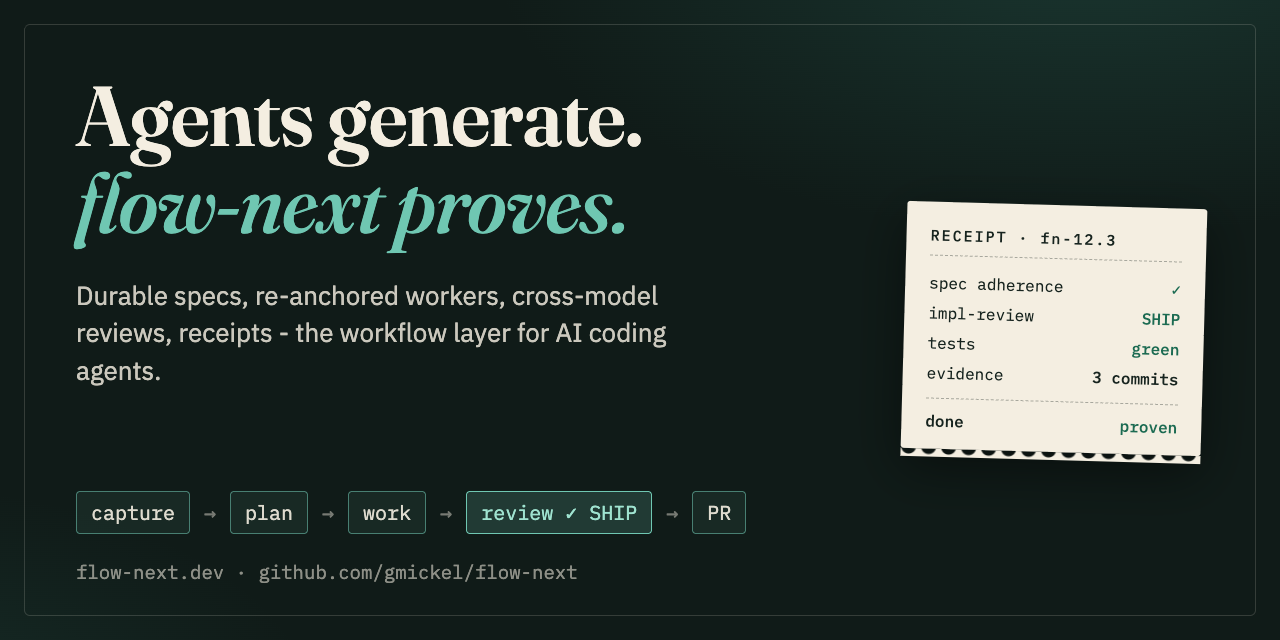
Flow-Next gives coding agents a repeatable path from an idea, bug, or performance complaint to a reviewed pull request with evidence. It captures numbered acceptance criteria, sends implementation and review to different model families, records stage receipts under the repository, and can explain a proposed route without writing anything. Version 6.0.2 fixes tracker-first specifications so durable issue identity is stored when the spec is created, reducing the risk of duplicate tracker tickets later.
OPERATIONAL VALUE
Use one small repository task to test whether durable specs, fresh-context workers, and evidence-mapped pull requests make agent work easier to audit and hand off.
QUICK VIDEO
Paste a failing test, preview the route with explain mode, then show the generated spec and the pull-request evidence that maps the fix back to acceptance criteria.
Reality: Flow-Next is MIT open source and supports Codex, Claude Code, Cursor, OpenCode, Factory Droid, and Grok Build, but setup writes workflow material into the repository and the full path expects Python 3.11+, project tooling, GitHub CLI, jq, agent access, and a configured review backend. Its receipts document what ran; they do not prove architectural quality or eliminate human review. Start on a disposable branch, inspect every installed skill and script, keep merge authorization narrow, and do not enable unattended merge behavior until branch protection and rollback are proven.
OPEN PRIMARY SOURCE →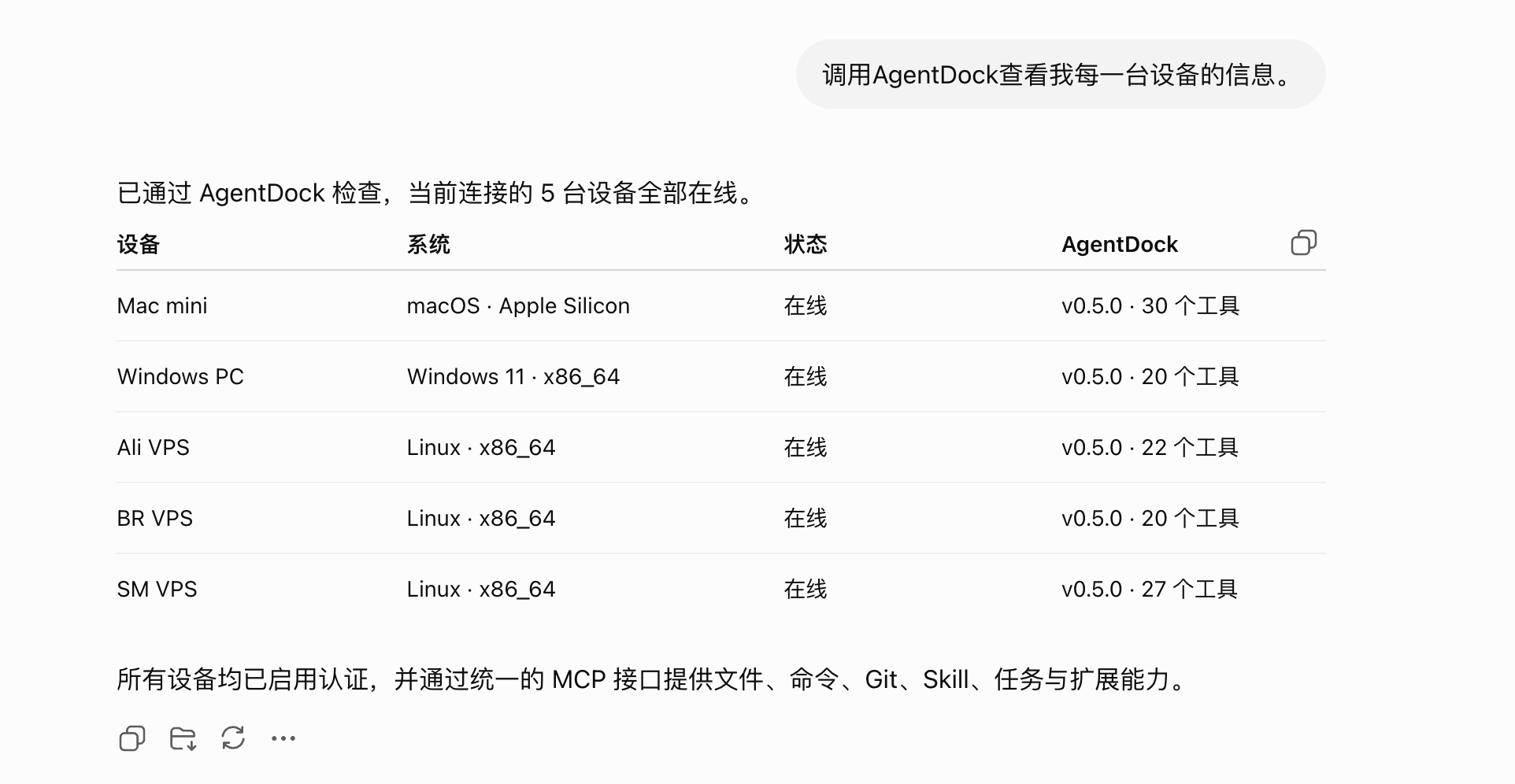
2. AgentDock 0.9.0
AgentDock is an MCP runtime that lets one AI client operate files, shells, Git, browsers, skills, and long-running tasks across local computers, servers, or containers. It supplies the tools and permission boundary rather than a chat model. Release 0.9.0 adds a formal plugin core, adapters for OpenAI/Codex and Claude plugin formats, pinned revisions and digests for remote sources, staged activation, crash recovery, workspace context inheritance, and redesigned cross-platform update transactions.
OPERATIONAL VALUE
Centralize controlled access to a workstation and VPS, keep task state recoverable, and expose the same audited tool surface to multiple compatible AI clients.
QUICK VIDEO
Connect a local-only AgentDock instance, let an agent inspect a harmless test folder, then show a denied out-of-scope path and the structured execution result.
Reality: AgentDock is Apache-2.0 open source with installers for Windows, macOS, Linux, and Docker, but it creates a powerful remote-control surface. Local-only use is the safest first test. Public or multi-device access requires strict authentication, scoped filesystem and command permissions, protected bearer tokens or OAuth, firewall review, dedicated browser profiles, and careful tunnel configuration. Version 0.9.0 is still pre-1.0; plugin adapters and update migrations deserve sandbox testing. The connected model, Cloudflare service, operating system, browsers, plugins, and imported skills keep separate terms and risks.
OPEN PRIMARY SOURCE →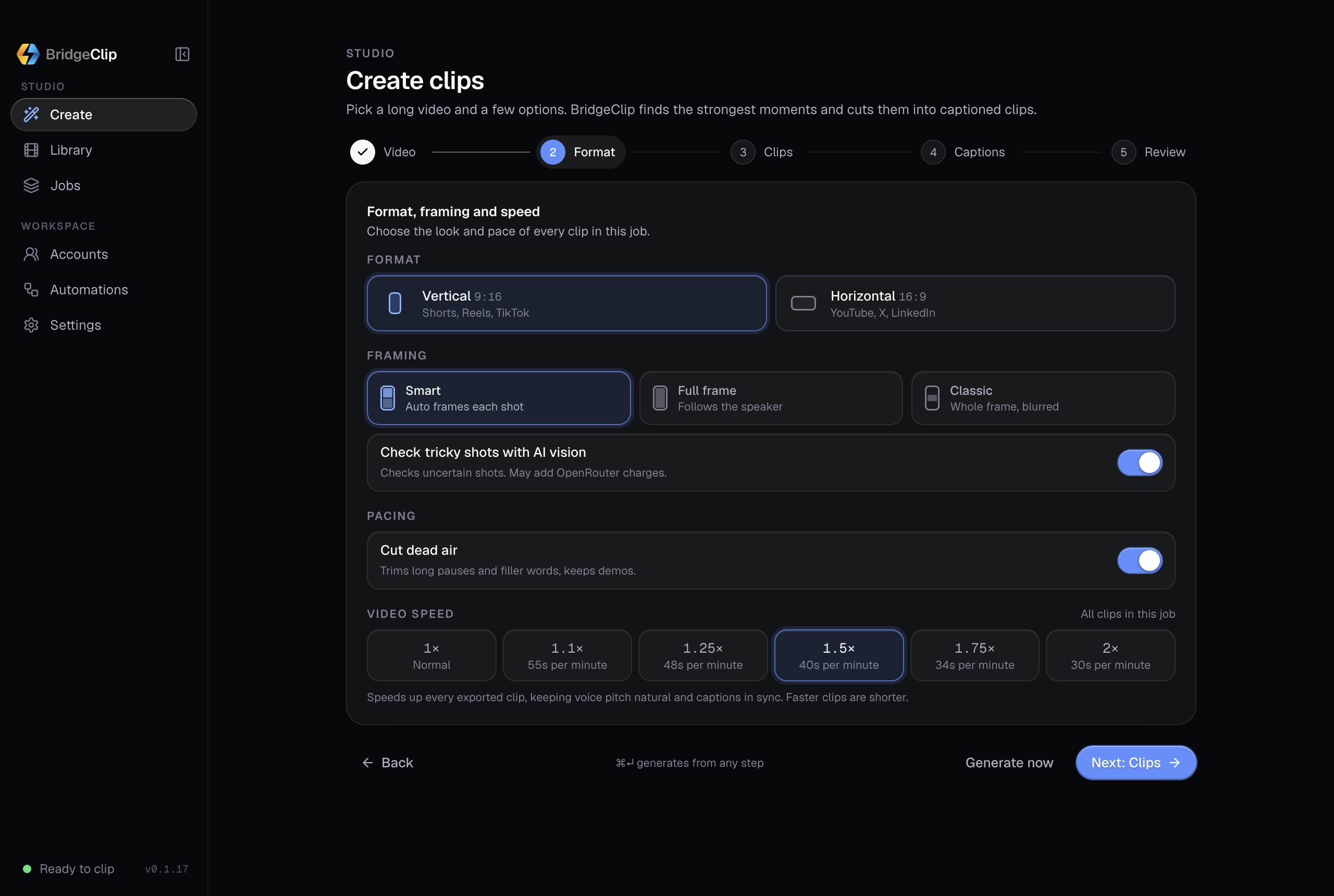
3. BridgeClip 0.1.18
BridgeClip is a new desktop app for turning podcasts, streams, local videos, YouTube links, or Twitch VODs into captioned short clips. It downloads or reads the source, sends audio to a selected OpenRouter transcription model, asks another model to rank moments, then renders crops, synchronized captions, dead-air cuts, and speed changes locally with FFmpeg. Release 0.1.18 adds a signed Windows x64 installer, joining signed and notarized macOS builds.
OPERATIONAL VALUE
Convert a long tutorial or podcast you own into reviewable vertical drafts while keeping final media rendering and project outputs on your computer.
QUICK VIDEO
Drop in a two-minute product walkthrough, preview three caption styles, compare normal speed with 1.25×, and reveal the transcript, plan, and finished 9:16 clip.
Reality: BridgeClip is MIT open source and bundles Python, FFmpeg, and yt-dlp in its signed desktop installers, but it is not fully local AI. Audio, transcript text, and sometimes sampled frames go to models through your OpenRouter account; optional posting uses Zernio and social platforms. Provider charges, retention, model licenses, and platform rules remain separate. Use only media you may download and republish, review captions and selected context, keep API keys in secure storage, and test the very new 0.1.x release on non-sensitive footage.
OPEN PRIMARY SOURCE →4. Motion Video Skill
Motion Video is a freshly published agent skill for producing beat-synced 1080p motion graphics through a fixed, inspectable pipeline. It turns a brief into scripts, voice cues, music and sound-effect plans, timed HTML composition data, HyperFrames renders, captions, and a smaller social encode. The package includes glass-keynote and comic styles, reusable templates, beat-grid and mix-balance utilities, and synthetic-audio regression tests instead of hiding the process inside a proprietary editor.
OPERATIONAL VALUE
Create a repeatable launch-video workflow whose timing files, composition code, audio checks, captions, and render commands remain visible and editable after the agent finishes.
QUICK VIDEO
Give the skill a 45-second release brief, inspect its beat grid and timeline, then compare the glass-keynote and comic treatments before showing the final social encode.
Reality: The skill code is MIT open source, but the production stack is not zero-cost or one-click. It requires Node.js 20+, Python 3.10 with NumPy and SciPy, FFmpeg/ffprobe, HyperFrames 0.7.99, and the authenticated multix CLI with Gemini and ElevenLabs keys. Voice, music, sound effects, fonts, provider accounts, and generated-media rights remain separately governed. Review the skill before installation, pin its dependencies, budget API usage, confirm music and voice permissions, and inspect every scripted claim and accessibility caption before publishing.
OPEN PRIMARY SOURCE →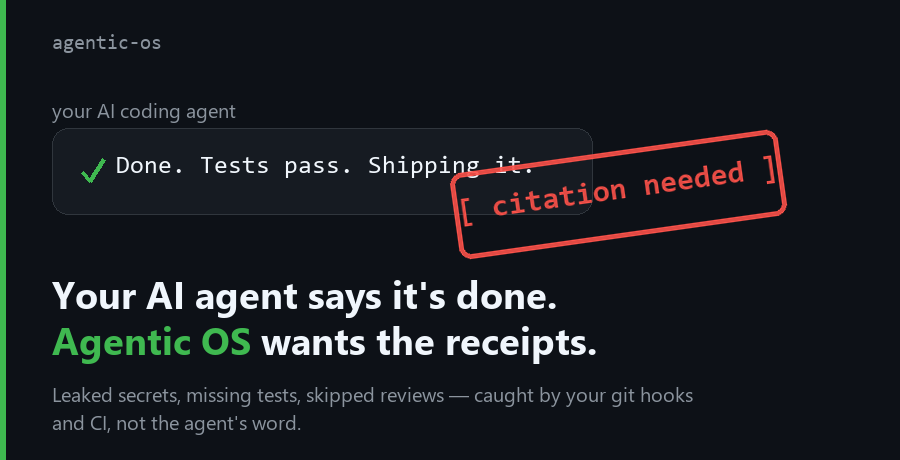
5. Agentic OS 1.8.27
Agentic OS adds machine-enforced backstops beneath instructions for coding agents. It classifies work by risk, records phase evidence, scans for credentials, runs repository tests, and validates that required review or testing was not silently skipped before shipping. Version 1.8.27 fixes generated Python bytecode being staged on first deployment and clarifies when two bundled skills should activate. The appeal is simple: an agent’s claim of “done” does not get the final vote.
OPERATIONAL VALUE
Add a visible evidence trail and pre-commit or CI gates to an agent-heavy repository without tying the workflow to one model vendor or coding client.
QUICK VIDEO
Run the safe credential demo, watch a generated fake key get redacted and blocked, then add evidence to a tiny task and show the validation gate pass.
Reality: Agentic OS is MIT open source and supports Markdown-reading agents including Codex, Claude Code, Cursor, Copilot, and Antigravity. Its installer offers a dry run and preserves conflicting files as sidecars, but it still adds repository instructions, state, hooks, validators, and CI conventions. Local hooks can be bypassed; only correctly configured required CI checks create a dependable merge floor. Review the deployment diff, confirm Windows or shell prerequisites, tune task classifications, protect branches, and treat credential scanning as one layer—not a replacement for secret rotation, least privilege, or independent security review.
OPEN PRIMARY SOURCE →5 Proven Classics
CrewAI remains a mature MIT framework for role-based agent teams and event-driven flows. Use it when explicit delegation helps; provider costs, tools, memory stores, and deployment services remain separate.
Source →LlamaIndex remains a capable MIT toolkit for ingesting documents, building retrieval pipelines, and connecting structured data to agents. Evaluate chunking and retrieval on your own corpus before trusting answers.
Source →LangChain remains the broad MIT integration layer for models, tools, retrieval, and agents. Its pace and abstraction surface reward disciplined version pinning, focused components, tracing, and regression tests.
Source →Langflow remains a useful MIT visual builder for prototyping agent and retrieval workflows, inspecting data flow, and exposing APIs. Production deployments still need authentication, secrets management, and observability.
Source →AnythingLLM remains an approachable MIT local-first workspace for chatting with documents, models, and agent tools. The application is open source; connected models, vector stores, extensions, and hosted services differ.
Source →Reality Check
Open source describes today’s code, not the complete operating stack. Flow-Next and Agentic OS modify repository workflow and cannot replace human engineering judgment. AgentDock exposes consequential machine access and should begin local-only with narrow permissions. BridgeClip sends audio, transcripts, and sometimes frames to selected cloud models. Motion Video depends on paid generation providers and separately governed media. Pin revisions, inspect installers and skills, isolate early tests, protect credentials, preserve branch controls, budget provider usage, and verify every output before merging or publishing it.
Bottom Line
Try BridgeClip first with a short video you own: its source is visible, the signed Windows build is current, and the before-and-after result is immediately useful—provided you accept OpenRouter processing. Then run Agentic OS’s safe credential demo or deploy it to a disposable repository with the dry run; it tests a more important idea than another agent wrapper: whether your workflow can reject an unsupported “done.” Keep AgentDock on the watchlist until you have a concrete multi-machine need and a defensible permission model.
Primary-source research completed September 26, 2026. Private Be Your Evolution field guide.