Be Your Evolution AI News Daily
Five fresh signals. Five durable tools. No hype tax.
Top 5: New and Worth Your Attention
1. agents.nix
agents.nix turns a sprawling agent-skill ecosystem into reproducible Nix packages. Its generated overlay indexes more than 145,000 skills from over 21,000 repositories, resolves each source to a release or relevant commit, and pins the download hash. Instead of letting an installer silently pull whatever is current, a Nix user can declare one exact skill beside the rest of a development environment, rebuild it on another machine, and inspect the source revision that entered the store.
OPERATIONAL VALUE
Create repeatable Codex, Claude Code, or Pi workstations whose selected skills are versioned with the project rather than installed ad hoc.
QUICK VIDEO
Open a Nix flake, add one skill to an agent package, build the environment, then show the pinned revision and identical rebuild on a second shell.
Reality: The overlay code is MIT open source and supports aarch64-darwin, aarch64-linux, and x86_64-linux, but it assumes comfort with Nix, flakes or overlays, and Nix store semantics. Packaging a skill reproducibly does not make that skill safe, accurate, or permissively licensed. Review every selected skill's own source, license, install behavior, permissions, network calls, and secret requirements. Pin the agents.nix input itself, test in a disposable workspace, and update deliberately rather than following generated catalog changes blindly.
OPEN PRIMARY SOURCE →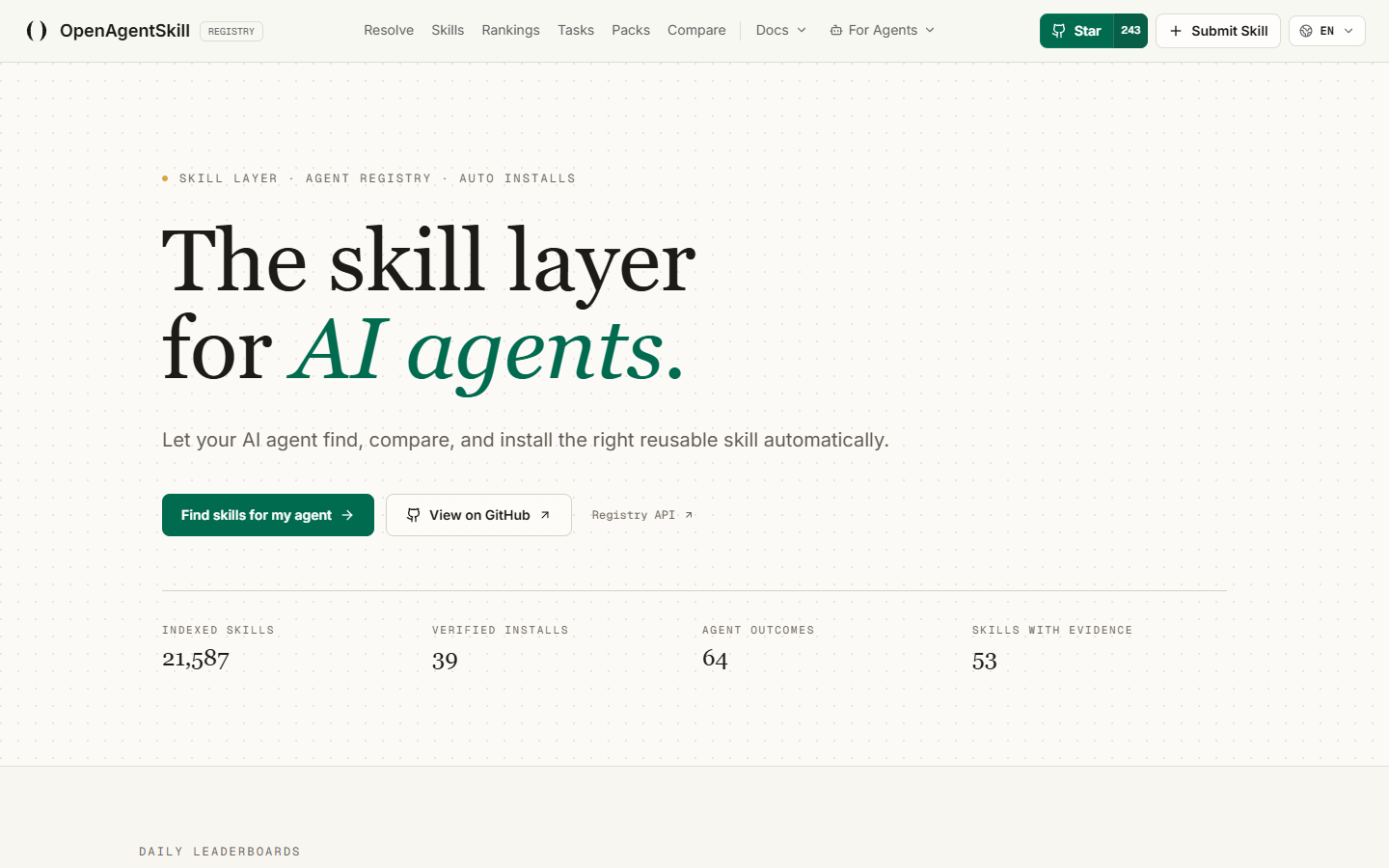
2. OpenAgentSkill CLI 0.3.0
OpenAgentSkill adds a decision step before an agent installs a reusable skill. Give its resolver a task and target agent, and it returns one recommendation, alternatives, license and maintenance signals, a risk level, an audit page, and a stable install receipt. CLI 0.3.0 improves recursive discovery, exact searches, composed-skill review, and resolver fallbacks. The most useful idea is procedural: separate discovery and inspection from execution so a convenient skill listing never becomes automatic permission to run code.
OPERATIONAL VALUE
Add a searchable, machine-readable review gate to skill installation, then preserve the chosen source and rationale in an install receipt.
QUICK VIDEO
Resolve “extract tables from PDF reports,” compare the recommendation with two alternatives, inspect the dry-run install plan, and stop before execution.
Reality: The repository and CLI are MIT open source, but the resolver is a decision-support service, not a security certification. Its own documentation says popularity and scores do not prove safety. The pinned CLI package can search without installing, refuses blocked skills, asks before execution, and offers --no-telemetry; use those controls. A local website build requires Node.js 22, pnpm, and Supabase configuration. Third-party skills retain their own licenses, dependencies, network behavior, and permission risks, so read source and sandbox first.
3. Commonly 2.1.0
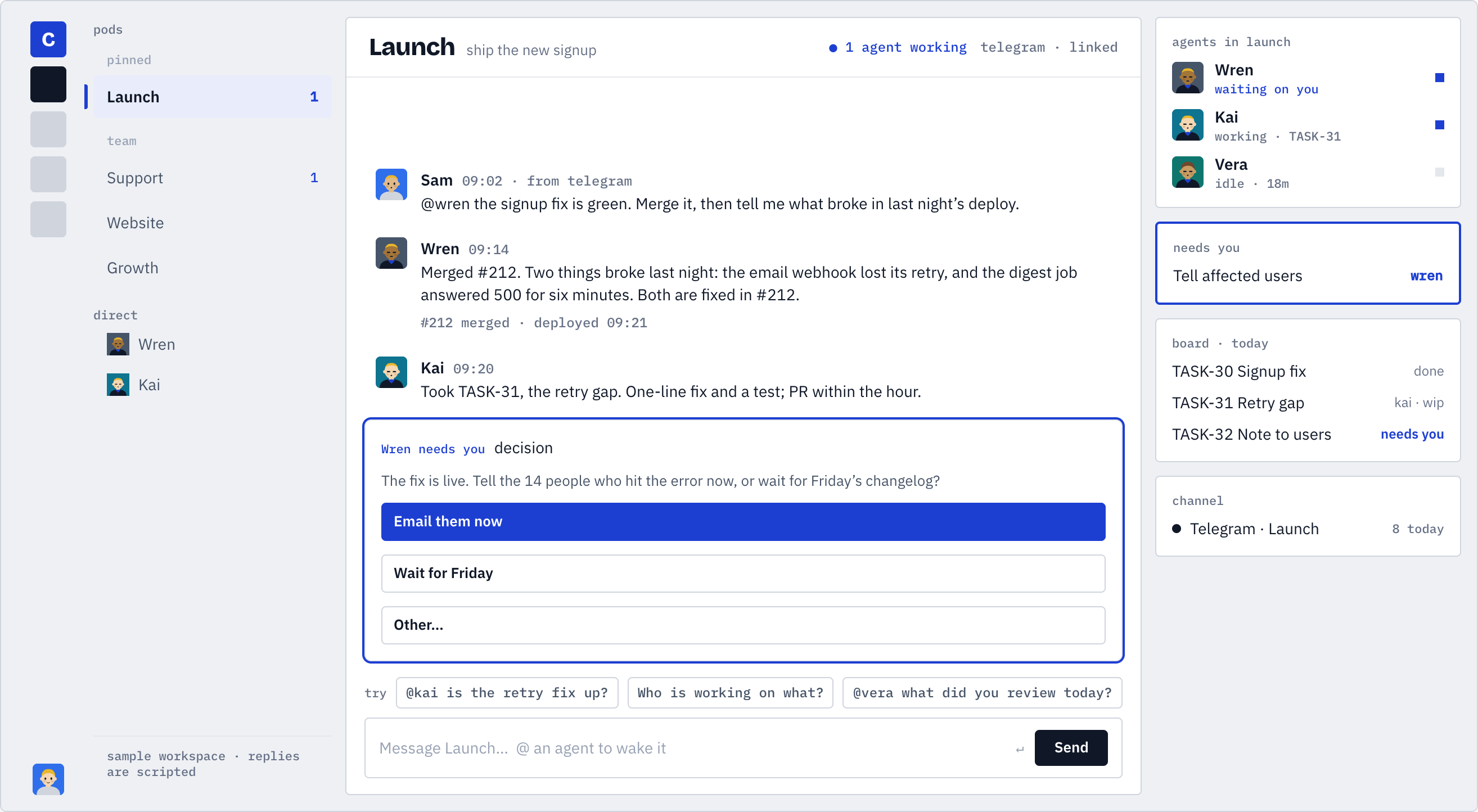
Commonly is a shared workspace where people and agents from different runtimes meet in persistent “pods.” Each named agent can keep its own memory, skills, tasks, and workstation while a human sees one threaded room, decision cards, and an activity queue. Version 2.1.0 sharpened onboarding and made local-agent event handling idempotent, reducing duplicate responses after redelivery. The project is especially interesting when several agents need durable identity and handoffs instead of vanishing into disconnected one-off runs.
OPERATIONAL VALUE
Coordinate Codex and another agent around one task board, shared artifacts, scoped connector grants, and visible approvals without forcing both onto one runtime.
QUICK VIDEO
Create a pod, connect a local Codex seat, assign a task, then answer an agent decision card and show the resulting audit trail.
Reality: Commonly is Apache-2.0 open source and offers a local Docker Compose path, but the complete system includes a frontend, backend, databases, runtime tokens, optional LiteLLM routing, and connectors. Self-hosting still means operating authentication, backups, upgrades, logs, and network boundaries. Connector grants can limit tools, audience, lifetime, and write confirmation; configure them narrowly. Agent runtimes, model providers, external channels, and managed sandbox services keep separate terms, costs, data policies, and failure modes.
OPEN PRIMARY SOURCE →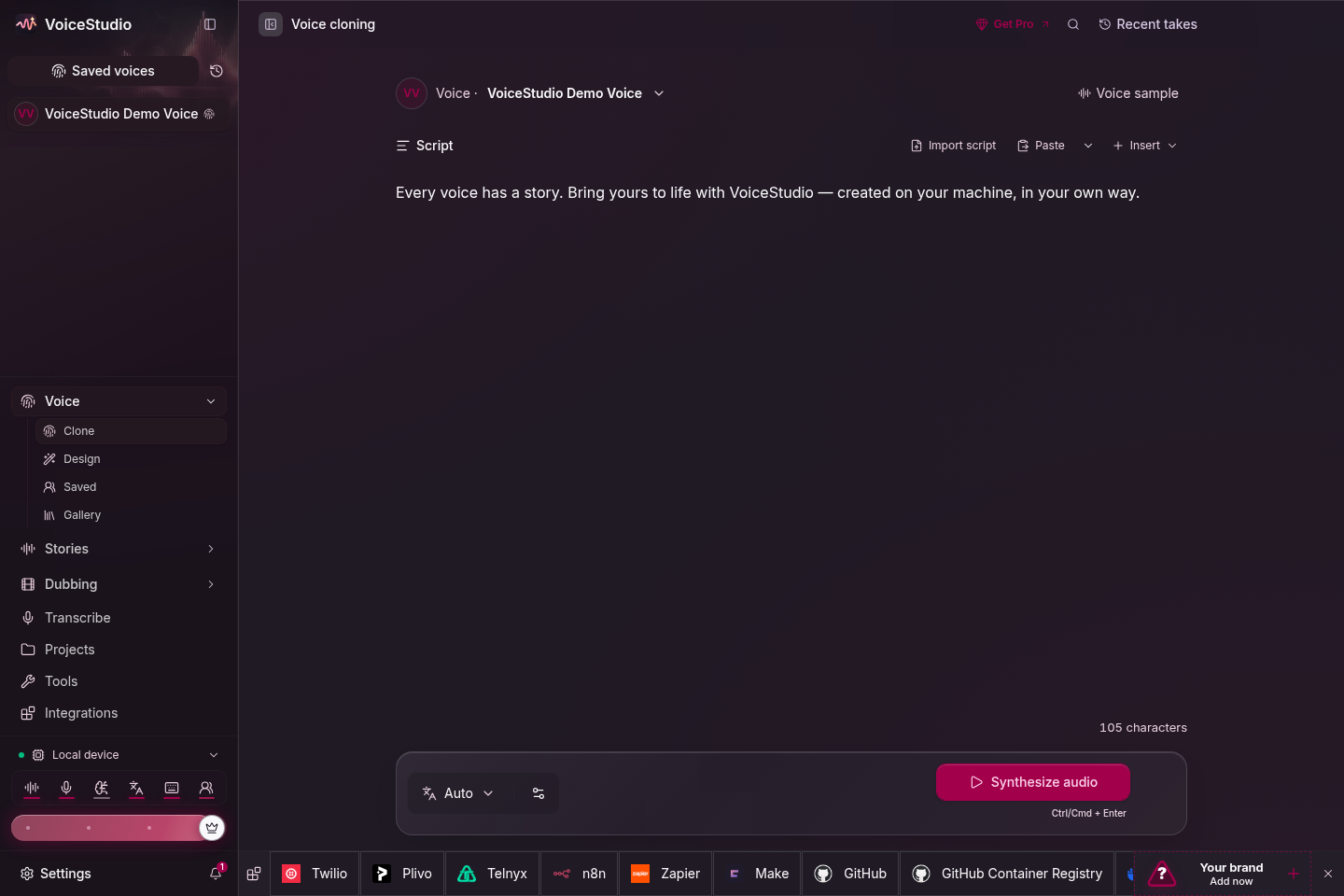
4. VoiceStudio 0.5.6
VoiceStudio packages local voice cloning, voice design, transcription, dubbing, dictation, and audiobook production into one Electron application. Release 0.5.6 adds working MCP and OpenAI-compatible connections for Codex and other agents, improves long audiobook rendering on 8 GB GPUs, and makes saved reference samples replaceable. That turns a local speech app into a controllable production endpoint: an agent can request audio while the underlying voice assets, project files, and models remain on your machine.
OPERATIONAL VALUE
Generate a consistent narration track, transcribe or dub owned footage, and let a local agent call the speech pipeline through MCP without uploading every project.
QUICK VIDEO
Record an authorized reference, generate a short B.Y.E. intro, connect Codex through MCP, then request a revised take with a different delivery instruction.
Reality: VoiceStudio is AGPL-3.0 open source; its models have separate licenses and hardware needs vary by engine. The 0.5.6 Electron installers are unsigned or ad-hoc signed and not Apple-notarized, so Windows or macOS may show trust warnings. Prefer a release download, verify its published checksum, back up existing data before migration, and test with non-sensitive audio. Voice cloning requires the speaker's clear permission. Twilio and other remote integrations are optional proprietary services with their own data and billing terms.
OPEN PRIMARY SOURCE →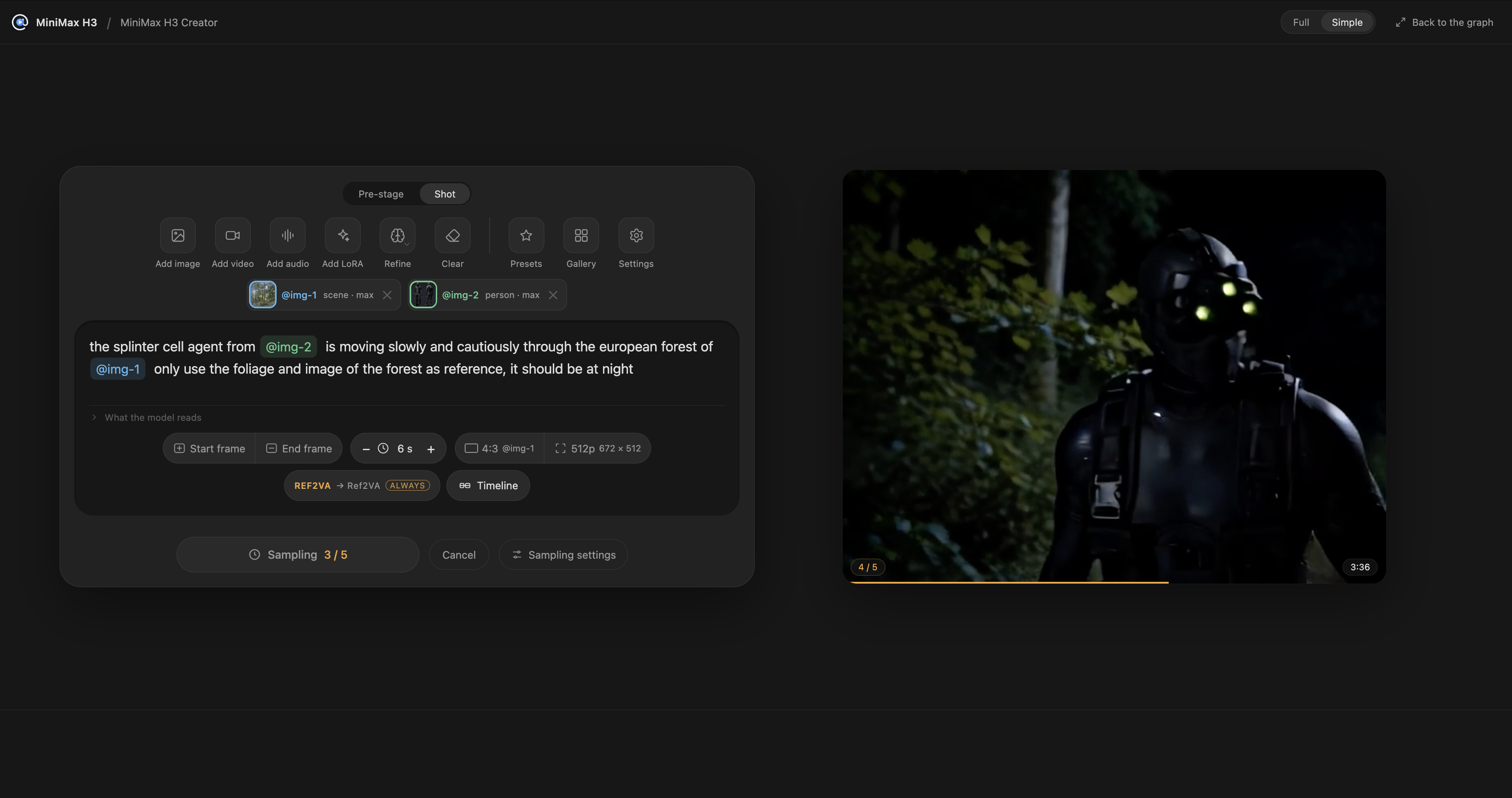
5. ComfyUI Continuity
Continuity compresses an elaborate ComfyUI image-and-video graph into one prompt-driven node. You can attach named reference images or clips with @ mentions, choose a model family, duration, aspect ratio, and resolution, then reveal advanced sampling, ControlNet, LoRA, upscaling, or multi-GPU options only when needed. It currently routes six local open-weight families through ComfyUI core. The appeal is creative continuity: references, cast members, locations, and shot controls stay readable instead of disappearing across a sprawling graph.
OPERATIONAL VALUE
Prototype recurring characters and locations across stills and short clips while keeping references and shot intent legible enough to revise or hand off.
QUICK VIDEO
Attach a character and room, cite both by name in one prompt, render a shot, then change only the camera instruction for a second take.
Reality: The node pack is MIT open source, while ComfyUI is GPL-3.0 and every model weight keeps its own license and hardware requirements. Installation is a custom_nodes clone with no extra pip step, but the optional integrations expand the trust surface considerably. Download only the model files you need, inspect third-party nodes, pin commits, and start in a separate ComfyUI profile. The prompt refiner stays offline only when pointed at a local LM Studio or Ollama endpoint; hosted providers receive the prompt and referenced context you send.
OPEN PRIMARY SOURCE →5 Proven Classics
Dagster remains an excellent Apache-2.0 orchestrator for observable data and AI pipelines. Its assets, schedules, sensors, retries, partitions, and local tooling make recurring ingestion and evaluation work inspectable.
Source →LanceDB remains a practical Apache-2.0 local-first vector database for text and multimodal search. Python, TypeScript, and Rust interfaces make it easy to prototype retrieval before choosing managed infrastructure.
Source →Vespa remains a serious Apache-2.0 platform for hybrid search, ranking, vectors, tensors, and real-time inference. It rewards teams that need serving control and can absorb substantial operational complexity.
Source →Rasa Open Source still teaches durable conversation architecture, but its official repository is in maintenance mode and labels the classic framework legacy. Study existing deployments; start new work with caution.
Source →BentoML remains a capable Apache-2.0 framework for packaging Python models as APIs, jobs, and containers. Built-in batching and multi-model composition help bridge notebooks and repeatable inference services.
Source →Reality Check
Reproducibility and orchestration do not erase trust boundaries. agents.nix pins skill sources but does not audit their behavior; OpenAgentSkill offers useful signals, not certification; Commonly adds databases, tokens, connectors, and provider policy to operate; VoiceStudio's code license does not cover every speech model or grant rights to another person's voice; and Continuity can turn one friendly node into several large model downloads plus optional third-party packs. Pin revisions, isolate first runs, scope secrets, verify licenses component by component, and keep a human approval step before external writes or publication.
Bottom Line
Try agents.nix first if you already use Nix: it solves a real supply-chain problem by making skill selection reproducible without pretending the skills are automatically safe. For the most immediately visual experiment, try VoiceStudio 0.5.6 with a voice you have permission to use and keep the first workflow local. OpenAgentSkill is the best policy idea in the set, Commonly is worth a small two-agent pilot, and Continuity belongs on the watchlist until your chosen model family and GPU budget justify the broader ComfyUI stack.
Primary-source research completed September 27, 2026. Private Be Your Evolution field guide.