Be Your Evolution AI News Daily
Five fresh signals. Five durable tools. No hype tax.
Top 5: New and Worth Your Attention
1. Open Slide 2.0.1
Open Slide gives coding agents a React-based presentation canvas instead of asking them to manipulate a closed slide editor. Its scaffold includes authoring skills, a 1920×1080 layout system, presenter mode, an asset manager, and click-to-comment feedback that agents can apply in source. Exports cover static HTML, PDF, and editable PowerPoint. Version 2.0.1 is a small reliability patch, but the broader workflow is immediately useful: draft, inspect visually, annotate exact elements, revise, and export without abandoning ordinary version-controlled code.
OPERATIONAL VALUE
Turn a brief into a reviewable deck repository, keep edits in version control, and export client-ready formats without hand-building every slide in PowerPoint.
QUICK VIDEO
Ask Codex for a five-slide B.Y.E. briefing, click one weak headline in the browser, attach a comment, apply it, then export the revised deck to PPTX.
Reality: Open Slide is MIT open source and its exported static site has no required server, but authoring assumes Node.js, pnpm, React, and comfort reviewing generated code. The included skills are instructions, not a guarantee of visual quality or factual accuracy. Inspect dependencies and generated assets, verify image and font rights, test PDF/PPTX output before presenting, and pin package versions for repeatable builds. Version 2.0.1 mainly improves the error shown for conflicting Vite installations.
OPEN PRIMARY SOURCE →
2. Hippo Memory 1.52.6
Hippo is a local SQLite memory layer shared across Codex, Claude Code, Cursor, OpenCode, Pi, and MCP clients. It tracks provenance, lets newer facts supersede old ones, strengthens useful memories, and weakens lessons marked wrong instead of treating every saved note as permanent truth. It can learn from commits, import existing rules, and consolidate project memory on a schedule. Release 1.52.6 fixes Windows support-bundle redaction for Git Bash, Cygwin, WSL, mount, and network-style home paths—a meaningful privacy repair for diagnostics.
OPERATIONAL VALUE
Keep deployment lessons, decisions, and recurring failure fixes available across multiple coding agents while retaining a human-readable, project-scoped audit trail.
QUICK VIDEO
Save one failed deployment lesson, recall it from two different agent clients, mark an outdated rule wrong, and inspect the replacement plus its provenance.
Reality: Hippo is MIT open source, requires Node.js 22.16+, and uses local SQLite by default. Its initializer can patch AGENTS.md or other agent files, install hooks, create a machine schedule, and scan Git history, so start with --no-hooks --no-schedule or a disposable repository and review every planned write. Optional cloud rerankers and API embedders send selected content to their providers; they are off by default. The project has also retracted an earlier benchmark magnitude, so judge the mechanism with your own retrieval tests.

3. Taskuary 0.3.6.13
Taskuary turns incoming email, chat, alerts, reports, and calendar context into a local timeline, assigns work to coding agents, and holds proposed replies or actions for human approval. You can follow an agent session, answer its questions, review its result, and approve sending from one place. Release 0.3.6.13 is a stability pass covering long Discord replies, invalid lookup arguments, startup diagnostics, and IPv6 handling. The compelling idea is not autonomous inbox control; it is a visible review queue between messages and agent actions.
OPERATIONAL VALUE
Collect scattered requests into one triage surface, delegate bounded work to Codex or another CLI agent, and keep external replies behind an explicit approval step.
QUICK VIDEO
Use Taskuary’s fictional browser demo to turn one message into a task, watch the agent draft a result, edit it in Review, and stop before approval.
Reality: Taskuary is MIT open source, Python 3.10+, and explicitly pre-1.0; breaking changes remain possible. The safe first look is its hosted demo with invented data, which does not connect, send, or run agents. A real installation touches sensitive communication systems, calendars, credentials, and coding-agent sessions. Connect one low-risk source first, minimize scopes, keep “approve and send” mandatory, and confirm retention, backups, logs, connector terms, and the behavior of every agent CLI you attach.
OPEN PRIMARY SOURCE →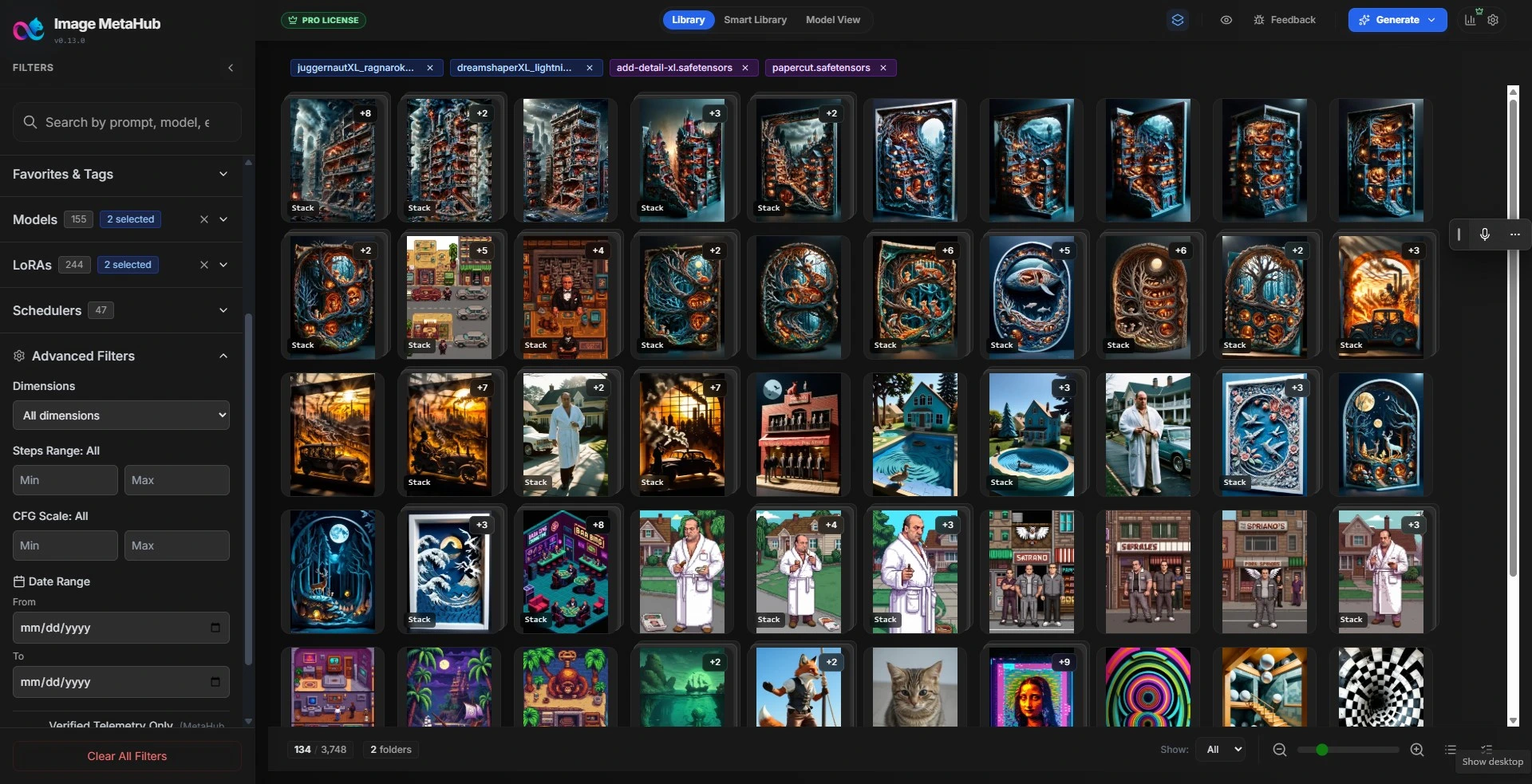
4. Image MetaHub 0.19.3
Image MetaHub indexes AI-generated images, video, and audio where they already live, then makes prompts, models, LoRAs, seeds, workflows, ratings, lineage, and visual similarity searchable. It understands output from ComfyUI, Automatic1111, InvokeAI, Forge, and other generators, so an old render can become a reproducible starting point instead of an orphaned filename. Version 0.19.3 adds a prompt library and read-only provenance view with on-demand SHA-256 fingerprints, while improving ComfyUI navigation, cache reuse, thumbnails, and workflow parsing.
OPERATIONAL VALUE
Recover the exact recipe behind a past asset, group useful prompt patterns, find near-duplicates locally, and send compatible workflows back into ComfyUI.
QUICK VIDEO
Index one messy output folder, search by LoRA and seed, open an image’s provenance summary, then relaunch its embedded workflow in ComfyUI.
Reality: The core repository is MPL-2.0 open source and keeps indexed files local by default, but several workflow-heavy features—including embedded ComfyUI generation, compare view, bulk operations, analytics, and unlimited visual search—require an offline paid Pro license or trial. Release installers are offered for Windows, macOS, and Linux; verify downloaded assets and back up the media directory before enabling file operations. Optional Civitai lookups make network requests. Models, prompts, source media, and generated outputs retain separate licenses and rights.
OPEN PRIMARY SOURCE →5. Interlinked CLI
Interlinked is a local policy and observability layer for coding agents. Where a supported client exposes pre-tool hooks, it evaluates delivered actions against deterministic rules, can block dangerous commands, secrets in source, or unvetted dependencies, and records a replayable local activity log. Claude Code and Codex are the supported pair; adapters for Cursor, Copilot CLI, Gemini CLI, OpenCode, and Pi are experimental. Its strongest contribution is explicit coverage reporting: the tool distinguishes events it actually observed from actions a provider never delivered to its integration.
OPERATIONAL VALUE
Add version-controlled guardrails and a grep-friendly action record around agent work, then inspect exactly which provider hooks and controls are active.
QUICK VIDEO
Enable Interlinked in a disposable repository, inspect capability coverage, attempt a clearly destructive command, show the deterministic block, then replay the logged event.
Reality: Interlinked is MIT open source, currently installs from GitHub source, and requires Node.js 22 on macOS, Linux, or WSL. It writes project state plus provider settings, hooks, bridges, and skill directories, so use a throwaway repository, pin a commit, inspect the changes, and test the documented uninstall path. A local guard is not a universal sandbox: it can enforce only actions the client exposes through its hook or bridge. Experimental adapters have narrower guarantees, and no log can reconstruct an event it never received.
OPEN PRIMARY SOURCE →5 Proven Classics
Continue remains an active Apache-2.0 coding-agent platform with IDE and CLI paths. Its configurable models, rules, tools, and workflows make it useful for teams avoiding one locked-in assistant.
Source →DSPy remains the MIT framework to study when prompts become programs that need measurable optimization. Its signatures, modules, and evaluators encourage repeatable improvement instead of endless manual wording tweaks.
Source →Chroma remains an approachable Apache-2.0 search and retrieval layer for prototypes. Its local developer experience makes document collections, embeddings, metadata filters, and semantic search quick to test before scaling infrastructure.
Source →Open Interpreter remains a powerful Apache-2.0 bridge between language models and local computer tasks. Its broad execution authority is educational and useful, but warrants strict sandboxing, review, and backups.
Source →Qdrant remains a mature Apache-2.0 vector search engine with filtering, hybrid retrieval, quantization, and distributed deployment. Choose it when a prototype’s embedded store needs clearer production operations and scaling.
Source →Reality Check
Today’s strongest tools all sit close to valuable data or powerful execution. Open Slide generates code and assets that still need human review; Hippo can patch agent configuration and schedule background work; Taskuary touches communication systems and proposed replies; Image MetaHub indexes creative archives and gates some operations behind a paid license; Interlinked sees only the tool events its provider integration exposes. Start in disposable projects, pin versions or commits, minimize connector scopes, back up source data, and test every approval, redaction, uninstall, and recovery path before trusting routine automation.
Bottom Line
Try Open Slide first: it turns an agent’s strongest medium—version-controlled code—into a deck workflow with a genuinely useful visual feedback loop. If your ComfyUI or local-generation archive has become unsearchable, Image MetaHub is the other immediate win; test the free core on a copied folder before paying for Pro. Hippo deserves a carefully isolated memory experiment, Taskuary belongs on the watchlist until one connector proves its review model, and Interlinked is worth testing when you need evidence about what a coding agent’s hooks actually covered.
Primary-source research completed September 28, 2026. Private Be Your Evolution field guide.