Be Your Evolution AI News Daily
Five fresh signals. Five durable tools. No hype tax.
Top 5: New and Worth Your Attention

1. Hermes Blind 0.3.2
Hermes Blind recovers the first real user request from a long Codex or Claude Code transcript and turns it into a compact, inspectable anchor. It skips tool output, sidechain turns, and compaction summaries without calling another model or external service. Version 0.3.2 aligns the Python package, portable skill, and plugin manifests, fixes version-pinned Gemini installation, and improves local log discovery. The practical win is simple: restore the original goal before accumulated debugging noise quietly changes the assignment.
OPERATIONAL VALUE
Re-anchor a sprawling coding session to its original constraints, then review the recovered text before pasting it back into the agent.
QUICK VIDEO
Start with a deliberately noisy session, run Hermes Blind in goals mode, compare its recovery file with turn one, and continue with the anchor restored.
Reality: Hermes Blind is Apache-2.0 open source, experimental, and requires Python 3.10+. It reads local agent transcripts, which may contain source code, prompts, paths, and sensitive output; inspect the selected file and generated anchor before sharing either. The project explicitly does not claim that recovering turn one proves better downstream behavior, detects drift, reduces bias, or resists adversarial prompts. Treat it as a transparent retrieval aid, not an autonomous correctness layer.
OPEN PRIMARY SOURCE →
2. skilld 3.2.0
skilld is an MIT-licensed registry and native CLI for finding, inspecting, running, installing, updating, and removing agent skills across nineteen supported targets. A transient run prints a skill without writing project files; installed skills are pinned to commits with lockfile, digest, and attestation checks. Version 3.2.0 adds installation from previously unindexed repositories, a filterable picker, local harness sandboxing, stricter path validation, and bounded references. That makes it a useful discovery layer with unusually visible provenance and rollback mechanics.
OPERATIONAL VALUE
Try a portable skill without installation, audit its source and permissions, then pin the exact accepted version across Codex, Claude Code, Cursor, or Gemini CLI.
QUICK VIDEO
Search for one design skill, run it transiently, inspect the author and source commit, install it into Codex, then verify and remove it.
Reality: skilld itself is MIT open source and states that it sends no telemetry, but every third-party skill remains separately authored, licensed, and potentially consequential. A readable SKILL.md can still direct an agent to execute scripts, access accounts, modify files, or contact external systems. Prefer the no-write run path first, inspect every referenced file, check the exact source commit and license, preserve normal approvals and sandbox limits, and avoid entering account credentials until you understand why the registry needs them.
OPEN PRIMARY SOURCE →
3. Flywheel 0.47.0
Flywheel is a Go CLI and skill set for coordinating parallel coding agents through file-owned work orders, deterministic gates, event logs, and review roles. Cheap workers build bounded units while a stronger lead plans and inspects the critical decisions. Today’s 0.47.0 release adds unit-level validation, inspection, resume, withdrawal, marks, read-only operation, and configurable hotkeys. It also tightens branch rebasing, rejects skipped required checks, and prevents workers from fetching or pulling, reinforcing the project’s controlled-factory model.
OPERATIONAL VALUE
Split a repository change into owned units, give disposable workers narrow briefs, and retain auditable evidence for checks, cost, review, and recovery.
QUICK VIDEO
Use the offline simulation adapter to initialize a tiny work order, watch a worker claim one file, run its gate, inspect the log, and withdraw it safely.
Reality: Flywheel is MIT open source, but version 0.47.0 and its four-star repository are early signals, not proof of production maturity. The CLI manages branches, worktrees, processes, and agent permissions; a mistaken brief or adapter configuration can still damage a repository or spend provider credits. Begin with the documented offline simulation in a disposable Git repository, verify release checksums, inspect every installed skill, keep ownership boundaries narrow, and require human review before merging or shipping.
OPEN PRIMARY SOURCE →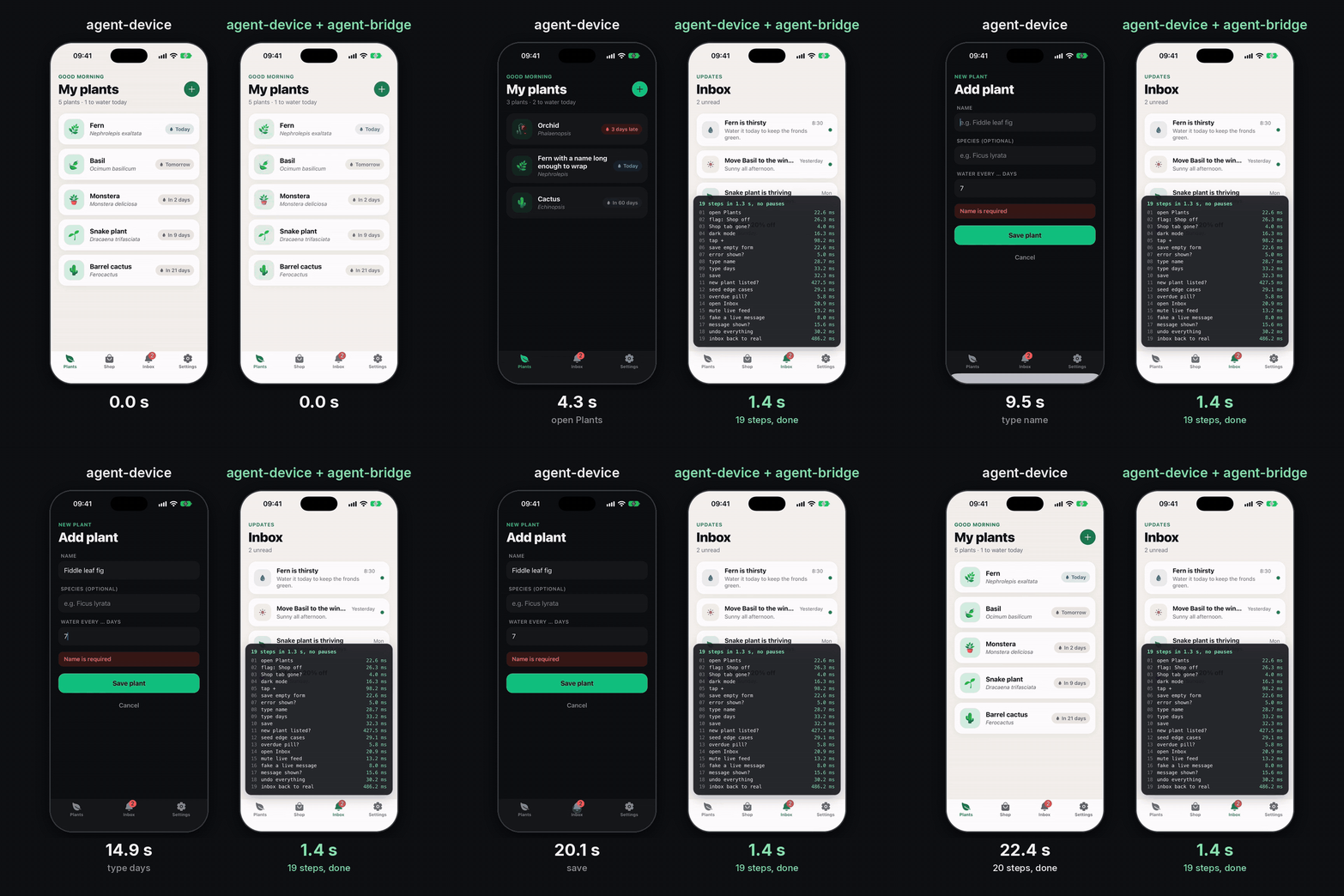
4. Agent Bridge 0.3.0
Agent Bridge lets coding agents control a running React Native development app through explicit in-app tools rather than slow sequences of taps. Agents can seed state, change flags, fill forms, navigate, mock network calls, inspect text, and restore the app afterward. Version 0.3.0 adds named scenarios with JSON-Schema validation, automatic cleanup even after failure, strict network mode, and reusable flow execution for scripts or CI. The result is a fast, repeatable bridge between code changes and realistic app-state checks.
OPERATIONAL VALUE
Give an agent deterministic access to hard-to-reach mobile states, reproduce bugs quickly, and run scenario-based UI checks without manually rebuilding setup data.
QUICK VIDEO
Apply a signed-in scenario, enable dark mode, seed a message, navigate to the target screen, verify text, then show automatic restoration after a failed flow.
Reality: Agent Bridge is MIT open source, newly created, and designed only for development builds; release builds receive empty stubs. Integration requires React Native or Expo code changes and careful selection of the tools exposed to the agent. State, network fixtures, and return values can leak secrets unless redaction is deliberate. Use an example app first, keep strict network mode on, allowlist tools, avoid production credentials, and combine it with—not substitute it for—accessibility and device-level testing.
OPEN PRIMARY SOURCE →5. agent-images
agent-images builds reproducible OCI containers for coding agents with Nix, covering Codex, Claude Code, Gemini CLI, Goose, OpenCode, Copilot CLI, and many others. The images can run directly under Podman or Docker or plug into agent-box for orchestration. Its strongest idea is isolation by construction: mount only the project data and credentials an agent actually needs instead of exposing the whole workstation. Recent maintenance keeps the catalog current while preserving inspectable build definitions rather than opaque downloadable environments.
OPERATIONAL VALUE
Run multiple coding agents in repeatable sandboxes, reduce accidental access to SSH keys or cloud credentials, and version the exact development tools available to each job.
QUICK VIDEO
Build the Codex image, mount a throwaway repository read-write and the rest of the machine nowhere, inspect visible files, then discard the container after one task.
Reality: agent-images uses the permissive Blue Oak Model License 1.0.0 for its source, but the bundled agent clients, package sources, base layers, and model services keep their own licenses and terms. Containers reduce visibility; they are not a perfect security boundary, especially with broad mounts, host sockets, privileged mode, or injected credentials. Review the Nix definitions, pin image digests, run rootless, mount the minimum directories, avoid Docker-socket access, and rotate any token exposed to a disposable job.
OPEN PRIMARY SOURCE →5 Proven Classics
Transformers.js remains the Apache-2.0 route to running pretrained models directly in browsers and JavaScript runtimes. It is ideal for private, serverless demos that need text, vision, or audio inference.
Source →The Apache-2.0 timm library remains a deep, practical catalog of image backbones, pretrained weights, training utilities, and reference implementations for classification, embeddings, transfer learning, and vision research.
Source →spaCy remains a mature MIT-licensed choice for production NLP pipelines. Its tokenization, entities, rules, training system, and packaged language pipelines solve structured text work without requiring a generative model.
Source →Gensim still handles streamed topic modeling, document similarity, and classic embeddings efficiently under LGPL-2.1. It is stable and useful for legacy workflows, but the project now explicitly limits itself to maintenance.
Source →Whisper remains an MIT-licensed baseline for local multilingual transcription, translation, and language identification. Its well-understood model sizes make it dependable for offline captions, interviews, and searchable media archives.
Source →Reality Check
Today’s tools improve control, but none removes the need for explicit boundaries. Hermes Blind reads sensitive transcripts; skilld installs third-party instructions; Flywheel coordinates agents that can alter Git state; Agent Bridge exposes application internals; and agent-images is only as isolated as its mounts, privileges, and credentials. Start in disposable repositories and development apps, inspect every skill or build definition, pin releases and image digests, keep human approval at merge and external-action boundaries, and distinguish an open-source wrapper from the separate licenses and costs of models, services, data, and generated media.
Bottom Line
Try skilld first, but use its transient no-write path: it gives you a fast, inspectable way to sample agent capabilities without immediately adding files across every client. If coding agents touch important repositories, agent-images is the higher-leverage second experiment—one rootless container with a minimal project mount will teach you more about practical isolation than another policy document. Agent Bridge is compelling for React Native teams, Hermes Blind solves a narrow but real context problem, and Flywheel deserves watching until its young orchestration model has broader field evidence.
Primary-source research completed September 29, 2026. Private Be Your Evolution field guide.