Be Your Evolution AI News Daily
Five fresh signals. Five durable tools. No hype tax.
Top 5: New and Worth Your Attention

1. ZCode 3.14.3
ZCode is a newly opened coding-agent workbench spanning desktop, browser, terminal UI, backend services, and an agent CLI. The useful idea is one local workspace with several interfaces instead of separate coding assistants that lose context between surfaces. A quick demo could open one repository in the TUI, switch to the web view, and inspect the same task trail. The source build is not lightweight: it pins Node.js 24 and pnpm, and its English documentation is less complete than the Chinese README.
OPERATIONAL VALUE
Give one coding agent a consistent project workspace across terminal, browser, and desktop surfaces while retaining visible local task state.
QUICK VIDEO
Start a bounded repository task in the terminal UI, open the matching web workspace, and compare the shared plan, files, and execution trace.
Reality: ZCode’s repository is Apache-2.0 open source, but the application is new and its full source setup expects exact Node.js and pnpm versions plus a multi-package build. Model providers, remote services, accounts, generated code, and usage charges remain separately governed. Begin with a throwaway repository, review provider configuration and network exposure, keep credentials out of test projects, and inspect every proposed command before execution.
OPEN PRIMARY SOURCE →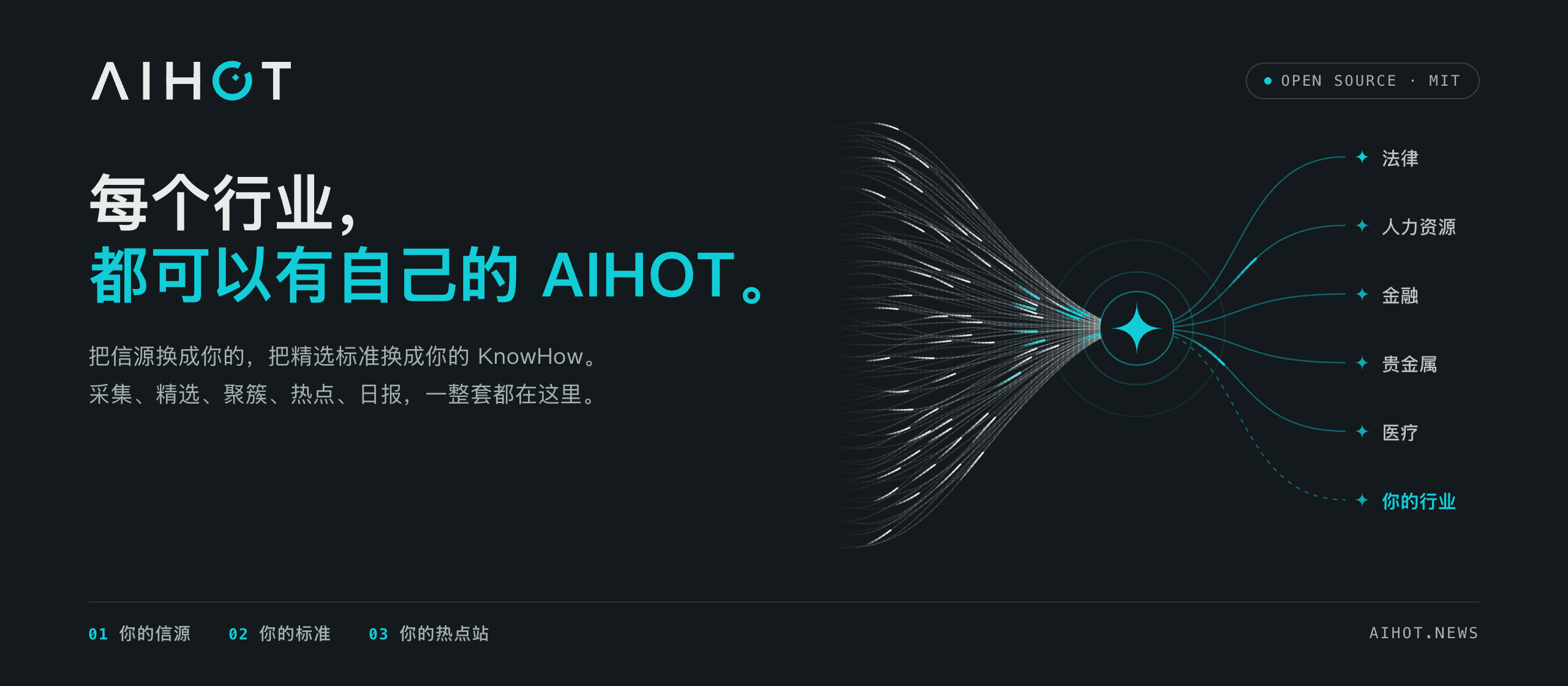
2. AIHOT
AIHOT is an unusually relevant open framework for turning chosen sources into a focused daily industry brief. It collects six source types, deduplicates, scores twice, clusters related reports into events, writes summaries, and publishes daily, weekly, and monthly editions. Its prompts and selection thresholds are exposed, so the operational value is a pipeline you can audit instead of a mysterious “AI news” feed. A sharp demo would replace the sample sources with five primary AI sources and compare its picks with today’s manual shortlist.
OPERATIONAL VALUE
Prototype an auditable source-to-brief pipeline whose inclusion rules, clustering, prompts, and output feeds can be tuned for one industry.
QUICK VIDEO
Swap in five official AI sources, run one collection cycle, then compare the framework’s clustered shortlist with a human-curated five-item edition.
Reality: AIHOT’s framework is MIT open source, but the repository describes itself as a production snapshot, not a polished general platform. Running it needs Docker, PostgreSQL, Node.js, and an OpenAI-compatible model API key. Model services, source-content rights, feeds, credentials, translations, and generated copy remain separate. Use primary sources, preserve canonical attribution, cap API spend, keep the admin interface private, and review every summary before publication.
OPEN PRIMARY SOURCE →
3. Strata 0.1.31
Strata is a young local inference engine packaged to run quantized Qwen3.8-Flash-Next variants on Windows or Linux with one or more NVIDIA GPUs, substantial system RAM, and SSD storage. It exposes local OpenAI- and Anthropic-compatible endpoints, making it potentially useful as a private backend for existing tools. The best video is a cold start, calibration, and one coding task on ordinary hardware. Treat the repository’s speed and quality figures as author benchmarks to reproduce, not universal performance guarantees.
OPERATIONAL VALUE
Test whether a large open-weight model can serve existing agent clients locally through familiar API shapes without renting a dedicated inference server.
QUICK VIDEO
Install one supported quantization, run the calibration step, connect a simple OpenAI-compatible client, and measure startup time, memory, and task latency.
Reality: Strata’s engine code is MIT open source; the model weights and quantized derivatives are separate open-weight artifacts with their own model cards and license terms. The recommended configurations can require 32–64 GB of RAM, a recent NVIDIA GPU, and tens of gigabytes of storage. Version 0.1.31 is very early. Verify hashes and weight provenance, reproduce benchmarks on your hardware, and do not confuse local execution with unrestricted model licensing.
OPEN PRIMARY SOURCE →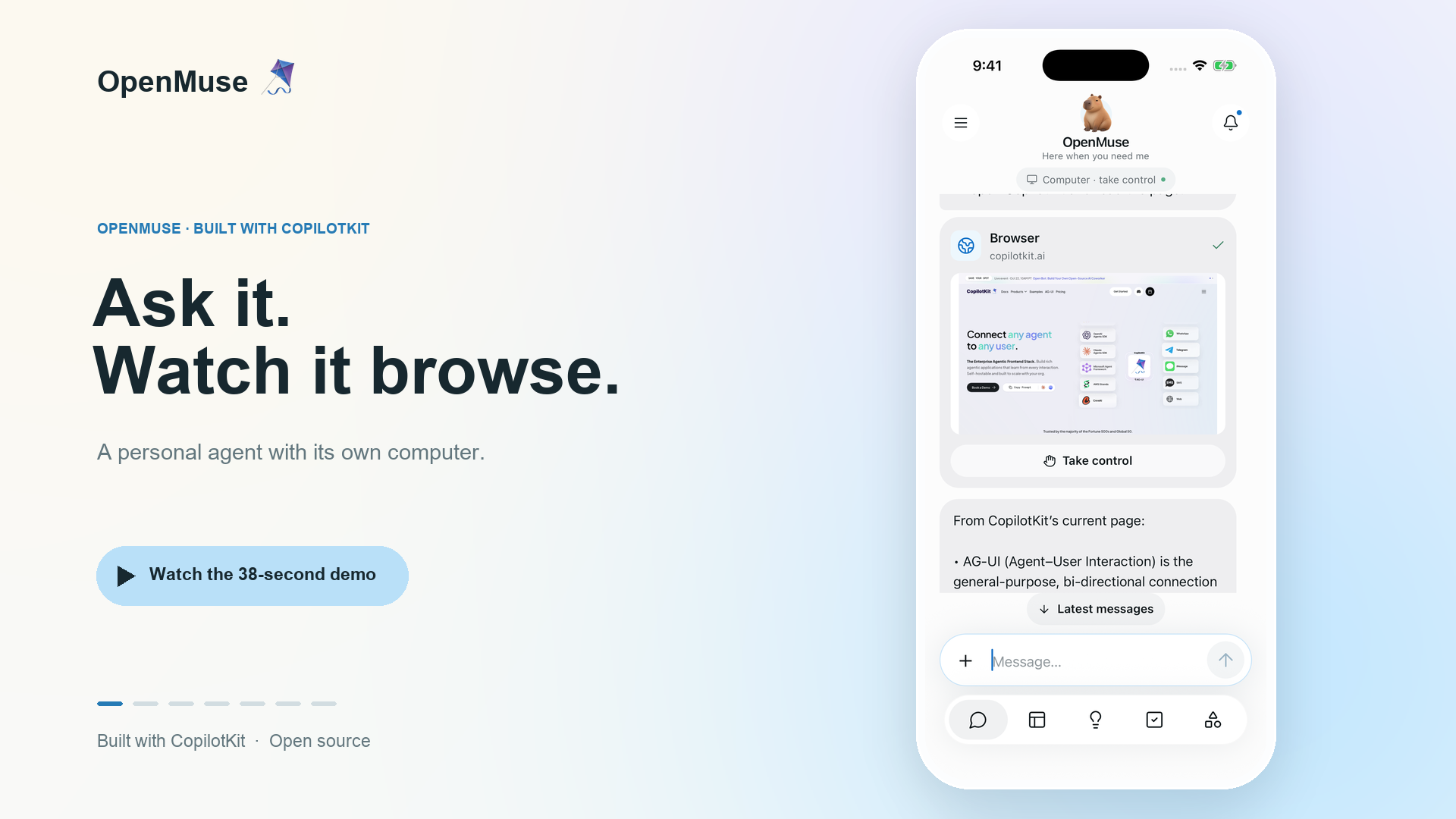
4. OpenMuse
OpenMuse is a self-hosted personal-agent application for iOS, Android, and the web, with visible plans, durable tasks, a persistent browser, optional Linux workspace, file handling, and rich result cards. The strongest operational idea is reviewable work that can continue beyond one chat window, with a human takeover path when browsing gets tricky. A quick video could assign a research task on mobile, watch its browser activity on desktop, then pause and resume. The maintainers label it alpha, and live integrations require configuration.
OPERATIONAL VALUE
Explore a reviewable personal-agent shell where long-running work, browser state, files, approvals, and human takeover stay attached to one durable task.
QUICK VIDEO
Launch a small research task from mobile, inspect the live browser on desktop, pause it, add one constraint, and resume to a saved result.
Reality: OpenMuse is MIT open source and explicitly alpha. Its Google integrations, CopilotKit components, model providers, hosted deployment, accounts, and usage charges are governed separately. Persistent browser profiles can expose authenticated sessions, and optional workspaces can execute commands. Use a fresh test account and browser profile, isolate secrets, keep send/delete/purchase actions approval-gated, and review the project’s verification notes before trusting it with personal data.
OPEN PRIMARY SOURCE →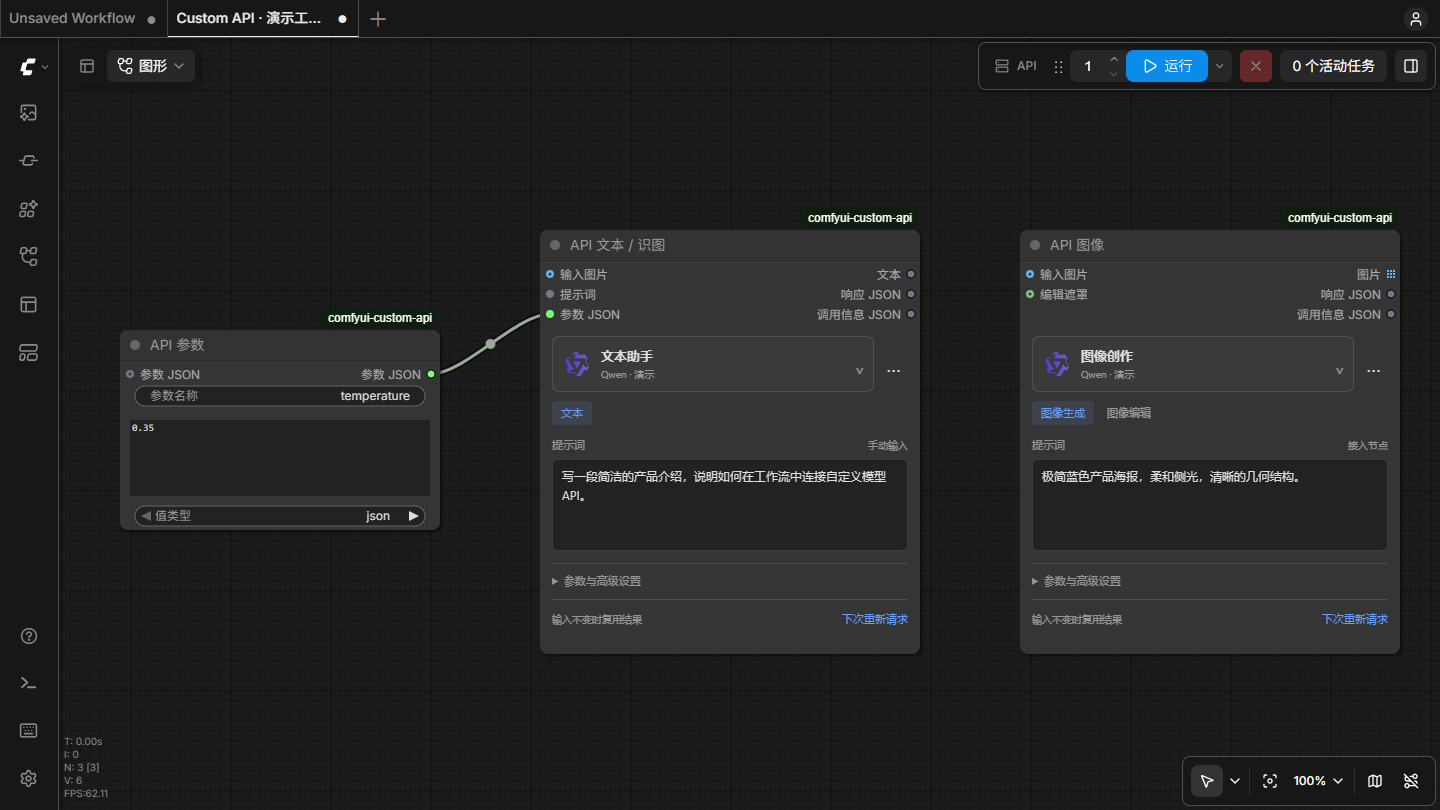
5. ComfyUI Custom API 0.2.2
ComfyUI Custom API connects configurable model endpoints to text, vision, image-generation, and image-editing nodes without requiring every provider to ship a dedicated extension. That could turn one workflow into a portable comparison harness across OpenAI-compatible and custom HTTP APIs. A quick demo would bind two image providers to the same prompt and inspect the redacted response metadata. The current release follows a reported server-side request boundary fix; the repository’s main branch is already developing 0.3.0, so pinning and review matter.
OPERATIONAL VALUE
Use one ComfyUI workflow to compare or route multiple model APIs while keeping provider templates, parameters, and returned metadata visible.
QUICK VIDEO
Configure two test endpoints, bind both to one image prompt, compare outputs and redacted call metadata, then show where secrets are stored locally.
Reality: The plugin is MIT open source, while every connected API, model, usage charge, retention policy, and generated-media license remains separate. Release 0.2.2 superseded 0.2.1 after a server-side request-forgery boundary was identified; the project reports the fix and tests, not a security certification. Use 0.2.2 or newer, bind ComfyUI to localhost, avoid shared multi-user deployments, protect plaintext local secrets, and confirm current Manager or Registry status before installation.
OPEN PRIMARY SOURCE →5 Proven Classics
Still the most practical MIT-licensed collection of official OpenAI API examples. Use it for implementation patterns, then confirm current endpoint behavior, model availability, pricing, and limits in the API documentation.
Source →The MIT-licensed framework remains useful for turning “this seems better” into repeatable model and system checks. Its benchmark registry is a starting point, not a substitute for your own task-specific evaluations.
Source →Microsoft’s MIT-licensed converter turns Office files, PDFs, images, audio, archives, and more into Markdown for downstream AI workflows. Conversion quality varies, so preserve originals and spot-check tables, structure, and OCR.
Source →Phoenix remains a capable observability and evaluation platform for traces, experiments, and prompt analysis. Its Elastic License 2.0 is source-available, not OSI-approved open source; hosted services have separate terms.
Source →TRL is an Apache-2.0 toolkit for supervised fine-tuning, preference optimization, and reinforcement learning. It is powerful but hardware-heavy; dataset rights, base-model licenses, reward design, and evaluation still determine whether training is responsible.
Source →Reality Check
The five featured code repositories use OSI-approved licenses: ZCode is Apache-2.0, while AIHOT, Strata, OpenMuse, and ComfyUI Custom API are MIT. That does not automatically open the model weights, hosted APIs, connected accounts, source content, or generated outputs. Strata’s model files are open-weight artifacts with separate terms; OpenMuse can reach browser sessions and external services; AIHOT needs paid-capable model access; and ComfyUI Custom API can send data to whichever endpoint you configure. Among the classics, Phoenix is Elastic License 2.0 source-available rather than open source. Start with disposable data, least-privilege credentials, explicit cost caps, and human review before external actions or publication.
Bottom Line
Try AIHOT first because it maps directly onto a real daily editorial operation: its exposed scoring, clustering, and prompt pipeline could sharpen source triage without replacing human judgment. Put ZCode second on a disposable repository to see whether one task genuinely carries across terminal and web surfaces. Strata is the most interesting local-AI experiment, but only if the hardware is already available. Keep OpenMuse and ComfyUI Custom API on a monitored test bench until their young security and deployment stories mature.
Primary-source research completed October 1, 2026. Private Be Your Evolution field guide.