Be Your Evolution AI News Daily
Five fresh signals. Five durable tools. No hype tax.
Top 5: New and Worth Your Attention
1. ismail
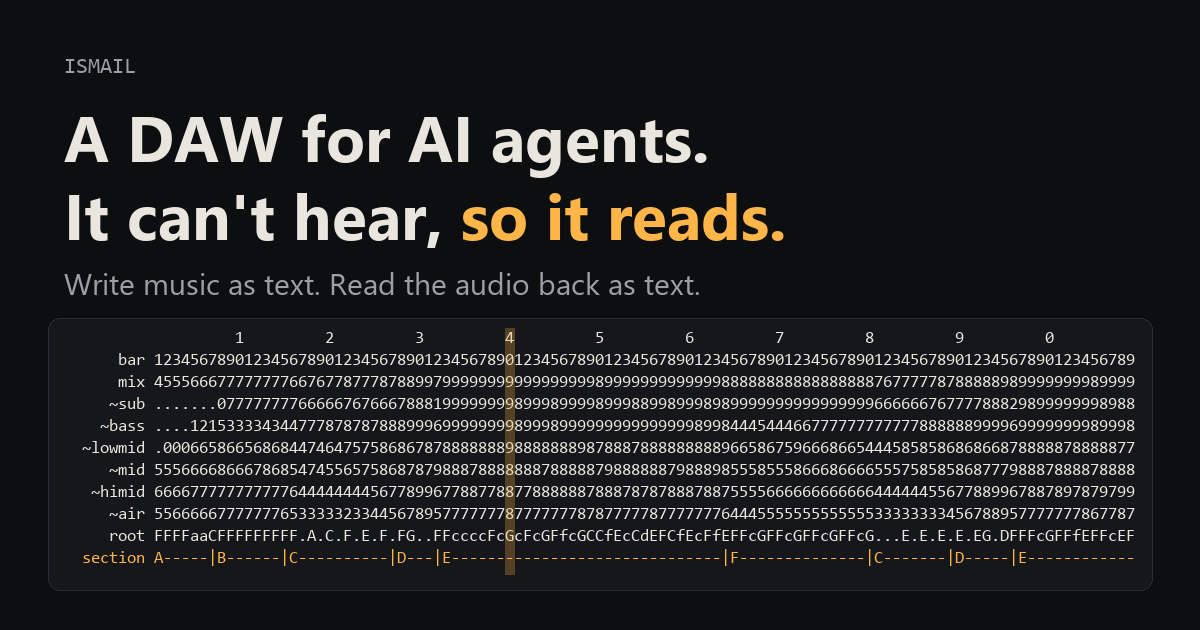
ismail is a local, text-native digital audio workstation built for agents rather than musicians clicking a timeline. An agent writes notes, instruments, effects, and automation as code, renders the song, then reads structured musical and spectral analysis before revising it. The unusually practical hook is precision: one bar or patch can change without regenerating the whole track. Its MCP server, CLI, Python API, and bundled agent skill make a compelling creative workflow to test.
OPERATIONAL VALUE
Give a coding agent a versionable music workspace where tracks, edits, analyses, and finished renders remain inspectable instead of disappearing behind a prompt-only generator.
QUICK VIDEO
Ask an agent for a 16-bar loop, inspect its text score and listening report, change one bass phrase, then compare the two renders.
Reality: ismail is MIT open source and runs on Windows, macOS, and Linux with Python 3.10 or newer. Basic synthesis is local, but MP3 previews require FFmpeg; optional perceptual analysis and stem separation add large model and PyTorch dependencies. The project is days old and has no tagged release, so pin a reviewed commit. Agent providers, imported recordings, samples, composition rights, and output rights remain separately governed.
OPEN PRIMARY SOURCE →
2. Médula 0.3.0
Médula is a small coordination kernel and reproducible lab for asking whether simultaneous coding agents are about to collide. Before a write, it compares the agent’s intent with other active work and decides who should wait. The repository publishes raw sessions, diffs, evaluations, and costs rather than only promising safer parallelism. Its test scenario is especially useful: clean Git merges can still hide semantic breakage. Version 0.3.0 also fixes crossed waits and supports Claude subscription sessions.
OPERATIONAL VALUE
Measure whether parallel coding work creates semantic conflicts, and inspect each coordination decision instead of relying on branch isolation alone.
QUICK VIDEO
Run the offline six-task room-booking benchmark, show the clean merge with broken tests, then replay the same collision through Médula’s decision log.
Reality: Médula is MIT open source and its mocked offline tests need no API key, but the real benchmark expects Python 3.12, uv, Bash-compatible tooling, agent clients, and configured model access. The authors report that the fast decider is still uncertain on many real write states, so slow-path calls and judgment remain important. Provider subscriptions, model terms, repository contents, generated code, and inference charges are separate from the code license.
OPEN PRIMARY SOURCE →
3. Career Agent
Career Agent is a local-first job-application workspace designed around explicit review rather than automatic mass submission. It stores research, unchanged résumé files, sourced answers, duplicate checks, packet versions, approvals, and confirmation evidence in one dashboard while Codex or Claude handles research and supported browser forms through a shared skill. The strong operational idea is an auditable handoff: the agent may prepare work, but only the exact reviewed batch is authorized. A fictional demo lets you examine the workflow safely first.
OPERATIONAL VALUE
Keep job research, document integrity, answers, approvals, and submission evidence in one private workspace while retaining a manual checkpoint before external action.
QUICK VIDEO
Load the fictional demo, filter roles, inspect a prepared packet, approve one item, and show how changed answers invalidate the earlier approval.
Reality: Career Agent is MIT open source and defaults to local SQLite, but it is a new repository without tagged releases. Setup expects Node.js 22, Git, a private résumé workspace, and a separately installed Codex or Claude client; live applications also require browser access and human handling for logins, CAPTCHAs, assessments, and unsupported forms. Employer terms, assistant subscriptions, browser tools, personal data, and submission consequences remain separate. Test only with fictional data first.
OPEN PRIMARY SOURCE →
4. AstraRouter
AstraRouter is an OpenAI-compatible gateway for routing requests across model providers by priority, cost, latency, quality, tenant, region, sensitivity, and other policy inputs. Its dashboard centralizes providers, models, keys, tools, caches, health, and spend, while response metadata records which provider actually answered. That could remove routing logic duplicated across several applications. The project is only one day old, however, so the broad surface and security claims need independent testing before it handles production prompts or credentials.
OPERATIONAL VALUE
Place one policy and audit layer between several AI applications and providers, then change routing or failover without editing every client.
QUICK VIDEO
Start the Docker stack without provider keys, inspect its mocked verification path, then add two test endpoints and force a visible failover.
Reality: AstraRouter is Apache-2.0 open source with no tagged release yet. Its full stack uses Docker Compose or a native Go and Node build, stores sensitive provider configuration, and can expose a dashboard or temporary tunnel. Avoid piping remote installers directly into a shell; clone and review the scripts first. Keep the admin surface private, rotate test keys, and reproduce routing, billing, cache, and failure behavior. Provider services, models, prompts, retention policies, and charges remain separate.
OPEN PRIMARY SOURCE →5. SkillCorpus 0.4.0
SkillCorpus turns scattered SKILL.md packages into a curated, searchable skill layer with aggregation, safety and license gates, deduplication, retrieval models, and evaluation tooling. Release 0.4.0 adds a shared directory so several supported agent hosts can reuse installed skills across sessions. The important distinction is deployment: the code, retrieval models, and 1,000-skill demo are public, but the full catalog is not yet downloadable and the hosted SkillHub service remains closed. That makes it promising infrastructure, not a turnkey open corpus.
OPERATIONAL VALUE
Build or test a governed skill-retrieval layer that selects a small number of task-specific procedures while preserving provenance and per-skill licensing.
QUICK VIDEO
Query the public demo for one document task, inspect the returned skill and license, then compare an agent response with and without that procedure.
Reality: SkillCorpus code is primarily Apache-2.0, while its match and evaluation toolkits are MIT; every collected skill retains its upstream license. The 1,000-skill demo and retrieval models are open artifacts, but the full 114,190-skill corpus is still marked coming soon and hosted SkillHub is proprietary. Self-hosting the models requires separate data and ML dependencies. Review every retrieved script before execution, disable sharing where appropriate, and do not treat automated safety or license gates as legal approval.
OPEN PRIMARY SOURCE →5 Proven Classics
This Apache-2.0 inference engine remains a strong default for serving open-weight language models at scale. Validate supported hardware, quantization, model licenses, and memory needs against your exact deployment.
Source →Microsoft’s MIT-licensed SDK still offers a mature way to combine prompts, plugins, memory, and agent workflows across major languages. Its abstractions help most when your application already needs explicit orchestration.
Source →Haystack remains a capable Apache-2.0 framework for explicit RAG, routing, tools, and agent pipelines. Its modular graph is valuable when retrieval and generation stages must stay visible and testable.
Source →LocalAI’s MIT-licensed server unifies local text, vision, voice, image, and video backends behind familiar APIs. Start with one small model; hardware support does not guarantee acceptable speed.
Source →AUTOMATIC1111 remains an influential AGPL-3.0 local image interface with deep extension support, but development has slowed. Prefer isolated installs, scrutinize extensions, and check each model’s separate weight license.
Source →Reality Check
All five featured repositories publish source under OSI-approved licenses: ismail, Médula, and Career Agent use MIT; AstraRouter and the main SkillCorpus code use Apache-2.0. SkillCorpus also includes MIT subtoolkits, per-skill upstream licenses, open retrieval models, a small public demo corpus, a not-yet-released full corpus, and a proprietary hosted service. Code openness does not open connected models, providers, employer sites, imported media, personal data, or generated outputs. New agent tools can execute commands, reach browsers, store credentials, and act externally. Clone and review rather than pipe installers, use disposable data and test keys, keep services local, pin versions, cap spend, and require human approval before submissions or publication.
Bottom Line
Try ismail first: it is the clearest, most visual experiment and tests a genuinely different idea—an agent editing versionable music rather than requesting a finished song. Put Career Agent second, but only with its fictional demo, because its approval and evidence model is a thoughtful pattern for any workflow that ends in an external action. Médula is the deeper engineering read for parallel-agent work. SkillCorpus deserves architectural study; AstraRouter should remain on a private test bench until its young control plane has broader scrutiny.
Primary-source research completed October 2, 2026. Private Be Your Evolution field guide.