Be Your Evolution AI News Daily
Five fresh signals. Five durable tools. No hype tax.
Top 5: New and Worth Your Attention
1. explainroo 0.1.1
explainroo lets a coding agent turn a script and JavaScript scene file into a narrated MP4. Kokoro supplies local speech, Whisper aligns words, Chrome draws frames, and ffmpeg assembles the result. It also creates contact sheets and automated checks for clipped text and speech mistakes. That is unusually practical for B.Y.E. explainers: the agent can build, inspect, and revise a short visual lesson without a timeline editor or paid rendering service.
OPERATIONAL VALUE
Convert a newsletter concept, product walkthrough, or technical lesson into a reviewable local video package with voice, captions, music, and multiple social aspect ratios.
QUICK VIDEO
Give an agent a 60-second B.Y.E. topic, compare the midnight and blueprint looks, inspect the contact sheet, then play the finished vertical MP4.
Reality: explainroo is MIT open source and needs Node.js 20.11+, ffmpeg, and Chrome or Chromium. First setup downloads roughly 400 MB of Kokoro and Whisper assets. No GPU is required, but the maintainer tests Linux most thoroughly; Windows and macOS support is less mature. Local rendering is free, while your coding agent and optional OpenRouter illustrations carry separate terms and charges. Voice models, fonts, source media, music, and output rights remain separately governed.
OPEN PRIMARY SOURCE →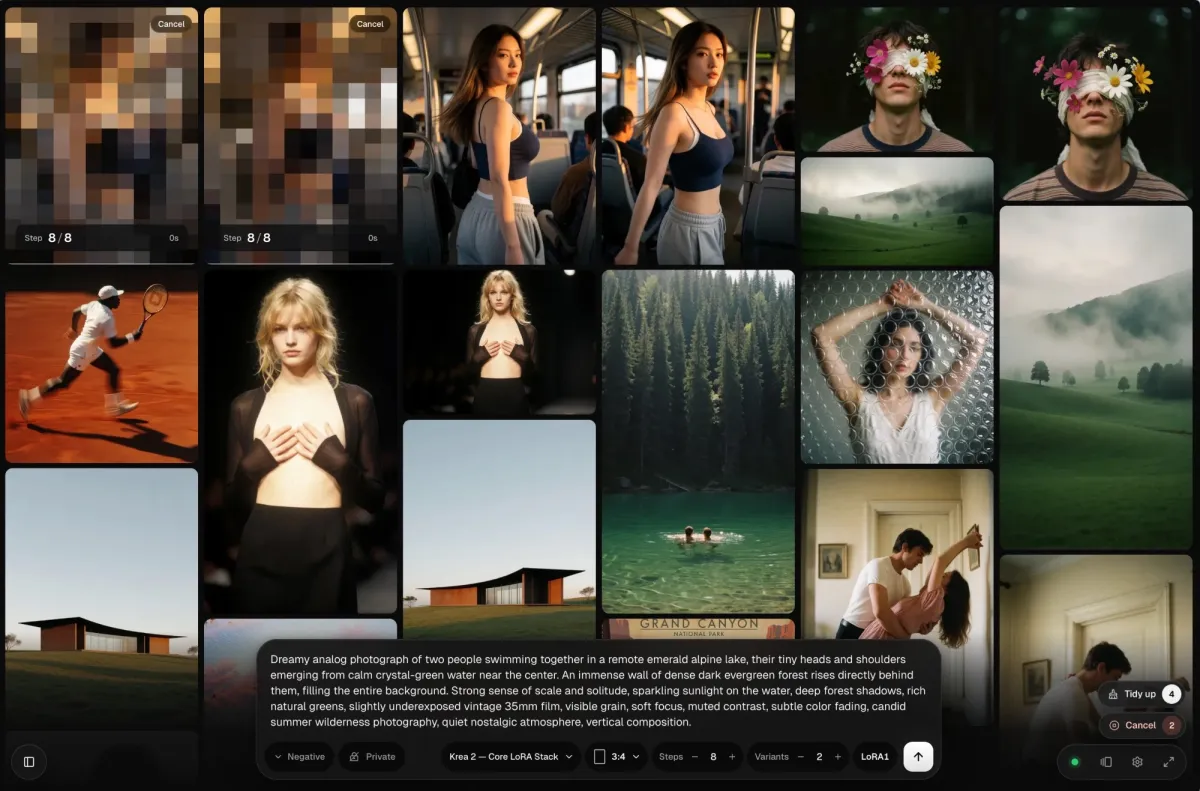
2. HEISS UI 0.15.0
HEISS UI puts a calm prompt box, gallery, and model-specific controls over an existing ComfyUI installation. It supports 28 image and video model families, converts imported workflow JSON into approachable controls, and can expose the same local studio to phones or other devices on a LAN. ComfyUI still executes every job, so experienced users keep their graphs while everyday prompting becomes much easier. The useful idea is separation: build workflows in ComfyUI, then run them through a simpler creative surface.
OPERATIONAL VALUE
Let a less technical collaborator reuse approved ComfyUI workflows, LoRAs, references, upscalers, and galleries without editing the node graph for every generation.
QUICK VIDEO
Import one existing ComfyUI workflow, watch HEISS turn its inputs into controls, render from a phone, then compare the original and upscaled outputs.
Reality: HEISS UI is MIT open source, but ComfyUI, custom nodes, downloaded models, and generated media retain their own licenses. It requires a working ComfyUI backend plus Node-based setup for the interface. LAN access expands the attack surface; bind and firewall it deliberately, avoid exposing it to the public internet, and verify how the Hidden gallery and device authentication behave before trusting sensitive images. The advertised video families remain beta, and model downloads can consume substantial disk and VRAM.
OPEN PRIMARY SOURCE →3. Strands Decider
Strands Decider is a 2B-parameter decision model for choices, yes-or-no gates, and ordered scores inside agent workflows. Instead of asking a general LLM to generate prose for every routing step, it returns typed options with confidence values. That could make triage, tool selection, moderation queues, and simple evaluators cheaper and easier to audit. The repository includes training code, data inventories, evaluations, and a local HTTP server, but its published confidence calibration only applies to the tested short-classification distribution.
OPERATIONAL VALUE
Route low-risk newsletter and automation decisions locally, then escalate low-confidence cases to a stronger model or a person instead of paying for every judgment.
QUICK VIDEO
Feed ten support-style requests into the CLI, show its route and confidence, then compare a fixed escalation threshold against a full LLM call.
Reality: The code and StrandsAgents adapter are Apache-2.0 open source/open weight; the checkpoint layers a LoRA and readout head on Qwen3.5-2B-Base, whose terms must also be checked. Installation uses Python and downloads base weights on first run. CPU, CUDA, MPS, and experimental MLX paths are documented. Its unauthenticated server binds to localhost by default—keep it there. The model card reports weak transfer on unfamiliar rubrics and long multi-step documents, so benchmark your own traffic before trusting confidence thresholds.
OPEN PRIMARY SOURCE →4. dots
dots pairs an OpenRouter model with a patched Firefox engine designed to look and behave like a consistent human browser. It preserves profiles, moves the pointer, types keys, aligns locale with a proxy, and can expose the same browser through MCP. That tackles a real automation failure point: pages that reject obvious WebDriver sessions. It is also exactly why this deserves caution. The repository has only four commits, makes strong anti-detection claims, and places credentials, cookies, and website rules inside a young security boundary.
OPERATIONAL VALUE
Test whether browser reliability improves on permitted research tasks where normal automation fails before redesigning a workflow around more expensive manual handoffs.
QUICK VIDEO
Ask dots to compare several public pages, watch the live pointer and typing, then repeat with a standard browser agent and record failure differences.
Reality: dots is MIT open source with Windows and Linux instructions, but it has no tagged release and installs from GitHub through uv. It requires an OpenRouter API key and downloads a modified browser stack. Use a disposable OS account and fresh site profiles, pin a reviewed commit, restrict tasks to sites that permit automation, and never use fingerprint evasion to bypass access controls. OpenRouter, proxy services, target websites, accounts, personal data, and resulting actions remain separately governed.
OPEN PRIMARY SOURCE →
5. Aetox 1.9.8
Aetox is a Windows-native agent harness combining a general assistant, coding desk, and delegated agent teams. It can work with files, browsers, terminals, Git, language servers, documents, spreadsheets, slides, OCR, speech, MCP, and cloud or local models. That breadth fits a Windows-heavy publishing workflow and the signed Store build lowers installation friction. However, the project is source-available rather than open source, and its public source stops at version 1.7.0 while current binaries continue at 1.9.8.
OPERATIONAL VALUE
Evaluate one desktop surface for research, document production, code work, and delegated tasks without forcing every workflow into a browser-only assistant.
QUICK VIDEO
Give Aetox a small folder, ask it to summarize files and produce a spreadsheet, then move the same task into its Code surface for verification.
Reality: Aetox is free to use but not OSI-approved open source; do not describe the current binary as reproducibly built from the repository. It requires 64-bit Windows 10 or later and offers Store, installer, Scoop, portable, and CLI paths. A trial provider works without a key, while 28 external provider integrations have separate privacy, price, and retention terms. Because the harness can write files, run commands, browse, and coordinate agents, start in a disposable workspace with narrow permissions and human approval.
OPEN PRIMARY SOURCE →5 Proven Classics
Transformers remains the Apache-2.0 reference library for loading and fine-tuning many model families across text, vision, audio, and multimodal work. Individual model weights and datasets still carry separate licenses.
Source →ONNX Runtime remains a dependable MIT-licensed engine for portable inference across CPU, GPU, mobile, and browser targets. Export compatibility and operator support need validation for every model you plan to ship.
Source →OpenVINO’s Apache-2.0 toolkit is still valuable for optimizing and serving AI models on Intel hardware. Its conversion and quantization paths reward careful benchmarking rather than assuming every exported workload improves.
Source →LangGraph remains a useful MIT-licensed foundation for stateful agent workflows, durable execution, and human checkpoints. Hosted LangSmith observability is a separate proprietary service with its own account and pricing.
Source →DVC remains an Apache-2.0 way to version datasets, models, and reproducible pipelines beside Git. Remote storage credentials, hosted Studio features, and large-file costs require separate operational planning.
Source →Reality Check
explainroo, HEISS UI, dots, Transformers, ONNX Runtime, OpenVINO, LangGraph, and DVC publish code under OSI-approved licenses. Strands Decider publishes Apache-2.0 code and adapter weights, but its Qwen base model and every training source still need their own review. Aetox is source-available, not open source, and its public code trails the shipped binary. None of these licenses automatically cover connected providers, downloaded models, datasets, websites, voices, media, accounts, or generated outputs. New browser agents, LAN studios, local servers, and desktop harnesses can expose keys or mutate files; pin versions, isolate tests, back up data, and keep consequential actions behind human approval.
Bottom Line
Try explainroo first: it has the clearest path from today’s editorial work to a useful, visible result. HEISS UI is the second test if simplifying ComfyUI for everyday creation or collaborators matters more. Strands Decider deserves a measured benchmark on one low-risk routing task. Keep dots isolated until its anti-detection claims and browser supply chain mature, and treat Aetox as a convenient proprietary-style binary evaluation—not an open-source deployment.
Primary-source research completed October 4, 2026. Private Be Your Evolution field guide.