|
B.Y.E. / DAILY AI TRY / 10.20.26
Be Your Evolution AI News DailyOctober 20, 2026 · Five newer tools explored, five proven classics worth keeping Top 5: New and Worth Your Attention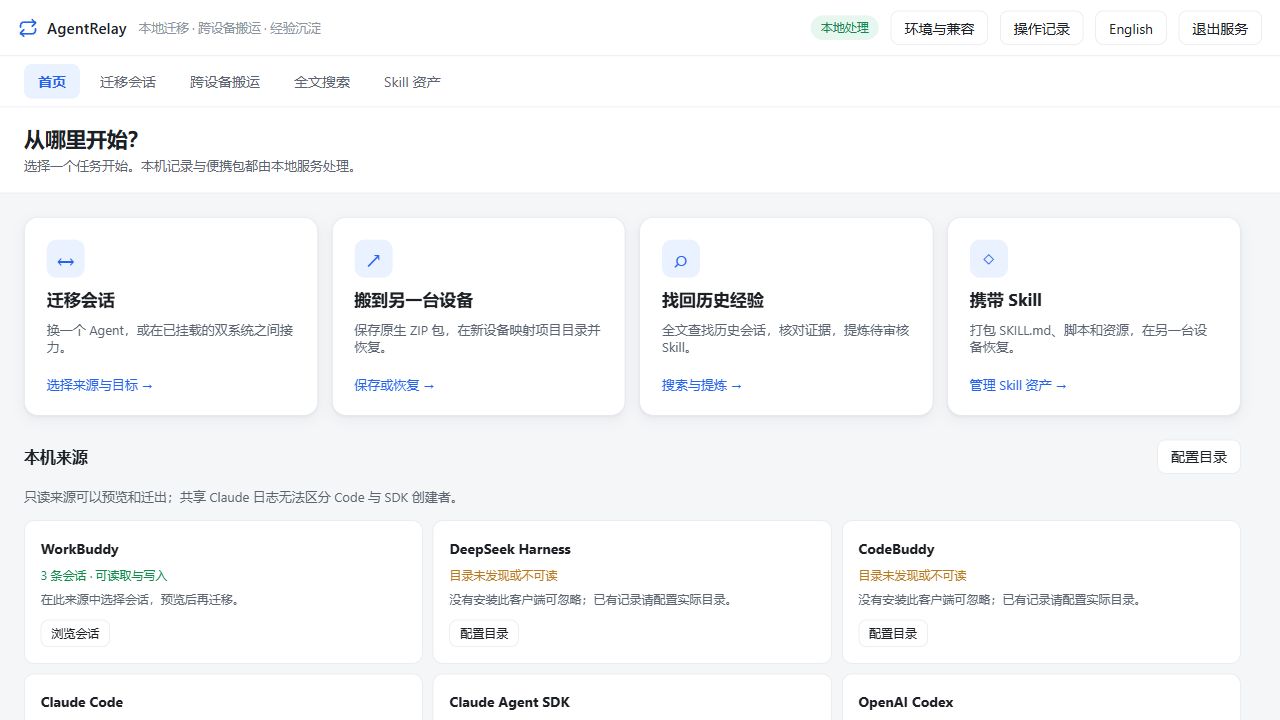 WATCHLIST 1. AgentRelay Portable 1.1.0AgentRelay Portable moves selected conversations and skill files among Codex, Claude Code, WorkBuddy, DeepSeek Harness, CodeBuddy, and supported JSON exports. Version 1.1.0 adds WorkBuddy AI separation, Tencent Yuanbao JSON import, English controls, and stronger cross-device packaging. The universal bundle includes runtimes for Windows, macOS, and Linux, so a useful test is exporting one non-sensitive session, previewing the conversion, and checking whether its messages, tool results, and skill draft survive intact. OPERATIONAL VALUE QUICK VIDEO Reality: The code is MIT open source and the release publishes checksums plus a GitHub build attestation. Support is uneven: the project distinguishes file conversion, native-package restoration, client indexing, and actual conversation continuation, and some WorkBuddy AI desktop behaviors remain unverified. The bundle is unsigned on macOS and handles sensitive local histories, so work from copies, inspect the preview, exclude secrets, verify the checksum, and never treat a successful file move as proof that the destination client can safely resume the conversation. OPEN PRIMARY SOURCE → TRY NOW 2. Launch Video KitLaunch Video Kit turns an owned website into an editable brand kit and a 30-to-60-second product film. Ten agent skills cover brand extraction, story, voice, score, sound, motion, mixing, review, and visual world-building. The film’s copy and timing live in JSON, while screenshots and brand assets remain replaceable. That makes it unusually aligned with reusable creative handoffs: an agent can build the first cut, but Jason still receives inspectable source, audio stages, review notes, and a normal MP4. OPERATIONAL VALUE QUICK VIDEO Reality: The repository is MIT open source, but the setup is not one click: its documented path uses Node.js, FFmpeg, uv, whisper.cpp, Python dependencies, and the HyperFrames renderer, with the current quick setup written for macOS. The included voice, alignment, music, and sound path is a starting point, not automatic creative approval. Use only owned or cleared websites, logos, screenshots, fonts, voices, music, and footage; verify third-party notices; and review every extracted claim before publishing. OPEN PRIMARY SOURCE →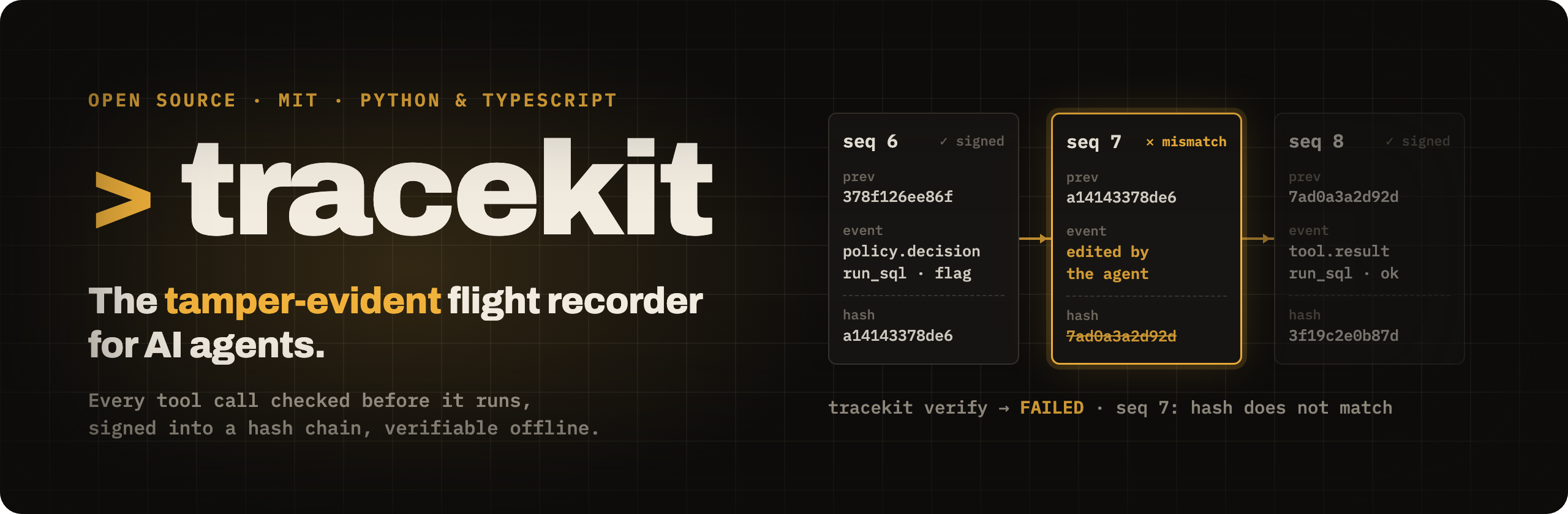 TRY NOW 3. Tracekit 1.4.0Tracekit is a tamper-evident flight recorder and policy gate for agent runs. It can instrument supported frameworks, inspect tool calls before execution, record model and tool activity into a signed hash chain, and verify whether the record changed later. Its local demo needs no API key and deliberately shows a destructive hidden instruction plus an edited log. That gives Jason a concrete way to test whether an agent workflow produces evidence strong enough to review after a mistake instead of trusting its own summary. OPERATIONAL VALUE QUICK VIDEO Reality: Tracekit is MIT open source, but coverage varies by integration: its own compatibility table labels some paths stable and others experimental. A verified hash chain proves the captured record has not changed; it does not prove every relevant event was captured, that a policy was correct, or that the model’s output was truthful. Traces can contain prompts, tool arguments, paths, and sensitive data. Start with a disposable mock workflow, inspect storage and redaction behavior, and never treat observability as permission to grant broader access. OPEN PRIMARY SOURCE → WORTH A LOOK 4. Kokon 0.9.4Kokon packages local Qwen-Image 2.1 generation and photo editing into a desktop application with an MCP server and local HTTP API. Version 0.9.4 adds native Linux packages, macOS 15 support, reversible color-LUT versions, and faster inpainting. Windows, macOS, and Linux users can describe edits, restyle or relight images, and retain local project versions without uploading media. For Jason, the strongest test is agent-directed editing that still leaves every image version visible and the original untouched. OPERATIONAL VALUE QUICK VIDEO Reality: Kokon’s application code is AGPL-3.0 open source, while Qwen weights, GGUF conversions, the VAE, upscaler, and generated-media rights retain separate terms. The practical floor is substantial: Windows and Linux list roughly 12 GB VRAM, 16 GB RAM, and 15 GB free disk; an 8 GB GPU path is beta, as are AMD, Intel, Mac, and Linux support. macOS builds are not notarized. Verify release hashes, keep the server local, preserve originals, and test one cleared image before committing storage or production work. OPEN PRIMARY SOURCE →WATCHLIST 5. ComfyUI MOSS Prompt EnhancerComfyUI MOSS Prompt Enhancer generates MOSS-Image prompts locally through a GGUF language model. It supports caption and structured layout modes, preserves requested Chinese text, and can reverse-engineer a connected image into a reusable prompt when paired with a compatible vision projector. The node only writes prompts; it does not generate the final image. That separation is useful for repeatable art direction because Jason can inspect the prompt, spatial boxes, dimensions, token usage, and repair count before passing anything downstream. OPERATIONAL VALUE QUICK VIDEO Reality: The node code is Apache-2.0 open source, but it requires an existing ComfyUI installation, Python 3.10 or newer, a compatible llama.cpp server, and separately licensed GGUF weights; image mode also needs the matching visual projector. The author’s text-flow test used a large 27B quantized model, so VRAM, RAM, speed, and quality vary sharply. Its offline tests cover plumbing and safety checks, not real inference quality. Keep references cleared, verify model cards, align layout dimensions to multiples of 16, and judge every resulting prompt and image manually. OPEN PRIMARY SOURCE →5 Proven ClassicsDAGSTER · WORTH A LOOK
Dagster remains a strong Apache-2.0 orchestrator for observable data assets and pipelines. Its local tooling aids debugging; deployment infrastructure, integrations, and Dagster+ commercial features remain separate choices. Source →LANCEDB · TRY NOW
LanceDB remains an Apache-2.0 embedded retrieval library for text, images, and other vectors. It suits local prototypes; embedding models, source data, cloud services, and production scaling require separate decisions. Source →RASA OPEN SOURCE · WATCHLIST
Rasa remains an Apache-2.0 framework for controlled text and voice assistants with explicit dialogue logic. The public repository is mature, but recent activity and commercial platform boundaries deserve review before adoption. Source →DEEPEVAL · TRY NOW
DeepEval remains an Apache-2.0 testing framework for LLM outputs, RAG, and agents. Its metrics create repeatable checks, but judge selection, evaluation data, model calls, and hosted Confident AI remain separate. Source →DSPY · WORTH A LOOK
DSPy remains an MIT framework for optimizing modular language-model programs against measurable goals. It can reduce manual prompt tweaking; datasets, evaluators, provider costs, and optimization overfitting still need discipline. Source →Reality CheckOpen-source code is only one layer. AgentRelay can move files without proving a destination client can resume them. Tracekit can verify captured records without proving coverage or policy quality. Launch Video Kit still depends on a multi-tool media stack and cleared creative assets. Kokon and the ComfyUI node require separately licensed models and meaningful local hardware, while “local” servers still need access controls. Preserve originals, use disposable tests, verify hashes and model cards, minimize permissions and keys, keep sensitive traces private, and require human review before publishing any migrated history, agent action, prompt, image, voice, or video. Bottom LineTry Launch Video Kit first on an owned landing page because it produces the most reusable creative handoff: brand tokens, editable story JSON, staged audio, review artifacts, and a finished MP4. Run Tracekit’s no-key demo next; it is a compact way to test what trustworthy evidence around agent actions should look like. Keep AgentRelay, Kokon, and the MOSS Prompt Enhancer as focused lab trials until their compatibility, hardware, model terms, and output quality match a real workflow. Curated from official project repositories and documentation. Verify current terms before production use; software, services, models, data, and content may carry different licenses. |