|
B.Y.E. / DAILY AI TRY / 10.23.26
Be Your Evolution AI News DailyOctober 23, 2026 · Five newer tools explored, five proven classics worth keeping Top 5: New and Worth Your Attention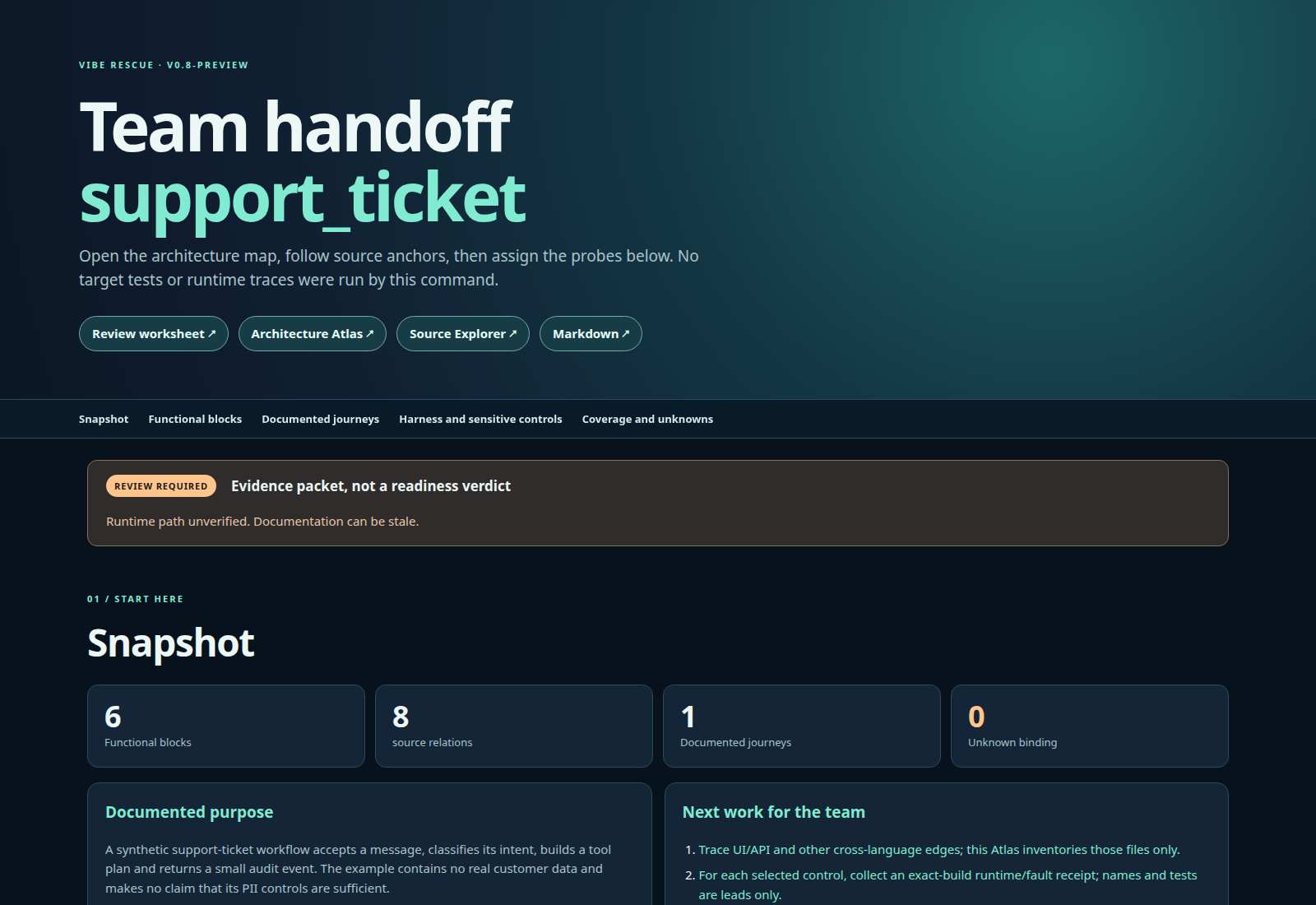 WORTH A LOOK 1. Vibe Rescue 0.8 PreviewVibe Rescue turns an unfamiliar or hurried codebase into a source-linked handoff before anyone asks an agent to repair it. Its no-AI exploration pass inventories entry points, dependencies, large files, conflicting agent instructions, call paths, unknowns, and review worksheets. Optional scanners then attach file-and-line evidence for complexity, copied code, secrets, vulnerable dependencies, and other risks. For Jason, the practical trial is mapping one disposable repository and judging whether the handoff exposes useful uncertainty instead of inventing confidence. OPERATIONAL VALUE QUICK VIDEO Reality: The repository is MIT open source and labels this build a preview. The first mapping pass needs Git, Bash, Python 3.11+, and a tree-sitter package; broader checking may add Node tools and downloaded scanners. Coverage differs by language, unresolved calls stay unresolved, and the full AI repair path has limited recorded real-project testing. Some checkers may execute a target project’s configuration, so use a throwaway copy or isolated machine, scope private directories carefully, and treat every finding as a lead requiring tests—not proof that code is safe. OPEN PRIMARY SOURCE → TRY NOW 2. Flow Video RecorderFlow Video Recorder is an agent skill for producing narrated, captioned product demos from repeatable flows. It drives browser apps through Playwright or native iOS apps through Maestro, then adds a visible cursor, click ripples, captions, and optional narration. Voice can come from ElevenLabs, OpenAI, macOS speech, or a local command; silent captioned output also works. The appeal is not automatic marketing magic, but an editable flow script that can be rerun when the product changes. OPERATIONAL VALUE QUICK VIDEO Reality: The skill is MIT open source. Browser capture requires Node 20+, FFmpeg, Playwright, and Chromium; iOS capture additionally requires macOS, Xcode, a booted simulator, and Maestro. Cloud narration needs a provider key and incurs separate service terms and costs, while custom local speech quality varies. Optional framing installs Remotion on first use. Run only against accounts and data approved for recording, keep secrets out of scripts and frames, verify captions against the screen, and obtain clearance for voices, brands, music, footage, and final distribution. OPEN PRIMARY SOURCE →WATCHLIST 3. hbenchhbench is the local benchmark engine behind Harness Playground. It runs coding agents such as Codex, Claude Code, Gemini CLI, OpenHands, Aider, and OpenCode against selected tasks, stores each job, and reports which tasks were solved. The useful idea is controlled comparison: keep the dataset and scoring fixed while changing the agent or model. Jason could use it to test whether a new harness actually improves repository work instead of trusting a polished single demo or anecdote. OPERATIONAL VALUE QUICK VIDEO Reality: hbench is Apache-2.0 open source and very new. Its documented local path requires Docker on Linux or macOS; building from source also needs Rust. Most agent adapters require their own installed client, account, API key, model access, and usage charges, although local-model servers are documented. Benchmark scores inherit the task quality, environment, judge, time limits, and agent configuration. Start with low-cost disposable tasks, inspect what reaches each provider, cap budgets, and do not treat a small arena result as proof of safety or production reliability. OPEN PRIMARY SOURCE →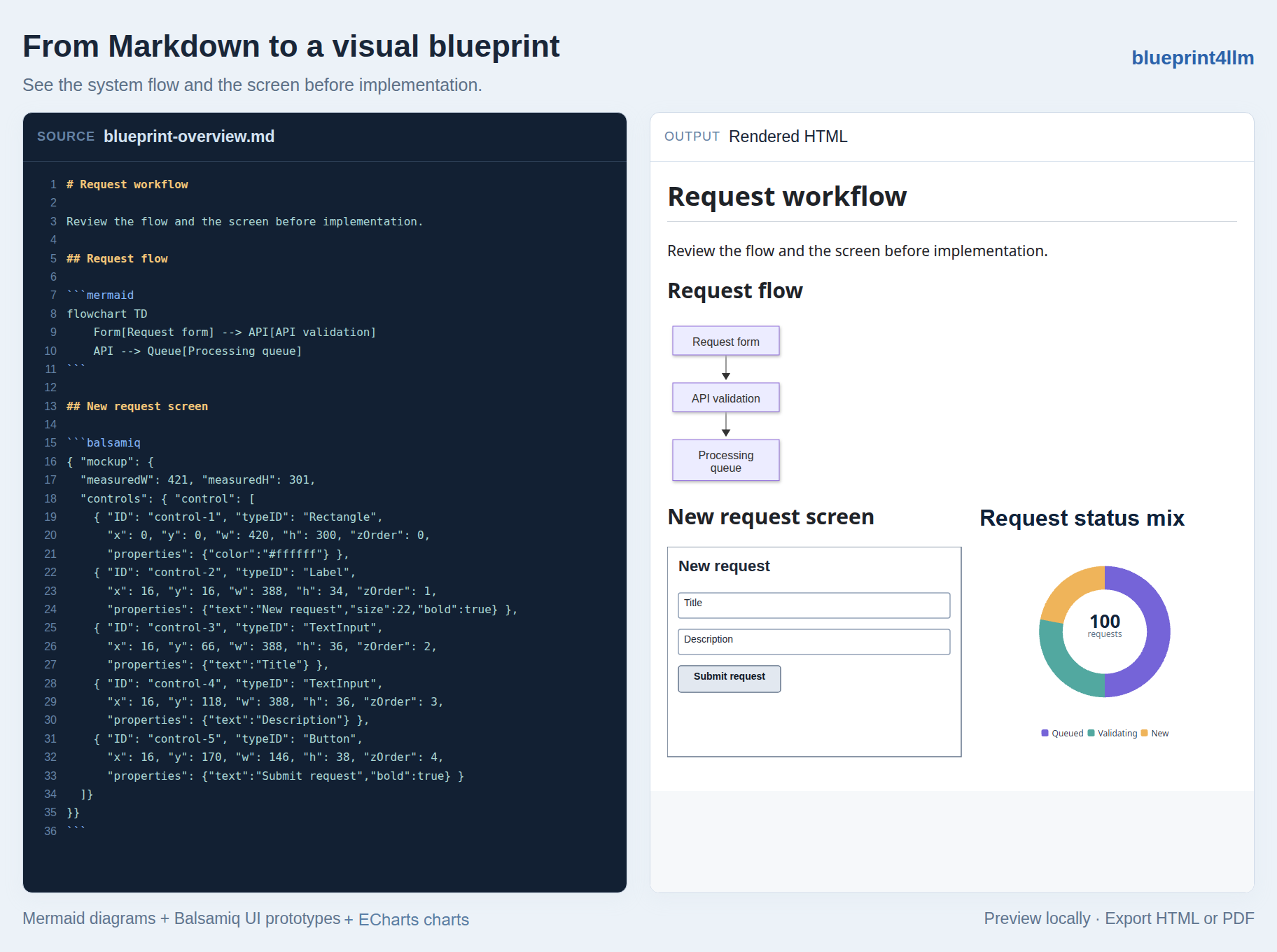 TRY NOW 4. blueprint4llmblueprint4llm turns a Markdown plan into a reviewable visual package before implementation begins. It can render Mermaid, D2, Graphviz, draw.io JSON, Excalidraw, OpenAPI, Figma frames, Vega-Lite, ECharts, wireframes, and other supported blocks into live previews, HTML, PDF, SVG, PNG, or JPEG. Built-in limits and diagnostics reject active SVG content and many unsafe or unsupported inputs. Jason’s best test is converting one agent plan into an architecture diagram plus interface wireframe, then reviewing both before code exists. OPERATIONAL VALUE QUICK VIDEO Reality: The repository reports an MIT license and requires Node.js 22.13+, npm, and Puppeteer’s Chrome. Most local renderers work offline, but Figma URL mode needs a narrowly scoped token and external images in HTML still need a connection; exported Figma SVGs are embedded. Supported formats intentionally omit some editor-specific effects and interactions, and large diagrams may scale poorly in PDF. Review diagnostics, keep sensitive designs local, avoid putting tokens in documents, and compare every generated diagram with the source plan before it becomes an implementation contract. OPEN PRIMARY SOURCE →WATCHLIST 5. MossStudio 0.1.0MossStudio is an Electron and React desktop workspace for MOSS-Image prompts, region layouts, layers, models, agent assistance, generation jobs, and project history. Its separate MossInfer sidecar can target a local NVIDIA machine or a Linux GPU reached over SSH, while the canvas keeps text, people, and object regions editable. That direction is interesting for Jason because structured composition and model management sit beside the creative work instead of being scattered across terminals, JSON files, and unrelated launchers. OPERATIONAL VALUE QUICK VIDEO Reality: MossStudio code is MIT open source, but version 0.1.0 is explicitly in development. The maintainer says real NVIDIA generation, Windows installers, and remote-GPU behavior still await hardware acceptance; macOS has no local MossInfer inference. Development needs Node and pnpm, while inference needs an NVIDIA host, drivers, the separate engine, and separately licensed MOSS-Image weights. Agent providers, optional image-graph tools, training components, SSH credentials, models, and outputs retain their own terms. Treat it as a UI and workflow preview until real installation, security, performance, and output tests pass. OPEN PRIMARY SOURCE →5 Proven ClassicsGOOGLE AGENT DEVELOPMENT KIT · TRY NOW
Google ADK remains an Apache-2.0, code-first Python toolkit for building and evaluating agents. Its framework is open source; model providers, deployment targets, credentials, and usage charges remain separate. Source →LTX-VIDEO · WORTH A LOOK
LTX-Video remains an Apache-2.0 codebase for local video-generation research and ComfyUI workflows. Model weights, hardware demands, source-media rights, and generated-output permissions require separate, careful review. Source →MILVUS · WORTH A LOOK
Milvus remains an Apache-2.0 vector database for large-scale similarity search. It is powerful when retrieval volume justifies operations work; embeddings, source data, infrastructure, and managed Zilliz services remain separate. Source →PROMPT FLOW · TRY NOW
Prompt flow remains an MIT toolkit for prototyping, testing, evaluating, and tracing LLM applications. It supports disciplined experiments, while provider calls, evaluation data, deployment services, and monitoring costs stay separate. Source →TXTAI · TRY NOW
txtai remains an Apache-2.0 framework for semantic search, embeddings, and language-model workflows. It can keep a compact local stack, but models, indexed content, storage, and production scaling need separate choices. Source →Reality CheckOpen-source code does not make an entire workflow open, private, safe, or free. Vibe Rescue’s report quality depends on language coverage and may invoke project-aware scanners. Flow Video Recorder can capture sensitive screens and routes cloud narration through separate providers. hbench scores only the chosen tasks, judges, budgets, and environments. blueprint4llm validates supported structures without proving a plan is correct. MossStudio is a pre-acceptance interface around separately licensed models and GPU infrastructure. Preserve source files, isolate experiments, minimize keys and permissions, inspect generated artifacts, verify model and service terms, and require human acceptance before any repair, benchmark conclusion, public demo, architecture commitment, or image release. Bottom LineTry Flow Video Recorder first on a harmless local browser flow because it turns a recurring creative chore into an editable, rerunnable handoff. Use blueprint4llm next to make one upcoming plan visual before implementation. Vibe Rescue deserves a bounded test on a disposable repository; keep hbench and MossStudio on the watchlist until their young workflows have broader evidence and your available Docker, provider, GPU, and security setup matches their requirements. Curated from official project repositories and documentation. Verify current terms before production use; software, services, models, data, and content may carry different licenses. |