|
B.Y.E. / DAILY AI TRY / 10.25.26
Be Your Evolution AI News DailyOctober 25, 2026 · Five newer tools explored, five proven classics worth keeping Top 5: New and Worth Your Attention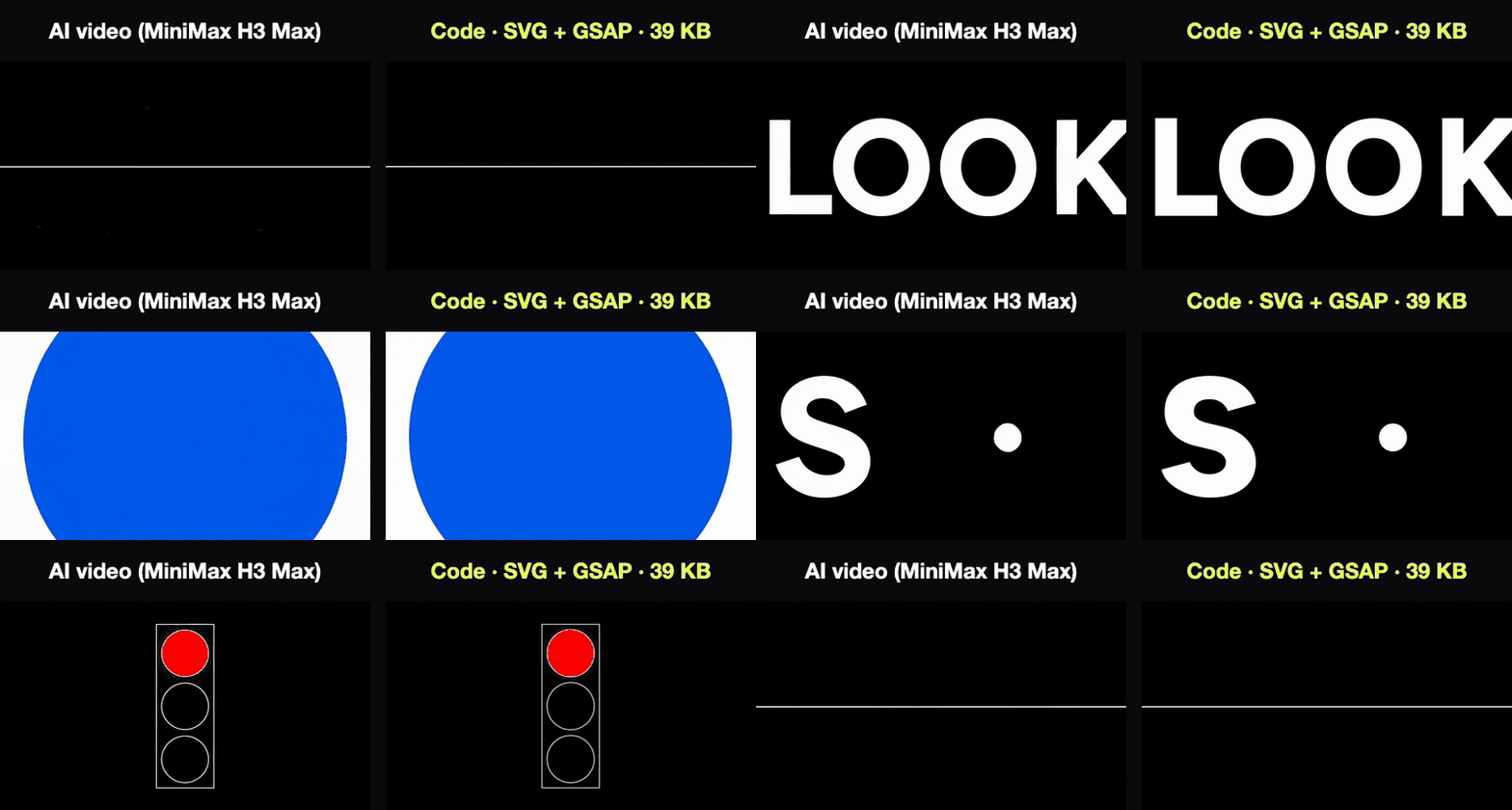 TRY NOW 1. Motion2CodeMotion2Code teaches coding agents to rebuild a reference motion-design clip as editable SVG and a single GSAP timeline, then compare the result frame by frame. It can also reconstruct interactive website recordings with ScrollTrigger rather than flattening them into video. For Jason, that makes a strong reusable-effects experiment: recreate one short kinetic-title idea, preserve the code, and evaluate how closely its timing and composition match the cleared reference. OPERATIONAL VALUE QUICK VIDEO Reality: Motion2Code is MIT open source. Its helper scripts need Python 3.9+, FFmpeg, and Playwright plus Chromium for browser-based checks; the produced animation relies on GSAP, whose own current terms still apply. The repository is new and its examples are curated, so matching a simple demo does not prove parity on complex footage, licensed typefaces, logos, characters, or interactions. Use only references you may reproduce, inspect generated HTML and dependencies, test responsive behavior and accessibility, and retain human art direction. OPEN PRIMARY SOURCE → WATCHLIST 2. SAM 3 Segmentation SkillThis agent skill wraps Meta’s SAM 3 into a careful local workflow for outlining, counting, and cutting out objects. It saves raw proposals, supports overlapping crops for tiny items, records reversible review decisions, and exports PNG masks, COCO RLE data, review sheets, and a zoomable viewer. The discipline is the attraction: outputs are labeled as model proposals rather than ground truth, making uncertainty visible before masks enter an editing pipeline. OPERATIONAL VALUE QUICK VIDEO Reality: The skill repository is MIT open source, but SAM 3 code and weights use Meta’s separate license and require accepted Hugging Face access. Actual segmentation needs Linux or Windows WSL2, uv, roughly 11 GB of disk, and an NVIDIA GPU; the author suggests 12–24 GB VRAM and says CPU and Apple GPUs are unsupported. The author also states the project was mostly agent-written and not broadly human-tested. Never treat counts or masks as verified truth, especially for medical, safety, scientific, or legal decisions. OPEN PRIMARY SOURCE →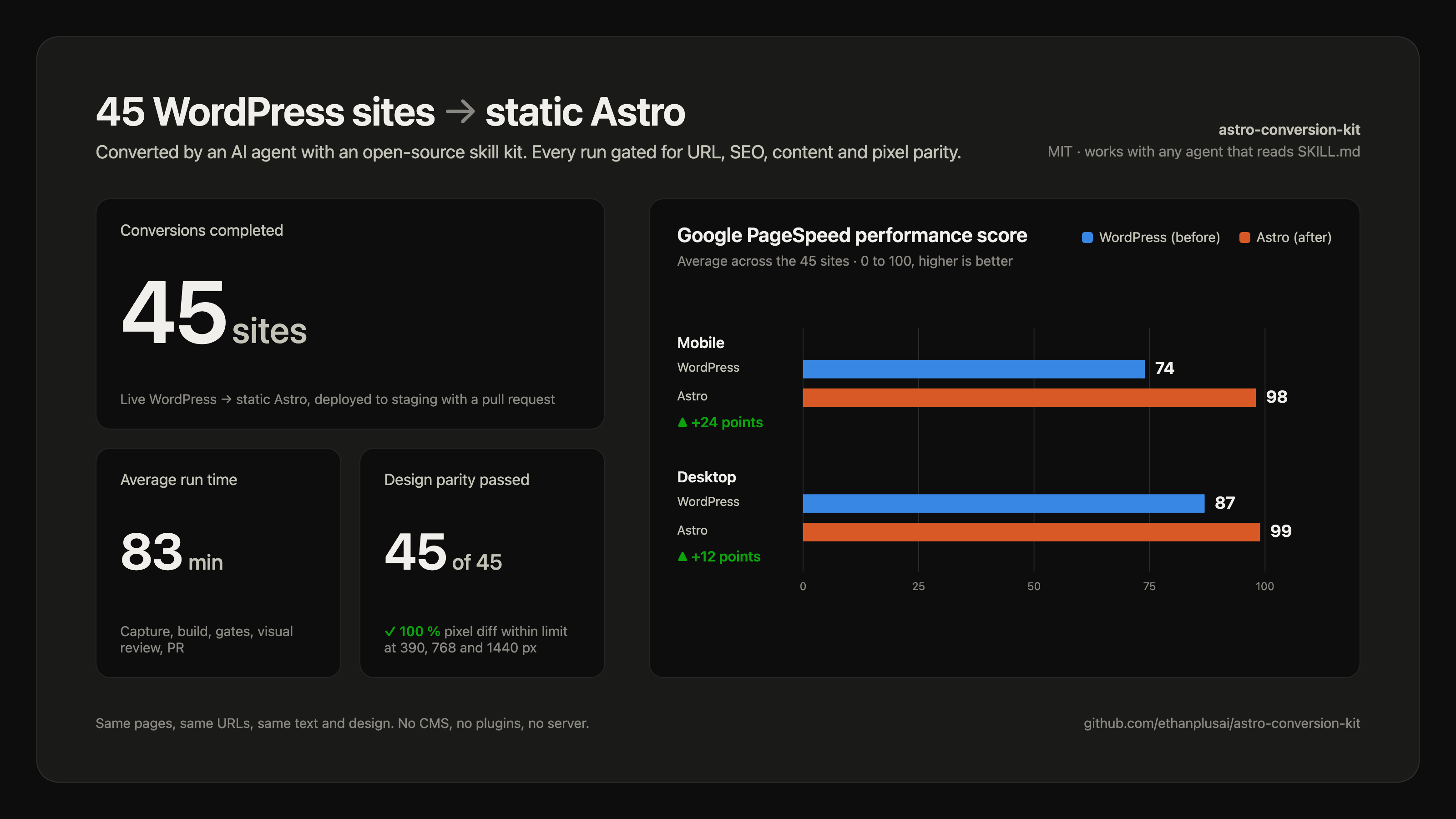 WORTH A LOOK 3. Astro Conversion KitAstro Conversion Kit gives a coding agent a gated path for rebuilding WordPress or another live site as static Astro. It captures rendered pages, keeps URLs, metadata, media paths, redirects, and structured data in scope, and compares design at 390, 768, and 1440 pixels. A run aims to end with a pull request, noindexed staging deploy, and launch runbook. That is useful evidence, but not permission to alter a production site. OPERATIONAL VALUE QUICK VIDEO Reality: The kit is MIT open source and requires current supported Node 22 or 24, Git, Playwright Chromium, and host-specific tooling. Its scripts can automate capture and verification, but live sites may contain private content, authenticated pages, forms, third-party scripts, dynamic search, commerce, analytics, or contractual assets that static capture cannot safely reproduce by assumption. Treat benchmark claims as project-reported. Do not touch DNS, hosting, production files, or form destinations without explicit scope, backups, rollback, security review, and owner approval. OPEN PRIMARY SOURCE → TRY NOW 4. Video to BlenderVideo to Blender is an agent skill for translating a reference clip, image, or idea into native Geometry Nodes, Shader Nodes, and compositor graphs. Its Python tooling builds and inspects those graphs, while a tested node-group library supplies reusable structures for geometry, motion, materials, and effects. This fits Jason’s editable-handoff rule: the useful product is not just a render, but a Blender scene whose paths, materials, camera, and procedural controls remain changeable. OPERATIONAL VALUE QUICK VIDEO Reality: The skill code is MIT open source and requires Blender 5.2 or later. Blender itself is GPL, and imported models, textures, fonts, reference footage, add-ons, and rendered music keep separate rights. The repository is new; its 39 documented node groups and checks reduce common scripting errors but do not guarantee visual similarity, efficient topology, stable simulation, or production-ready lighting. Use cleared references, review every graph and dependency, test render time on your hardware, and package the .blend plus linked assets for portability. OPEN PRIMARY SOURCE → WATCHLIST 5. ComfyUI Hy-NomasComfyUI Hy-Nomas brings Tencent’s video world model into native ComfyUI nodes. A world can start from text or an image, continue through chained segments, and respond to timed actions or keyboard-like camera controls. The custom node uses ComfyUI’s stock sampler and memory management with distilled INT8 weights. The creative hook is unusually tangible: storyboard a navigable location, then steer short continuation shots while preserving the workflow and seeds. OPERATIONAL VALUE QUICK VIDEO Reality: The node code is GPL-3.0, while Tencent’s Hy-Nomas weights and the Qwen text encoder are separate downloads with their own licenses and use conditions. The project is explicitly work in progress, targets current ComfyUI around 0.42, needs an NVIDIA GPU with at least 12 GB VRAM, and uses faster paths on newer RTX hardware. The repository’s timing examples came from an RTX 4090 and are not universal. Expect changing inputs, visual drift, long renders, continuity failures, and the usual likeness, source-image, safety, and output-rights review. OPEN PRIMARY SOURCE →5 Proven ClassicsOPENAI WHISPER · TRY NOW
Whisper remains an MIT speech-recognition baseline with multilingual transcription and translation. It is practical for private rough transcripts, but accuracy, diarization, timing, sensitive audio, and model errors need review. Source →SAM 2 · WORTH A LOOK
SAM 2 remains Meta’s Apache-2.0 foundation for promptable image and video segmentation. Its checkpoints and dependencies require separate inspection, and every mask remains a proposal needing human validation. Source →REMBG · TRY NOW
rembg remains a focused MIT background-removal tool available as a library, CLI, server, and container. Results vary by model and edges, so hair, transparency, and fine detail require inspection. Source →ULTRALYTICS · WATCHLIST
Ultralytics remains a convenient YOLO toolkit for detection, segmentation, tracking, pose, and classification. Its AGPL-3.0 and enterprise options require careful fit review before closed or commercial deployment. Source →OPENTOONZ · WORTH A LOOK
OpenToonz remains BSD-3-Clause 2D animation software with scanning, cleanup, drawing, compositing, and effects. It rewards a traditional production mindset; plug-ins, codecs, fonts, and project assets remain separate. Source →Reality CheckOpen-source code does not automatically make a workflow local, lightweight, safe, or unrestricted. Motion2Code adds browser and media tooling; SAM 3 needs separately licensed gated weights and NVIDIA hardware; Astro Conversion Kit can expose production migration risks if its boundaries are ignored; Video to Blender inherits asset and Blender ecosystem obligations; and Hy-Nomas combines young GPL nodes with separate model terms and demanding GPU paths. Preserve original media, hashes, prompts, workflows, editable projects, and review evidence. Isolate unfamiliar code, minimize credentials, verify dependency and model licenses, benchmark locally, and never equate technical output with creative or factual acceptance. Bottom LineTry Motion2Code first on one short, cleared animation reference: it offers the fastest route to a reusable, inspectable effect and an honest side-by-side result. For a richer creative build, test Video to Blender on a tiny procedural environment and require the .blend file, assets, graph validation, and render together. Keep SAM 3 and Hy-Nomas in bounded hardware trials, and treat Astro Conversion Kit as a staging-only evaluation until a specific migration is explicitly approved. Curated from official project repositories and documentation. Verify current terms before production use; software, services, models, data, and content may carry different licenses. |